

WHAT'S NEWS
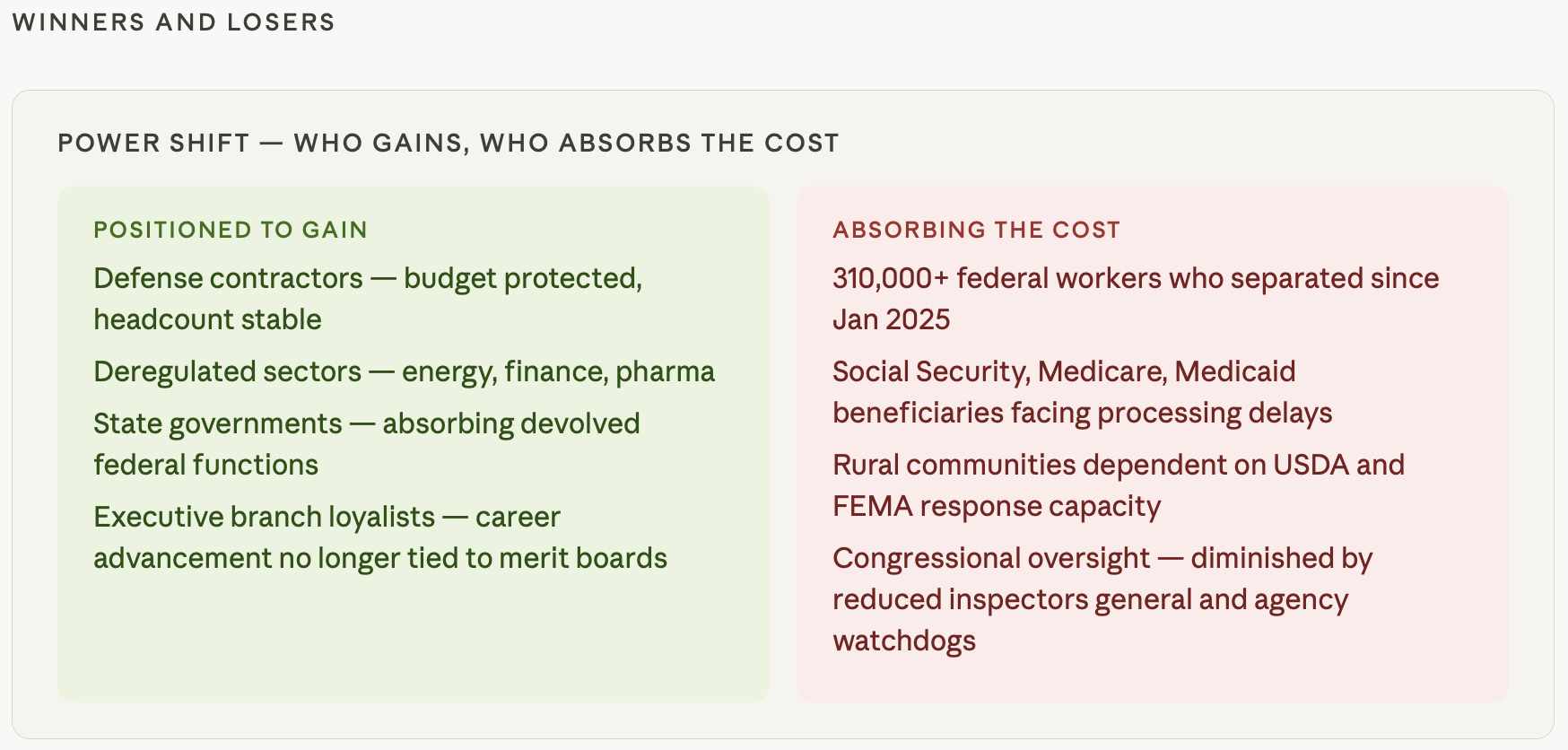
The Trump administration has reduced the federal civilian workforce by roughly 9% since January 2025, approximately 210,000 positions, while simultaneously reclassifying tens of thousands of career civil servants under "Schedule Policy/Career," a mechanism critics say subordinates merit to political loyalty.
With grocery prices 31% higher than pre-pandemic levels, Trump's inflation approval rating sits at 34%, imperiling Republican House candidates in swing districts and setting the stage for what historians and strategists alike describe as a structurally difficult midterm environment.
The pattern is not uniquely American: across the G7, incumbents are under siege from affordability politics, with UK Prime Minister Starmer at 75% disapproval, France cycling through governments, and Canada's Mark Carney navigating a post-Trudeau realignment, a convergence suggesting the electoral turbulence of 2026 is systemic, not episodic.

ANALYSIS
There is an old Washington axiom, polished to a fine edge by every political consultant since James Carville, that the economy is the ground beneath every election. In 2026, that ground is shifting. Not in the manner of a cyclical correction, or a temporary disruption to be managed with messaging, but in a way that is forcing a structural reckoning with two decades of accumulated institutional change, executive expansion, and deferred governance.
The November midterms will be contested in an environment shaped by three reinforcing pressures: a cost-of-living crisis with no clear political owner willing to absorb full accountability, a federal administrative apparatus that has been reduced in size and reoriented in mission at a pace unseen since the post-World War II demobilization, and a global landscape in which no major democracy, not the UK, not France, not Canada; has found a durable formula for governing through economic stress without hemorrhaging public trust.
To understand what is at stake, it helps to go back - not to 2024, or even to 2017, but to 1883.
HISTORICAL CONTEXT
The Pendleton Civil Service Reform Act of 1883 was, in its time, a radical restructuring of the relationship between elected leaders and permanent government. Before Pendleton, federal appointments were instruments of political reward, the spoils system. After it, competitive merit examinations and protected tenure became the constitutional firewall separating policy from politics at the operational level. For 140 years, that firewall held, imperfectly but consequentially.
What the Trump administration has done since January 2025, through a combination of executive orders, workforce reduction programs, and the newly finalized "Schedule Policy/Career" classification, is to begin dismantling that firewall systematically. The mechanism is not novel: a version of Schedule F, as it was previously known, was attempted in the final weeks of the first Trump term. But the second-term execution has been broader, faster, and operationally more consequential.
The Office of Personnel Management reported that more than 300,000 federal employees had left government since January 2025, though the precise count remains contested by litigation, deferred resignation timing, and data gaps. The Department of Education has been reduced by 69%. The Department of Housing and Urban Development by roughly 40%. USAID, as an institution, has effectively ceased to exist as an independent agency, with 83% of its programs eliminated. The DOGE Temporary Organization, formally scheduled for termination on July 4, 2026 - will have permanently restructured the federal workforce well before its own sunset.
When highly skilled employees depart, the damage to capacity may far exceed the numeric reduction. — Miller Center, University of Virginia, September 2025
The 1946 Administrative Procedure Act, which established the legal framework for how federal agencies make rules and exercise authority, was premised on a certain vision of the administrative state: technocratic, insulated, predictable, and accountable to Congress through oversight rather than to the White House through employment. Schedule P/C, as the reclassification is now known, effectively inverts that premise for tens of thousands of workers in "policy-related" positions, making their tenure contingent on executive alignment rather than performance review.
Good-government organizations argue the shift will produce an executive branch that is more politically compliant and less institutionally capable. The administration's position is that it will produce one that is more responsive and less resistant to democratic mandates. Both claims may be partly correct. The historical record on merit-versus-loyalty tradeoffs in large bureaucracies is, to say the least, not conclusive - though the cautionary examples tend to be more vivid than the success stories.
INSTITUTIONAL IMPACT: THE ADMINISTRATIVE STATE
The federal workforce, at its post-DOGE size, now approximates its 1973 and 1994 levels, a statistic the administration cites as evidence of proportionality. The counterargument, advanced by public administration scholars, is that the country it serves is significantly larger, more complex, and more globally integrated than it was in either of those years, and that the operational load on the agencies has not shrunk commensurately with their headcount.
The practical effects are becoming visible in service delivery. The National Taxpayer Advocate's June 2025 report to Congress warned of "operational readiness" concerns at the IRS ahead of the 2026 filing season, citing the departure of experienced personnel in mission-critical areas. FEMA, the agency that responds to hurricanes and wildfires, has seen significant workforce reductions at a moment when climate-driven disasters show no signs of declining in frequency or cost. The Social Security Administration, which administers benefits for 70 million Americans, has been the subject of sustained scrutiny over processing backlogs following staffing cuts.
The tension here is the oldest one in American governance: the president is constitutionally obligated to execute the law faithfully, but the law - passed by Congress - often requires institutional capacity the president has chosen to reduce. The 1974 Congressional Budget and Impoundment Control Act was passed precisely because Congress grew alarmed by executive discretion over appropriated funds. The current conflict between executive workforce decisions and congressionally mandated agency functions is, in structural terms, a variant of the same dispute: who controls the machinery of government, and to what end.
THE ELECTORAL ARITHMETIC
History is a blunt instrument, but it is rarely wrong about midterm elections. The president's party has lost ground in 20 of the last 22 midterm contests stretching back to 1938. The two exceptions - 1998 and 2002 - each required extraordinary circumstances: an overreaching impeachment proceeding and a terrorist attack of historic magnitude, respectively. No comparable insulation exists in 2026.
Republicans enter November defending a three-seat Senate majority and a 219-to-213 House advantage, margins that leave almost no room for defection. A record 56 incumbents from both parties have already announced they will not seek re-election, a number that, historically, has preceded wave elections. Democrats lead national generic congressional polls by modest single-digit margins, consistent with out-party performance in midterm cycles.
The economic picture compounds the structural headwinds. Grocery prices have risen 31% since February 2020. The government's February 2026 inflation report showed grocery prices accelerating again, rising 0.4% in a single month, an annualized pace of roughly 5%. Coffee prices rose 18.4% in 2025 before climbing further. Lettuce: up 12.2% in February alone. These are not abstractions. They are weekly experiences for voters who decide elections in suburban swing districts from suburban Phoenix to suburban Milwaukee.
And then there is Iran. The U.S. military engagement that began in early March 2026 has sent oil prices sharply higher, pushing up energy costs at the exact moment Republican candidates were hoping to steer the conversation toward tax cuts and refunds. With the conflict's resolution uncertain, the administration's window to shift the economic narrative before November is narrowing.
It's Trump's economy now. Americans want him to do more to fix it than he has so far. — Brookings Institution, April 2026
GLOBAL CONTEXT
It would be a convenient analytical error to treat the 2026 American political environment as singular. It is not. The same forces, affordability anxiety, institutional distrust, anti-incumbent volatility, are operating across every major democracy simultaneously.
In the United Kingdom, Prime Minister Keir Starmer governs with a large parliamentary majority and a 75% disapproval rating, a combination that is statistically anomalous and politically precarious. Nigel Farage's Reform UK now leads national polls. The political infrastructure of the British center-left, rebuilt at considerable effort after the Corbyn years, is under pressure from an electorate that feels the 2024 mandate has not yet been redeemed in the form of lower costs or improved services.
France has cycled through four governments in roughly a year. The fundamental problem, a deficit too large to close without pain, and an electorate unwilling to absorb it, has not changed between governments, only the names on the ministerial doors. Whether Marine Le Pen's coalition or a revived left ultimately inherits the crisis is a second-order question; the first-order fact is that centrist governance is no longer capable of commanding durable majorities in the fifth-largest economy on earth.
Canada presents a partial counterexample. Mark Carney, the former Bank of England governor who succeeded Justin Trudeau as Liberal leader, holds a 57% approval rating and has stabilized the governing coalition. The key variable appears to be the Trump factor itself: Canadians, facing direct U.S. tariff pressure and sovereignty rhetoric from Washington, have consolidated behind a leader perceived as competent to manage the external threat. When the adversary is identifiable and external, national politics temporarily simplifies. That dynamic does not exist for American voters, who are dealing with a government that is simultaneously the agent and the object of the economic disruption they feel.
The FGS Global Radar polling of 20,000 people across 27 countries found that pessimism is the dominant mood in every single country surveyed, a consistency that argues against purely local explanations. Seventy-four percent of global respondents believe their political system serves a rich and powerful elite rather than ordinary working people. That figure, replicated across democracies as culturally and institutionally distinct as France, Canada, the United States, and Germany, points toward something structural rather than contingent.
THE BALANCE OF POWER
The 2026 elections will be cast, in most political coverage, as a verdict on Donald Trump. That framing is accurate but incomplete. What is also on the ballot, less visibly, but more durably, is a set of questions about institutional design that will outlast any individual presidency.
A Republican Congress retained would likely consolidate the administrative restructuring of the past 18 months, making permanent what was begun by executive order. A Democratic House majority would introduce subpoena power, oversight hearings, and the return of the congressional check that has been largely dormant during unified Republican government. It would not reverse the workforce reductions, those are structural now, but it would constrain the pace of further change and restore a measure of the executive-legislative tension that the Constitution's framers designed as the normal condition of government, not an exceptional one.
Neither outcome resolves the underlying economic pressures. Grocery prices will not fall on November 4th. Energy costs will remain elevated as long as the Iran conflict is unresolved. The institutional knowledge lost in a 9% workforce reduction accumulates in departures, not reversals. The federal government's operational capacity, its ability to deliver on the statutory obligations Congress has assigned to it, will take years to rebuild, if the political will to do so ever exists.
What the elections will determine is the pace and direction of the next chapter. The "Leadership Reset" of 2026 is not a moment of invention, no election is. It is a moment of accounting: for 18 months of executive-first governance, for a cost-of-living crisis that no party owns cleanly, and for an administrative state that has been reshaped faster than the public has been given the chance to evaluate the consequences.
The American political system has historically proven capable of self-correction. The Pendleton Act was itself a correction, born of the Garfield assassination and public fury at machine politics. The 1946 Administrative Procedure Act was a correction to wartime executive expansion. The 1974 Budget Control Act was Congress reasserting itself after Watergate. Each correction took years, required a galvanizing event, and produced institutions that themselves eventually required correction.
Whether the 2026 elections constitute that kind of correction, or simply a reshuffling of margins within an increasingly stressed system, is the open question. The voters who answer it will be standing in line at grocery stores that are 31% more expensive than they were five years ago, paying gas prices elevated by a war the country did not vote to enter. History suggests they will make their views known clearly.
Whether those views produce a durable reset, or simply the next cycle of grievance and volatility, is the question that will outlast November.
Sources: Brookings Institution (April 2026); Bureau of Labor Statistics; Office of Personnel Management; Government Executive; Miller Center, University of Virginia; Morgan Stanley Global Investment Office; FGS Global Radar 2026; Wikipedia 2026 United States elections; NPR Politics; Washington Post; ECPS Virtual Workshop Series.


