

The 2026 Las Vegas Grand Prix on 21 November produced 352 overtakes and 35 changes of the lead, by Formula 1's own count. The previous record was 186, set at the wet 2023 Dutch Grand Prix, so the new mark is nearly double the old one. Max Verstappen won the 50-lap race by 0.639s from Lando Norris. The top five finished within three seconds of each other.
By any measure the race was an outlier. An independent database that counts passes the same way at every race puts the total lower, at 185. That is still almost twice the next busiest race of 2026. It is also almost nine times the 21 passes the same database recorded at Las Vegas in 2025. The main cause was not the early-season "yo-yo" swapping driven by battery offsets. It was an unusually powerful slipstream, made stronger by energy-starved cars on a very long straight.
That distinction matters because the race came one day after the FIA announced unanimous agreement on a framework for simpler, 2.1-litre V8 engines from 2030. Verstappen said the racing "isn’t how it should be". Mercedes team principal Toto Wolff called it a mega race. McLaren's Andrea Stella urged the sport not to rush to a verdict. The FIA World Motor Sport Council is due to consider the 2030 framework in Shanghai on 10 December 2026.
What happened on the Strip
Verstappen started from pole after the fastest qualifier, Kimi Antonelli, took a five-place grid penalty for a new power unit component. Verstappen won in 1h27m39.624s. F1's Power Rankings article says he officially led 45 of the 50 laps, yet the lead still changed hands 35 times. According to the BBC, his biggest lead at any point was 1.5 seconds.
George Russell, Antonelli, Norris and Verstappen's Red Bull team-mate Isack Hadjar all led at times. The finish was decided in the last three laps:
- Russell locked up at Turn 5 on lap 48 while attacking Antonelli for second, hit the barrier and recovered to ninth.
- Antonelli lifted off the throttle on the back straight, which cut the electrical energy he could deploy. He fell from second to fourth.
- Norris took second, 0.639s behind. Oscar Piastri finished third, 1.529s back, after starting 17th because of an engine penalty.
Antonelli was already champion before Las Vegas, on 402 points, and Mercedes had won the constructors' title in Brazil. The live fight is for second place in the drivers' standings. Verstappen is on 304, Lewis Hamilton on 267, and Russell and Norris on 264 each. Hemera explained how the tow decided qualifying and the Verstappen–Russell duel in its report on 22 November.
Las Vegas against its own history
The Strip circuit has always produced passing. The race is 6.201km long and its straight down the Strip runs for almost 2km. Even so, the 2026 race stands apart from the three earlier editions, as the table below shows.
Race | Winner | F1 official count | Independent count | Winning margin |
|---|---|---|---|---|
Las Vegas 2023 | Verstappen | 181 | 77 | 2.070s over Leclerc |
Las Vegas 2024 | Russell | not published | 54 | 7.313s over Hamilton |
Las Vegas 2025 | Verstappen | not published | 21 | 23.546s over Russell |
Las Vegas 2026 | Verstappen | 352 | 185 | 0.639s over Norris |
Sources: Formula1.com, F1 Race Review, Wikipedia race records.
The two counts measure different things. F1 has not published a detailed definition of its own figure, so the two columns should not be mixed. But both tell the same story. On F1's count, the 2026 race had nearly twice as many passes as the 2023 race, which was itself the busiest race of that season. On the independent count, Las Vegas had been getting quieter each year under the previous ground-effect rules, falling from 77 to 21. It then jumped to 185.
The winning margins show the same pattern. The 2025 race was won by more than 23 seconds, after both McLarens were disqualified for excessive plank wear. In 2026 five cars were nose to tail on the final lap.
Las Vegas against the rest of 2026
The 2026 rules have raised passing totals at many circuits. F1 reported 120 overtakes at the season-opening Australian Grand Prix in March. The independent count lets each 2026 race be ranked on the same basis.
2026 Grand Prix | Overtakes (independent count) | Rank of 21 races |
|---|---|---|
Las Vegas | 185 | 1 |
Japan | 96 | 2 |
Italy (Monza) | 93 | 3 |
China | 77 | 4 |
Britain | 58 | 6 |
Australia | 48 | 12 |
Spain (Madring) | 13 | 20 |
Monaco | 11 | 21 |
Sources: F1 Race Review.
The gap between the top and bottom is large. Las Vegas had almost twice as many passes as Japan, the next busiest race. Other counts of the debut race at Madrid's Madring circuit in September put the figure even lower, at four passes. So the 2026 rules do not produce passing everywhere. They amplify the character of each circuit. Las Vegas was the extreme case at one end, and Madrid and Monaco were the extremes at the other.
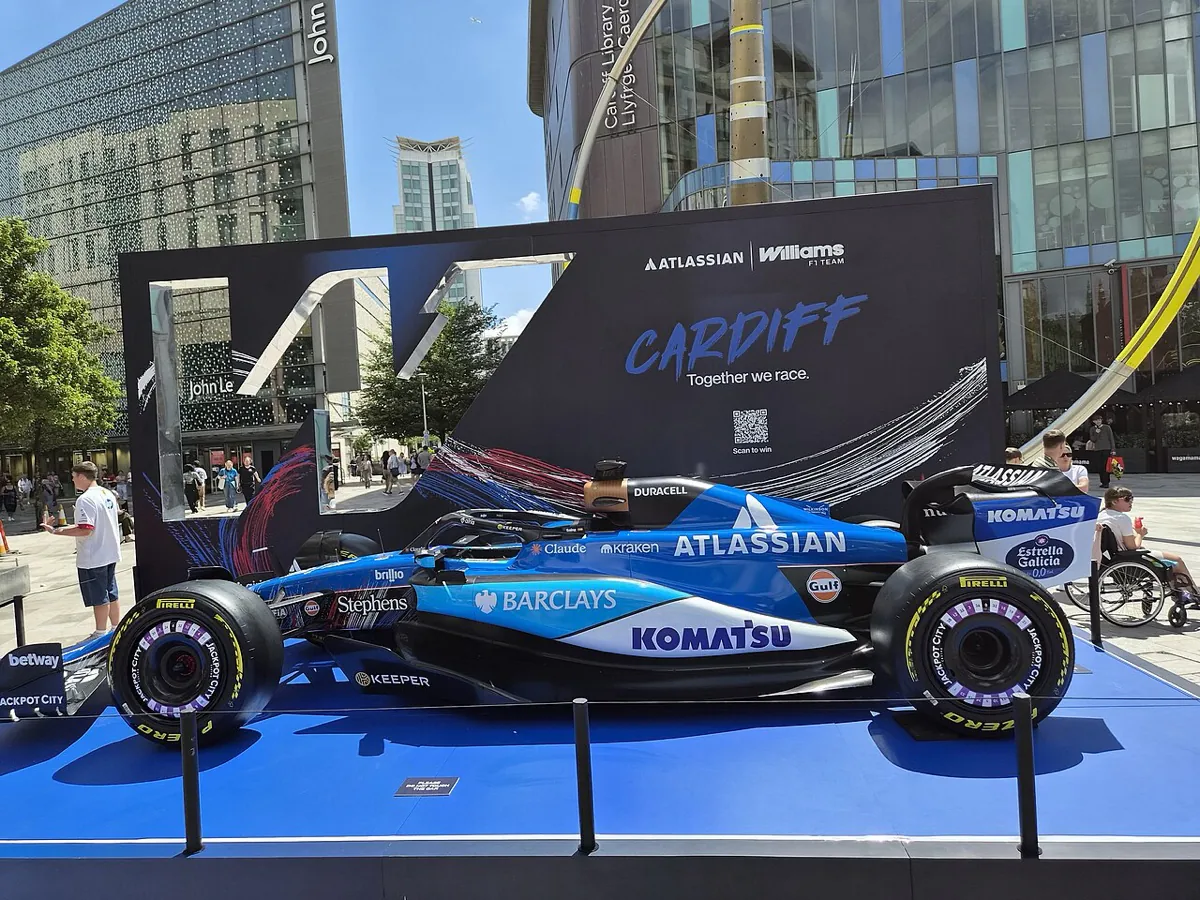
A Williams Formula 1 car on display at a Formula 1 event in Cardiff, July 2026. Photo: Bearas / Wikimedia Commons, CC BY-SA 4.0.
Why the tow was so strong
The 2026 power units split output roughly evenly between a combustion engine of about 400kW and an electric motor, the MGU-K, rated at 350kW. The batteries cannot sustain full electrical deployment for long, so on long straights cars run out of electrical energy and fall back on combustion power alone. There is no DRS this year. Instead, a driver within one second of the car ahead at a detection point gets "overtake mode", which provides an extra 0.5MJ of energy on the following lap.
The Race's analysis argues that the battery offsets behind early-season swapping were not the main cause at Las Vegas. The slipstream was the main cause. The car behind punches a smaller hole in the air, so it is faster on a straight. Several factors made that effect unusually large:
- Energy-starved straights. With batteries depleted, cars took longer to cover the straight, so the tow acted for longer. The Race put its value at around a second a lap.
- Slow corners. With no high-speed bends, following cars lost little in the turbulent air and stayed in touch.
- Little tyre wear. Tyre degradation was low, so there were no big tyre offsets to split the field. The track temperature was around 12°C, according to RacingNews365.
- Little room to vary energy use. The layout offered few different ways to deploy energy. The main choice was whether to save some battery for the run to the line.
The result was that no one could escape. According to The Race, Russell sometimes came onto the Strip as much as 1.3 seconds behind Verstappen, outside the one-second overtake-mode window. He could still pass by the end of the straight. Hamilton described the effect plainly: "You always have to make sure you're in a tow. Otherwise, you're just a sitting duck to people around."
Cars that lost the pack lost a lot. Aston Martin's Mike Krack said: "If you have no tow, then it is long afternoon, long evening."
What the number does not show
The 352 figure has been challenged. Norris said that "some of the overtakes weren’t overtakes", because closing speeds of 20–30km/h meant a driver could press boost and drive past. RaceFans reported that F1 did not explain how its figure was compiled.
GPFans reported claims that the total included cars passing Arvid Lindblad's stricken Racing Bulls car under the safety car, cars passing Hamilton's spun Ferrari, and position changes in the pits. It suggested that the number of genuine racing passes may be closer to 260. That would still be a record by a wide margin.
Many passes were also temporary. Autosport noted that Turn 14 was the favoured overtaking point. The driver who had just lost a place could often take it back on the exit.
The paddock divides
The race split opinion within teams as well as between them.
“For me personally this isn’t Formula One, the way that we are racing. It looks great on TV but this isn’t how it should be.”
He added: "I remember winning one like this when I was playing Mario Kart." Cadillac's Sergio Perez called the racing "very artificial", according to Motorsport.com.
Others were more positive. Hamilton called it "a really great race". Norris said that from the outside it was probably the best race in F1 history, while still questioning the count. Wolff said: "I guess it was Indy 500 and NASCAR and Formula 1 mixed!" He also added: "That’s not going to happen everywhere."
The commercial verdict was clear. Reuters reported that F1 hailed the race as a success and said it was the 21st sell-out in a row in 2026.
What it means for 2030
The timing is awkward for F1. On 20 November 2026 the FIA said the FIA, Formula One Management, the teams and the power unit manufacturers had unanimously agreed a 2030 framework. It sets out a 2.1-litre turbocharged V8 with limited hybridisation, running on advanced sustainable fuels, in a lighter and simpler car. Much of the push came from frustration with 2026's energy management.
The FIA release gave no figure for electrical output. Motorsport.com has reported that the proposal would cut electrical power from 350kW to 200kW, with half of that reserved for an overtaking mode. That figure has not been confirmed. Separately, F1 said in June that the FIA, F1, teams and manufacturers had agreed to move the combustion share from 53 per cent in 2026 to 58 per cent in 2027 and 60 per cent in 2028.
Las Vegas gives evidence to both sides. Critics of the 2026 rules can point to drivers saying the passing took little skill. Defenders can point to The Race's finding that the main driver was the slipstream, which is an old feature of racing, rather than battery gimmicks. The closest historical comparison is the slipstreaming races at Monza before chicanes were added. The best known is 1971, when Peter Gethin won and the top five finished within about six-tenths of a second.
The 2025–2026 Las Vegas data also suggest that the circuit, not just the rules, decides the show. Stella declined to take a firm position. He said: "This race gave us a lot of information that we cannot ignore." He warned that it "would be a shame to process it in the space of a hot review".
What comes next
The Qatar Grand Prix at Lusail on 29 November 2026 is unlikely to look like Las Vegas. Abu Dhabi closes the season.
With 50 points left, Verstappen leads Hamilton by 37 points in the fight for second, and Russell and Norris by 40. On 10 December the World Motor Sport Council meets in Shanghai to consider the 2030 framework. That is where the sport's reading of Las Vegas will first carry formal weight.
Related coverage: Las Vegas Tow Explained: How Slipstream Shaped Verstappen v Russell · Verstappen Wins Las Vegas Grand Prix as Norris Takes Second
Featured image: 2026 Chinese GP - Red Bull - Max Verstappen - FP1 by Liauzh, via Wikimedia Commons, CC BY 4.0.


