

India’s automotive policy framework is approaching a pivotal moment as draft proposals for Corporate Average Fuel Efficiency (CAFE) Stage 3 and Stage 4 norms circulate among government departments, industry bodies and automakers. At the heart of the debate are two contentious ideas: whether small, lightweight cars should be regulated under a different emissions-and-efficiency formula than larger vehicles, and whether battery electric vehicles should continue to be treated as “zero emission” for fleet-average compliance purposes.
The outcome is expected to shape product strategies, investment flows and India’s road-to-net-zero trajectory for the next decade.
What CAFE 3 and 4 are designed to do
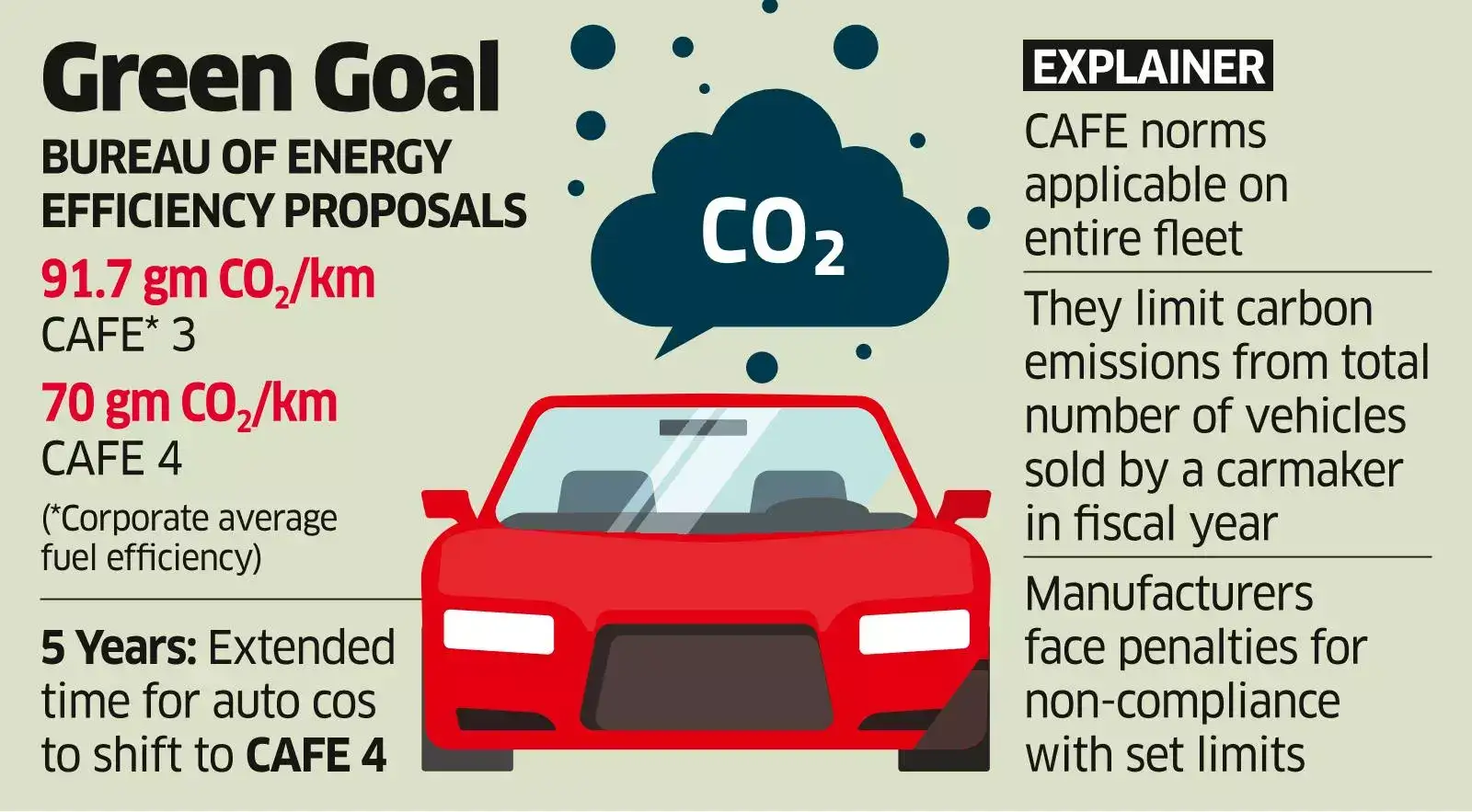
India’s CAFE framework, introduced under the Bureau of Energy Efficiency (BEE) and aligned with national climate commitments, sets fleet-average CO₂ targets for manufacturers rather than vehicle-by-vehicle limits. Companies that sell heavier, more powerful vehicles must balance them with efficient models - or increasingly, electrified ones - to meet their corporate average.
The proposed CAFE 3 phase (expected later this decade) tightens those average targets significantly, while CAFE 4 (toward the early 2030s) is designed as a further step-change, aligning India more closely with European and East Asian efficiency standards, according to policy notes circulated within the Ministry of Power and the Ministry of Road Transport and Highways.
Officials involved in the consultation process say the draft aims to balance three national priorities: decarbonization, affordability for mass-market buyers, and the competitiveness of domestic manufacturers.
The small-car question: fairness or fragmentation?
One of the most polarizing proposals is a differentiated treatment for small cars, particularly vehicles under a defined kerb-weight or footprint threshold.
Industry groups representing mass-market manufacturers argue that India’s vehicle mix is structurally different from that of Europe or North America, with compact hatchbacks and entry-level sedans forming a disproportionately large share of sales. Applying a single, increasingly strict fleet-average target, they contend, risks pricing small cars out of the market or forcing rapid, cost-heavy electrification that could undermine affordability.
Opponents - including environmental policy advisers and some global OEMs - counter that segmentation weakens the integrity of the standard. They warn that creating lighter targets for small vehicles could lock in internal combustion technology longer than necessary, slowing the transition to low and zero-emission mobility.
Analysts note that similar debates played out in other jurisdictions. The European Union’s CO₂ regime, for example, uses weight-based curves to set individual manufacturer targets, a system that has itself drawn criticism for incentivizing heavier vehicles.
The EV reclassification controversy
Even more contentious is the draft discussion around redefining how EVs are counted in fleet averages.
Under the current framework, battery electric vehicles are treated as zero tailpipe emission, allowing manufacturers to use them as powerful compliance “offsets” against higher-emitting petrol and diesel models. The new proposal, still at a conceptual stage, would shift toward a well-to-wheel or lifecycle-informed metric, reflecting the emissions associated with electricity generation rather than assuming a flat zero.
Policy officials argue that as EV adoption scales, the grid’s carbon intensity becomes increasingly relevant. According to data from the Central Electricity Authority, a significant portion of India’s electricity mix is still coal-based, even as renewable capacity grows.
Automakers and EV advocates have pushed back strongly. They warn that removing “zero emission” status could blunt investment incentives, particularly at a time when manufacturers are committing billions of rupees to local battery plants, charging infrastructure partnerships and EV platforms.
The Society of Indian Automobile Manufacturers (SIAM) has argued in consultation submissions that policy certainty is critical for long-term capital planning, especially as companies navigate overlapping standards on emissions, safety and localization.
Policy, politics and the climate calculus
The debate also intersects with broader national strategy. India’s long-term decarbonization goals, articulated in policy roadmaps supported by the NITI Aayog, emphasize electrification as a cornerstone of transport-sector emissions reduction.
Environmental groups argue that weakening the regulatory advantage of EVs at this stage could send mixed signals to both consumers and investors. Government officials, however, stress that the intent is not to penalize EVs, but to align regulatory accounting more closely with real-world emissions outcomes as the energy system evolves.
What’s at stake for manufacturers and buyers
For manufacturers, the structure of CAFE 3 and 4 will influence model mix, pricing and technology pathways. A differentiated small-car regime could preserve the viability of low-cost ICE vehicles for longer, while a lifecycle-based EV metric could raise the compliance value of hybrid technologies as a “bridge” solution.
For consumers, the stakes are equally tangible. Tighter standards without segmentation could accelerate the rollout of electrified powertrains in entry-level segments, potentially raising upfront prices but lowering operating costs. A softer approach may preserve affordability in the short term, at the risk of slower emissions reductions.
The road ahead
The draft norms remain under inter-ministerial review and stakeholder consultation, with a formal notification expected only after cabinet-level clearance. Officials say further technical studies - including grid-decarbonization trajectories and cost-impact assessments - will inform the final shape of the rules.
What is already clear is that CAFE 3 and 4 represent more than another regulatory update. They mark an inflection point in how India defines “clean mobility” - not just at the tailpipe, but across the entire energy and manufacturing ecosystem that powers its rapidly growing vehicle fleet.


