

Executive Summary: The End of Incurable Optimism
Between 2020 and 2023, the electric vehicle (EV) narrative operated under a powerful assumption: that policy, capital, and consumer demand would move in lockstep. Governments mandated the transition, capital markets underwrote it, and consumers - so the theory went - would inevitably follow.
That alignment has broken.
By 2025 - 2026, the industry has entered a phase best described as a reality check under constraint. Demand is no longer elastic. Capital is no longer free. And consumers are no longer ideological - they are transactional.
The result is not a collapse of the EV transition, but a repricing of its difficulty.
EV adoption continues, but under harsher conditions:
Financing costs anchored above a 7% floor, eroding affordability
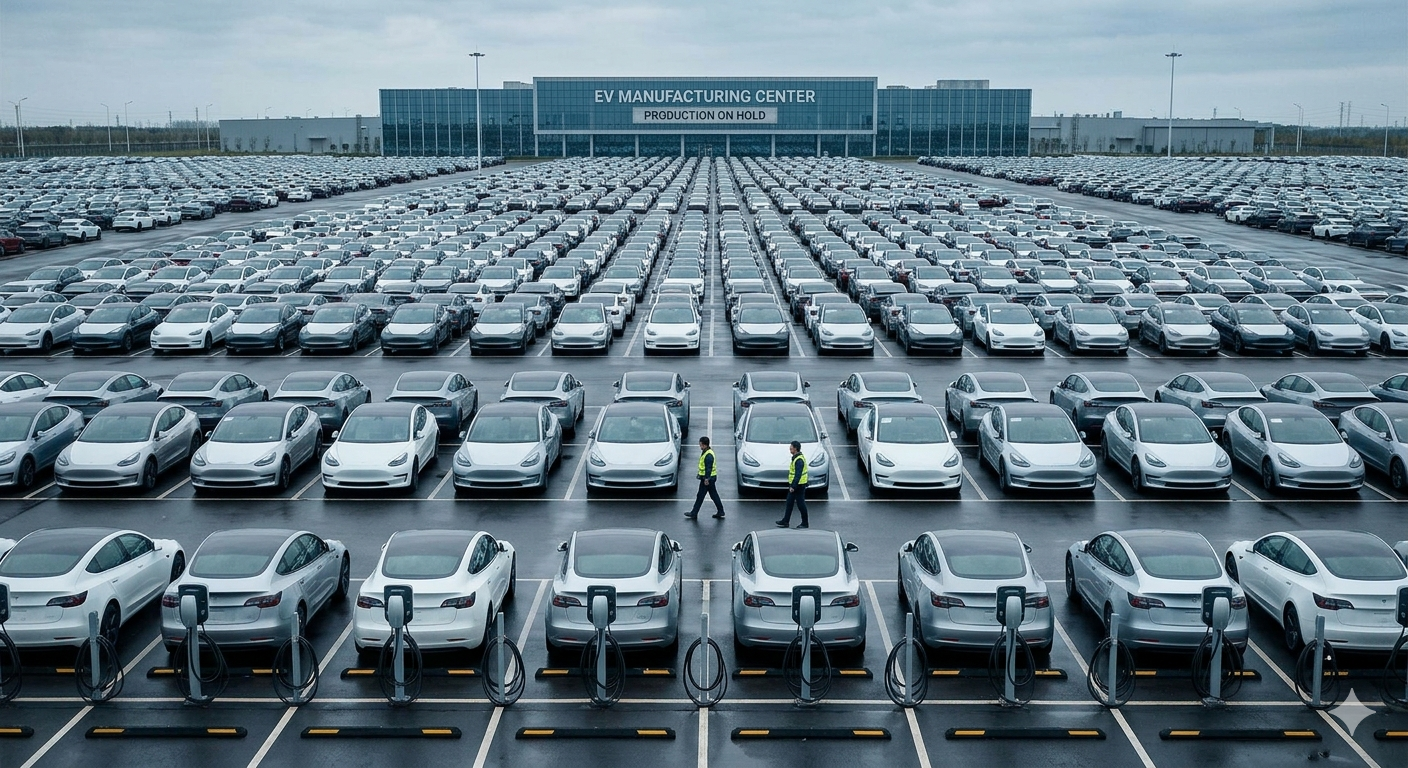
Dealer inventories swelling to 100+ days’ supply for EVs versus ~50 days for hybrids and ICE
Residual values weakening, triggering what industry insiders now call the “Used EV Cliff”
The narrative has shifted. This is no longer about how quickly the world can electrify. It is about which business models can survive electrification at scale.
The Policy vs. Market Chasm
When Mandates Meet the Early Adopter Plateau
The most immediate friction point is the widening gap between policy ambition and consumer pragmatism.
ZEV mandates across the United States and Europe were constructed in a low-rate, high-liquidity environment. Today’s buyer operates in a fundamentally different context:
Higher cost of capital
Greater price sensitivity
Lower tolerance for inconvenience
The industry has hit the Early Adopter Plateau.
The next wave of consumers is not motivated by emissions targets. They are motivated by:
Monthly payments
Reliability
Resale value
And on those metrics, EVs are struggling to compete consistently.
Inventory as a Signal, Not a Lagging Indicator
One of the clearest indicators of this mismatch is inventory accumulation.
Across multiple Western markets, EV days’ supply has exceeded 100 days, often double that of ICE and hybrid vehicles. This is not merely a production issue - it is a demand elasticity problem.
OEMs can build EVs. They cannot force consumers to absorb them at current price points.
Infrastructure: The Reliability Gap
While policymakers have focused on expanding charging networks, consumers are reacting to infrastructure reliability, not just availability.
Level 3 (DC fast charging) density remains uneven, and uptime inconsistency has created a perception problem. For mainstream buyers, the issue is no longer “Can I charge?” but “Can I rely on charging when I need it?”
The Limits of Policy Force
Governments can accelerate supply. They cannot engineer consumer confidence.
The result is a growing tension:
OEMs scaling back EV production targets
Governments quietly adjusting timelines
Consumers delaying purchase decisions
The transition is no longer linear. It is contingent.
The Great Strategic Divergence
All-In vs. Hedged vs. Agile
The industry is fragmenting into three strategic archetypes:
1. The All-In Operators
Fully committed to EVs, these companies rely on:
Vertical integration
Battery cost leadership (often via LFP chemistry)
High-volume scale economics
Their risk is binary: execution must be flawless.
2. The Hedged Operators
Maintaining ICE, hybrid, and EV portfolios, these firms prioritize:
Revenue stability
Optionality
Gradual transition pacing
But hedging introduces complexity and dilutes capital efficiency.
3. The Capital-Agile Operators (Emerging Winners)
A third category is now emerging - firms defined not by what they build, but by how quickly they can pivot what they build.
This is Capital Agility:
The ability to dynamically reallocate production, investment, and product mix in response to real-time market signals.
The Hybrid Renaissance: The Industry’s Profit Engine
The most consequential - and underreported - shift in the industry is the transformation of hybrids from transitional technology into financial infrastructure.
Hybrids are no longer a bridge. They are the ATM funding electrification.
Manufacturers with strong hybrid portfolios are now generating:
Higher margins than comparable EVs
Faster inventory turnover
Stronger residual values
This has created a structural advantage.
Companies like Toyota and Hyundai have leveraged hybrid demand to:
Deliver record profitability
Fund EV R&D internally
Avoid aggressive discounting
By contrast, firms that deprioritized hybrids in favor of full EV commitments are now recalibrating under pressure.
Ford has absorbed $19B+ in EV-related writedowns and losses, forcing a strategic pivot toward “multi-energy” platforms
Stellantis has similarly retrenched, rebalancing its portfolio after aggressive early EV commitments
The lesson is clear:
Profitability during transition matters more than ideological alignment with the end state.
Hybrids have become the cash flow stabilizer in an otherwise volatile transition.
The Economic Friction Layer
The Myth of Cost Parity
The industry’s early thesis - that EVs would achieve cost parity with ICE vehicles - has proven overly simplistic.
The true battleground is not MSRP. It is total economic experience.
The 7% Reality
The post-2024 interest rate environment has fundamentally altered purchasing behavior.
At 7%+ APR, the monthly cost advantage once touted by EV proponents has largely disappeared. Higher upfront prices amplify financing costs, making EVs less competitive on a monthly basis - the metric that matters most to consumers.
Insurance and Repair Economics
EV insurance premiums remain structurally higher due to:
Battery-related repair complexity
Limited repair networks
Higher write-off rates for minor collisions
These are not marginal costs; they are purchase decision variables.
The Used EV Cliff
Residual value instability has emerged as one of the most significant barriers to adoption.
Three-year-old EVs are depreciating faster than hybrids and, in some cases, ICE vehicles. This has triggered a pullback from:
Fleet operators
Leasing companies
Price-sensitive private buyers
The implications are profound:
Higher leasing costs
Lower consumer confidence
Reduced secondary market liquidity
This is not just depreciation - it is residual value volatility at scale.
Battery Replacement Psychology
Even if statistically infrequent, the perceived cost of battery replacement continues to weigh heavily on buyer psychology.
The issue is not technical - it is perceptual risk.
And in consumer markets, perception is often more powerful than reality.
The Software-Defined Trap
From Powertrain to Platform Failure
While much of the EV discourse has focused on hardware - batteries, range, charging - the emerging fault line in 2026 is software execution.
Legacy OEMs are not just struggling to build EVs. They are struggling to build software-defined vehicles (SDVs).
The Smart-Device OEMs
A new class of competitors has reframed the car as a consumer electronics platform on wheels.
These “Smart-Device OEMs” operate with:
Rapid software iteration cycles
Integrated hardware-software stacks
Continuous over-the-air (OTA) updates
They ship vehicles more like smartphones than traditional automobiles.
The Legacy Constraint
Traditional OEMs face structural disadvantages:
Fragmented software architectures
Supplier-dependent codebases
Slow update cycles
The result has been:
Bug-riddled rollouts
Delayed feature deployment
Erosion of brand trust among tech-savvy buyers
This is a critical misalignment. The very consumers most likely to adopt EVs are also those least tolerant of poor software experiences.
The Emerging Divide
The industry is bifurcating into:
Software Winners: Fast, integrated, user-centric
Metal Losers: Hardware-competent, software-deficient
This divide may ultimately prove more decisive than battery chemistry or manufacturing scale.
Geopolitical Chess: The Electric Iron Curtain
From Tariffs to Fragmentation
The geopolitical dimension of the EV transition has intensified dramatically.
The United States has implemented 100% tariffs on Chinese EV imports, while the European Union has introduced tightening countervailing duties aimed at limiting market access.
The stated goal is to protect domestic industry.
The actual outcome is more complex.
A Two-Speed EV World
The global EV market is fragmenting into two distinct ecosystems:
China and Aligned Markets
High-quality EVs priced as low as ~$15,000
Rapid innovation cycles
Dominance in LFP battery supply chains
US and Europe
Entry-level EVs closer to ~$45,000
Slower cost reduction
Higher regulatory and production costs
The result is effectively an Electric Iron Curtain.
Consumers in Western markets are shielded from low-cost alternatives - but at the cost of slower adoption and higher prices.
The Inflationary Feedback Loop
Tariffs and localization efforts are:
Increasing CAPEX requirements
Raising production costs
Delaying price parity
This creates a feedback loop:
Higher prices → Lower demand → Slower scale → Persistently high prices
Protectionism, in this context, acts as both shield and constraint.
Conclusion: The Era of the Multi-Energy Platform
The EV transition is no longer a binary contest between electric and combustion. It is evolving into a competition between production systems.
The defining capability of the next phase is not the ability to build the best EV.
It is the ability to build anything the market demands - on demand.
The Rise of the Multi-Energy Factory
The ultimate winners of 2026–2029 will be manufacturers capable of:
Switching between ICE, hybrid, PHEV, and EV production
Reallocating capacity within 24-hour cycles
Optimizing output based on real-time demand signals
This is the multi-energy platform.
It represents the convergence of:
Capital Agility
Manufacturing flexibility
Market responsiveness
From Darwinian Filter to Operational Discipline
The earlier phase of the transition could be described as Darwinian - survival based on adaptation.
The next phase is more exacting.
It is about operational discipline under volatility.
Who Survives?
The survivors will not be those with:
The most ambitious EV targets
The largest battery factories
The strongest policy alignment
They will be those with:
Profitable hybrid backbones
Software competence
Flexible manufacturing systems
Disciplined capital allocation


