

Analysis. Ukrainian, Russian and American negotiators left Abu Dhabi on 11 November. They had a deal in principle on a large prisoner exchange, and little else. Russia again refused any ceasefire before a full settlement. Its chief negotiator, Vladimir Medinsky, repeated Moscow's demand for the whole of the Donetsk region, according to an assessment by the European Council on Foreign Relations (ECFR).
In a column published by Al Jazeera on 14 November, the Riga-based journalist Leonid Ragozin reads the round bluntly: "Ukraine is running out of options, and Russia knows it". The argument deserves testing rather than repeating. Moscow's leverage is real, but it is narrower than it first appears. It comes from the air campaign against Ukraine's power grid. It also comes from Russia's success in widening the talks to Europe's security order. It does not come from the ground war, where Russian forces are barely moving.
What the Abu Dhabi round produced
The 10–11 November meeting was the first trilateral round since February. Rustem Umerov led Ukraine's delegation. The American side was the envoys Steve Witkoff and Jared Kushner, plus General Alexus Grynkewich, NATO's supreme allied commander in Europe, according to Interfax-Ukraine. The sides agreed to exchange at least 1,000 prisoners each.
The tone was hard. Davyd Arakhamia leads President Volodymyr Zelensky's parliamentary faction and sat on Ukraine's delegation. He called the round among the toughest since 2022. "I believe the Russians came with very, very strict instructions," he told a briefing on 11 November. Medinsky was equally blunt. He said Moscow would be satisfied "only when we win and sign a peace agreement on our terms."
On 12 November Witkoff and Kushner met President Vladimir Putin. Witkoff said afterwards that Putin had agreed to let Europeans join the next round. "They're our partners, and it's important for them to be involved," he said, as reported by Meduza. The Kremlin spokesman, Dmitry Peskov, said the next day that no final decision had been taken. He said Moscow expected the next round "fairly soon, in the foreseeable future". Hemera reported on 14 November that Zelensky says US negotiators have also asked whether Ukraine would give up Donbas in return for NATO membership.
The case that Moscow holds the stronger hand
The clearest source of Russian leverage is the bombing of Ukraine's energy system. Zelensky said Russia had struck energy facilities more than 310 times since the start of November, according to Euromaidan Press. On 13 November the grid operator, Ukrenergo, imposed all-day scheduled blackouts. Consumers in 12 regions lost power. Al Jazeera, citing Ukrainian figures, reported that Russia launched 3,519 drones over ten days, of which 3,068 were intercepted. Prime Minister Serhiy Koretskyi has asked European allies for generators, battery packs, mobile shelters and buses.
Ragozin argues that this pressure, rather than pressure from Washington, pushed Kyiv to the table before winter. That is his interpretation, not an established fact. It is consistent, however, with the view of Liana Fix of the Council on Foreign Relations (CFR), a US think-tank. Fix wrote that Russia sees itself holding the advantage in the air and missile war heading into winter.
The second source of leverage is the agenda. Medinsky called for "a new, comprehensive, and just security system in Europe." Anton Barbashin, a visiting researcher at ECFR, argued that this is the real prize. "Russia does not want a deal on Ukraine alone—it wants to revise the last 35 years of European security," he wrote. CFR's Thomas Graham summarised the resulting deadlock. Europeans want no talks on the security order without a ceasefire, while Russia wants no ceasefire until those talks conclude.
Western behaviour has also shifted. Russia's deputy foreign minister, Sergei Ryabkov, praised Grynkewich's presence, according to the Kyiv Post. NATO officials said he attended in his American military capacity. On 27 October Finland's president, Alexander Stubb, and Norway's prime minister, Jonas Gahr Støre, held a call with Putin. They said it was coordinated with Ukraine. The Moscow Times described it as the first publicly confirmed call between a European leader and Putin since July 2025. Germany's chancellor, Friedrich Merz, told the Westfalenpost on 9 November that he would not shy away from talking to Putin. He meant at the G20 summit in Miami in December, if Putin attends. Britain's defence secretary, Wes Streeting, told the Financial Times he wanted military-to-military channels with Moscow. "There is always a risk of miscalculation, and that's why having that direct communication is important," he said, as reported by Reuters.
Europe is also struggling to agree who should speak for it. At an EU summit in Dublin, Estonia's prime minister, Kristen Michal, said of the divisions: "You could even have a TV show about it."
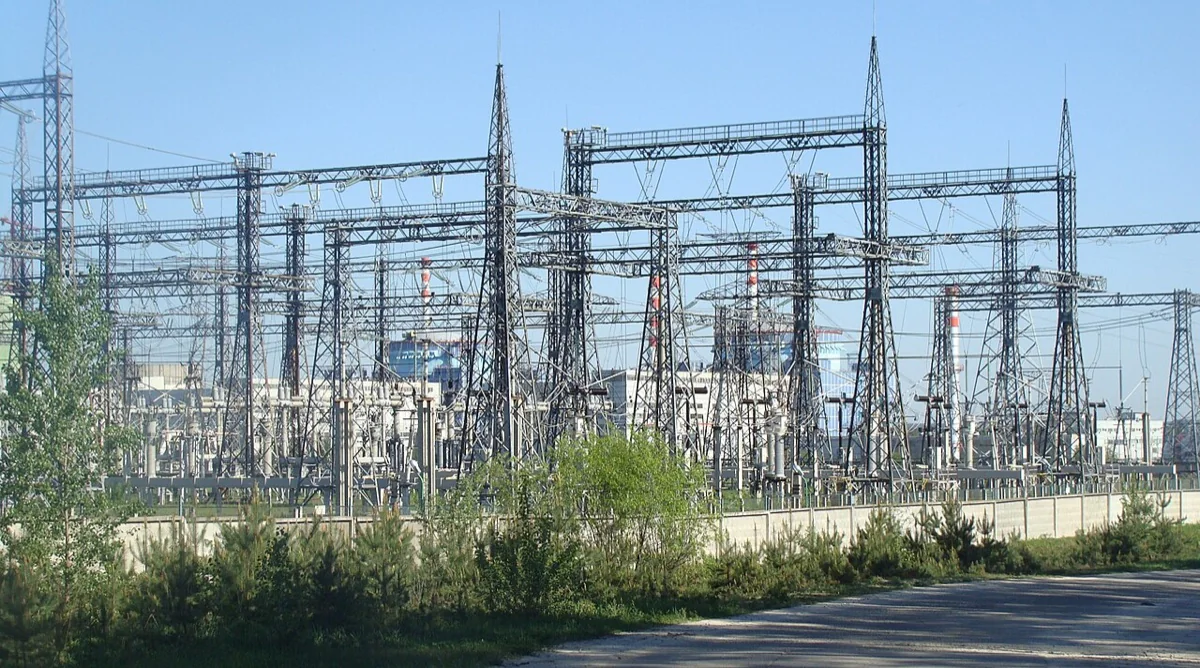
High-voltage switchgear near the Khmelnytsky nuclear power plant in Ukraine, photographed in 2013. Photo: RLuts / Wikimedia Commons, CC BY-SA 3.0.
The strongest objection
The best case against Ragozin's thesis is military and economic. Independent assessments put Russia's net territorial gain this year at 117 sq km, Al Jazeera reported. Russia's defence ministry claims 3,600 sq km. Either way, Russia is not close to taking the rest of Donbas by force. Ukraine has meanwhile struck Russia's five largest oil refineries since late October. Sources cited by Reuters say at least 30 per cent of Russia's refining capacity has been put out of action. Zelensky has said Putin "lives in a different reality". He claims Russian officers misjudge how much of Donbas they hold.
Some analysts argue the leverage is a product of Western choices, not Russian strength. Max Boot of CFR called the negotiations "a dangerous farce" and urged more support for Kyiv and more pressure on Moscow. On this view, Russia looks strong at the table only because Washington is not pushing it.
These points are serious. They rule out any claim that Russia is winning the war outright. But military stalemate and bargaining strength are different things. Despite the refinery strikes and its slow advance, Moscow has not moved its terms, as Medinsky's own words show. Russia has shown it can impose costs on Ukrainian civilians faster than Kyiv can absorb them. At the same time it has drawn the West into discussing the European order it wants to reopen. That is leverage, even without a breakthrough at the front.
What would change the assessment
Three things will decide whether Russia's advantage grows or fades. The first is the winter. If Ukraine's allies can supply enough air defence and emergency power to keep cities heated, the main source of Moscow's pressure weakens. The second is Russia's economy. If the refinery campaign bites hard into fuel supplies and revenue, the Kremlin's patience may become more expensive than it looks.
The third is sequencing. Ryabkov has warned that European involvement could derail progress. Moscow has not yet accepted a European envoy. Fix warned that "Russia could trap Europe and Ukraine in wider talks and make them scapegoats". Barbashin's advice is that "Europeans should not accept an abstract redesign of the security architecture as the price of peace in Ukraine."
European governments must decide whether to engage on Russia's broader agenda in exchange for a ceasefire. The other choice is to hold out and raise the cost of the war for Moscow. CFR's Matthias Matthijs expects, without greater US pressure on Russia, that "the war is likely to continue for the next two years." Abu Dhabi did not show that Ukraine has lost. It showed that Russia now has a large say in what the peace talks are about.
Featured image: The old and the new, Abu Dhabi, UAE (53710046569) by John Morton from Adelaide, via Wikimedia Commons, CC BY-SA 2.0.


