

Extreme weather has killed tens of thousands of people around the world in 2026. Heat, floods, wildfire smoke and a Himalayan rock-and-ice collapse caused the heaviest losses.
The tally comes as governments meet in Antalya, Türkiye, for the COP31 UN climate summit. Official data published this month show the scale of the year. The EU's Copernicus Climate Change Service says 2026 is "virtually certain" to end more than 1.5C above pre-industrial levels. A record-strength El Niño, which is still building, has yet to peak.
A hot year with hotter oceans
October 2026 was the warmest October on record, at 1.75C above the 1850–1900 average, according to Copernicus. It was the third month in a row above 1.5C. The agency estimates the full-year average at between 1.56C and 1.61C above pre-industrial levels. That would most likely make 2026 the second-warmest year on record, with about a one-in-five chance of tying or beating 2024.
The World Meteorological Organization (WMO) put January to September at 1.47C (±0.13C) above the 1850–1900 baseline in an update released on 9 November. Global mean sea level reached a record high, and the heat stored in the oceans kept rising. One year above 1.5C does not by itself mean the Paris Agreement limit has been breached. That limit refers to long-term average warming, not a single year.
Much of this year's extra heat comes from the Pacific. El Niño is a natural, periodic warming of the tropical Pacific that pushes up global temperatures. Copernicus says the current event already exceeds the peaks of the 1982–83, 1997–98 and 2015–16 events. Samantha Burgess, strategic lead for climate at the European Centre for Medium-Range Weather Forecasts, said: "An exceptionally strong El Niño is adding further heat to a climate already warmed by human activities."
Europe's heat and the Himalayan collapse
The deadliest single hazard was European heat. Researchers at Imperial College London estimated 50,391 heat-related deaths across 854 European cities between June and August. Their study is due to appear in Nature Health. It attributes 32,619 of those deaths, about 65 per cent, to human-caused warming. Attribution of this kind compares observed deaths with modelled deaths in a world without climate change. The 2026 total is 71 per cent higher than in 2022, the previous worst summer, when 29,480 died.
The authors say the true figure is higher. The cities they studied hold about 40 per cent of Europe's population, and the analysis leaves out a deadly heatwave in May. Italy, France, Spain and Germany were hardest hit. Clair Barnes is a climate scientist at Imperial and the study's lead author.
In Nepal, a mass of rock and glacier ice broke away on 26 August and fell into the Lhende Khola valley near the Tibetan border. The resulting flood of water and debris swept away whole communities. Nepalese authorities had confirmed 1,386 deaths and 5,130 people missing, according to Earth.com. Chinese authorities reported 43 dead in Tibet.
Scientists have pointed to rapid warming at high altitude and to thawing permafrost, the frozen ground that helps hold steep slopes together. Land above 4,000 metres in the Langtang catchment has warmed about five times faster than the global average since the 1960s, The Independent reported. Researchers quoted at the time cautioned that this particular collapse had not been formally linked to climate change.
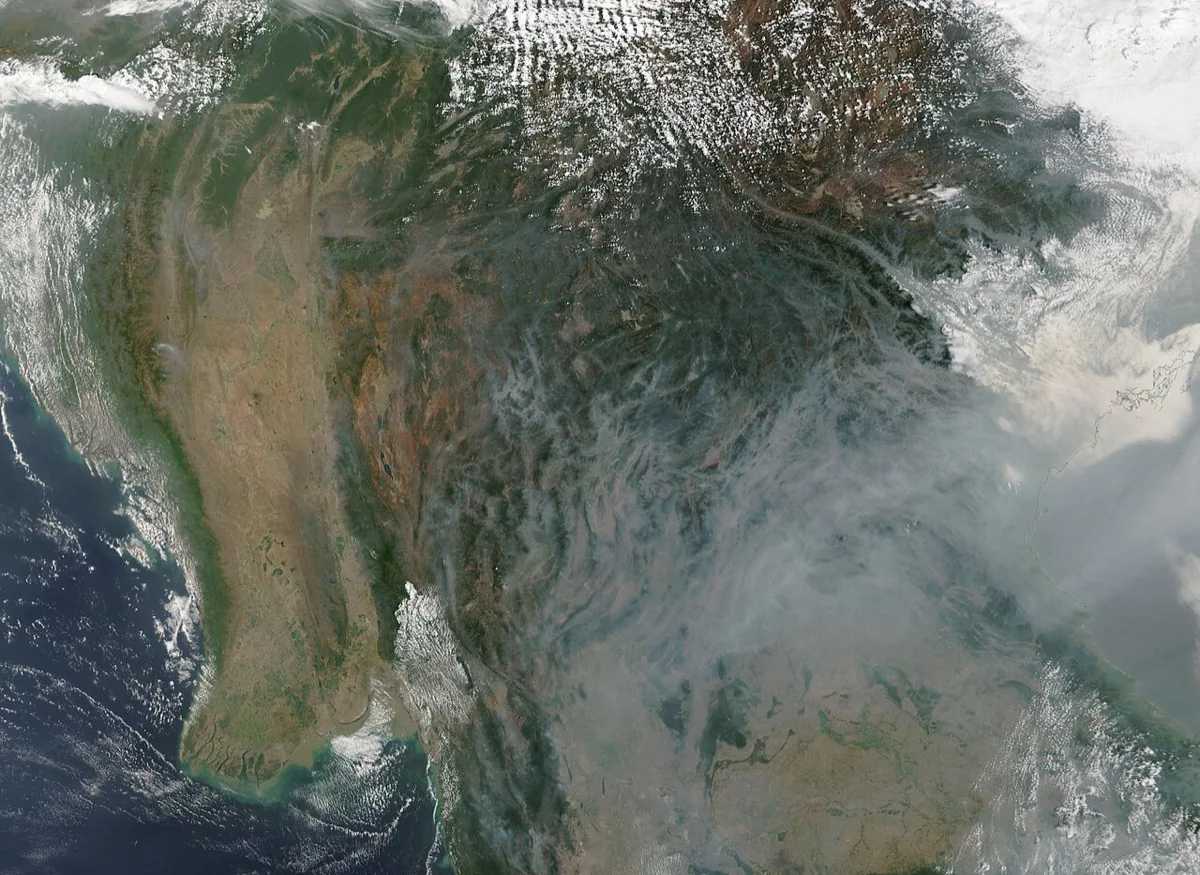
Smoke and haze from fires over Southeast Asia, seen by NASA's Terra satellite on 4 April 2024. Photo: MODIS Land Rapid Response Team, NASA GSFC / Wikimedia Commons, Public domain.
Floods, storms and smoke
The costs of extreme weather events are spreading through the wider economy, as Hemera reported in April.
The El Niño still to come
The WMO expects El Niño to be the strongest on record by December and to continue into early 2027. Celeste Saulo, its secretary-general, told reporters in Geneva on 21 October that the event "could be unprecedented in strength". In the WMO's state of the climate update she explained why it matters: "El Niño doesn't add new heat to the planet." She added: "It releases heat from the ocean, which is the warmest ever measured."
Tom Fletcher, the UN's humanitarian chief, called the coming El Niño a "wrecking ball" of extreme heat, drought and flooding. He released $50m for 11 of the most exposed countries, including Chad, Ethiopia, Somalia and South Sudan. "The choice is clear: we can wait for disaster or we can invest in resilience," he said.
The Climate Impact Lab, co-founded by Michael Greenstone of the University of Chicago, projects about 451,000 additional heat deaths worldwide between June 2026 and February 2027 because of the El Niño's extra heat. It expects Nigeria, Indonesia, Sudan, India and Brazil to be most affected. The projection uses peer-reviewed methods but has not itself been peer reviewed. The World Food Programme has warned that the El Niño could push about 50 million people into acute hunger.
What Antalya can deliver
Carbon dioxide in the atmosphere is still rising. The WMO puts the 2025 average concentration at about 426.8 parts per million, 53 per cent above the 1750 level. UN secretary general António Guterres said: "We have entered a new age of climate extremes."
At COP31, the central fight is over money for coping with these impacts. A draft text on the global goal on adaptation was published overnight on 13 November. It includes African countries' demand to triple adaptation finance to "at least $120 billion per year by 2035", Climate Home News reports. Another option would reopen parts of the finance target agreed at COP30, which African countries are expected to resist.
Ministers are arriving this weekend to take over the hardest issues from officials. A stocktaking plenary on the evening of 14 November is expected to show countries' first red lines. A draft of the summit's main cover decision is due early next week, ahead of the summit's scheduled close.
Featured image: Langtang-lirung-and-kimshung by Ahtih ( talk ), via Wikimedia Commons, CC BY-SA 3.0.


