

The US Federal Aviation Administration (FAA) lifted a nationwide halt on departing flights at 8:15pm Eastern Time on Friday 13 November (01:15 GMT on Saturday). The halt had lasted more than four hours. A telecommunications failure at the regional centres that manage high-altitude air traffic had led the agency to stop every departure in the country. Airlines warned that cancellations and delays would continue through the weekend. Aircraft and crews must be moved back into position.
It was only the second nationwide stop of all departures since the attacks of 11 September 2001. Al Jazeera described it as the longest ground stop in 25 years. The aviation data firm Cirium estimated that about 11,000 flights carrying more than 1.5 million passengers had been due to leave US airports after 4pm ET. Senior officials in the Trump administration blamed overloaded, ageing equipment. They said there was no sign of a cyberattack.
How the shutdown unfolded
According to Transportation Secretary Sean Duffy, instability in radar and communications data was first detected at 3:36pm ET. The FAA issued the ground stop at 3:54pm, citing "extraordinary circumstances and for reasons of safety". In a separate statement, the agency said: "Every flight has been accounted for, and international flights will be handled on a case by case basis."
Aircraft already in the air were allowed to continue to their destinations. Mr Duffy said more than 3,500 aircraft were airborne when the order was given, and that about 400 were still in the airspace at his last check. By 7:05pm ET, Cirium had counted at least 827 diversions: 670 aircraft returned to their departure airports and 157 landed elsewhere. Mr Duffy said medical flights, including organ transport, were not halted. Cargo carriers including UPS and FedEx were.
The effects were felt well beyond the US. A spokesperson for Sydney Airport said all US-bound flights from Sydney had been held. After the stop was lifted, they were "expected to depart as planned". Air Canada cancelled its remaining Friday flights between Canada and the US. About 70 flights at Mexico City's main airport were expected to be affected. Sports schedules were also hit. The University of Texas football team was grounded on board its aircraft. The Big 12 Conference said it was "evaluating any potential changes to Saturday's football schedule".
Overloaded routers, not hackers
At an evening news conference, Mr Duffy said "our switches, our routers actually got overloaded with data, and they went down". This caused instability in radar and communications across the country's control centres. He said the FAA had not lost all telecoms or radar capability and that the stop was a precaution. "It is the old hardware that went down," he said.
Mr Mullin said there was no indication as yet that anything was nefarious. He also said: "We're not ruling out anything at this point". Reporting by Investing.com noted that the cause of the overload has not been explained.
Officials rejected suggestions that the failure was linked to a separate Microsoft outage this week. That outage had disrupted Outlook, Teams and other office software. "We have no indication that the FAA's nationwide ground stop is related to any Microsoft services," Microsoft said. Mr Mullin said: "I don't see any reason to connect those two at all."
Officials also ruled out the FAA's new AI-assisted traffic-planning tool, known as SMART. Air Space Intelligence, the company behind it, said: "The current ground stop is not based on or a result of the SMART system." Mr Duffy said the tool was "completely disconnected" from the equipment that failed. In a letter dated 9 October, Democratic lawmakers had asked the FAA to pause changes to the air traffic control system.
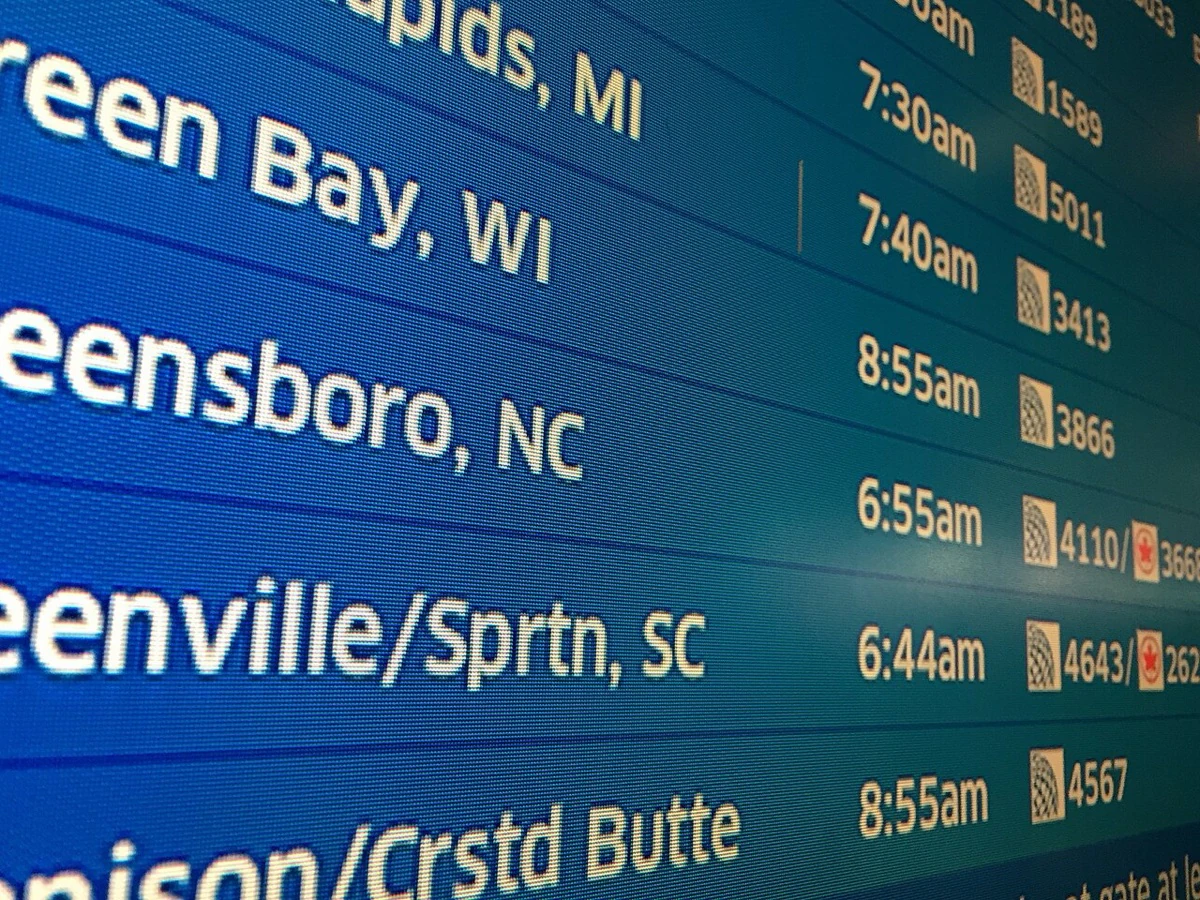
A departure board at Chicago O'Hare's Terminal C, photographed in March 2017. Photo: Redolta / Wikimedia Commons, CC0.
Old wires, new equipment and an auditor's warning
The administration's own account points to the transition from old to new systems as a source of risk. NBC News reported that Mr Mullin attributed the failure to new equipment overwhelming older systems. Al Jazeera reported that officials acknowledged new technology had overloaded antiquated parts of the network.
That matches concerns raised two months earlier. In a report published on 14 September, the Government Accountability Office (GAO), the US congressional auditor, found that the FAA had replaced only 2,560 of its 5,170 copper telecoms lines with fibre-optic cable by May 2026. Some of those lines date from the 1960s. The GAO also found that the FAA had no integrated master schedule for the first phase of its programme. Instead it was running 11,389 separate, unlinked project schedules. So equipment installations at the same sites could clash and disrupt controllers. The auditor warned that if the programme slipped, the FAA would have to keep relying on outdated systems prone to failure. This carried the risk of more flight delays and safety incidents. The FAA partially accepted the GAO's recommendations. The administration says 68 per cent of the legacy copper network has now been replaced.
The precise fault has not yet been publicly identified, so any direct link to the GAO's findings is not yet proven. But the pattern of failures is clear. In May 2025, controllers at Newark briefly lost radar. In September 2026, a severed fibre line disrupted flights into Newark and Philadelphia. In January 2023, the failure of a pilot-alert system caused the previous nationwide ground stop. Ron Bartsch, a professor of international aviation law at the University of the South Pacific, told Al Jazeera he questioned why backup systems did not take over immediately.
A slow weekend recovery
By 7:30pm ET on Friday, the tracking service FlightAware had recorded 4,238 cancellations and 10,079 delays on flights to, from or within the US. Flightradar24 put Friday's cancellations above 4,700. FlightAware data cited by ABC News put the number of cancelled Saturday flights at nearly 800.
American Airlines said it expected "residual delays and cancellations" into the following day. JetBlue cancelled its remaining Friday flights apart from some services to Europe. It said: "We expect disruptions to continue into tomorrow, including additional cancellations." Todd Curtis, an aviation safety analyst and chief executive of AirSafe.com, told Al Jazeera that re-routing aircraft and crews through interconnected hub networks could take more than a day. That would be so even after the technical fault had been fixed.
"I believe that it's going to take us some time to get back to capacity," Mr Duffy said. He added that he expected the system to be "back up and operational as we come into the heat of travel during Thanksgiving", which falls on 26 November.
A funding fight ahead
Mr Duffy used the outage to press Congress for money. "This is an emergency," he said, adding: "I want $50 billion." Congress approved $12.5bn in July 2025 for the first phase of the modernisation programme. The White House has asked for a further $30.1bn for aviation infrastructure. "Let's not do a patchwork fix to a system that's critical for every single family," Mr Duffy said. Mr Mullin said the system needed "a complete overhaul", which he estimated at about $50bn.
Democrats focused on the administration's handling of the problem. House minority leader Hakeem Jeffries called the stoppage an "unprecedented breakdown".
The FAA has not given a timetable for its investigation. The next tests are how quickly airlines clear the backlog this weekend and whether Congress responds to the administration's funding request before the Thanksgiving peak.
Featured image: Air traffic control tower, Orlando International Airport by Olga Ernst, via Wikimedia Commons, CC BY-SA 4.0.


