

The International Court of Justice ruled on 19 November 2026 that Myanmar committed genocide against the Rohingya during its 2017 military crackdown. It is the first time the UN's top court has found a state responsible for committing genocide.
The vote was nine to six. The ruling matters well beyond Myanmar. The court has twice before weighed genocide claims between states. Each time it stopped short. In Bosnia's case against Serbia, decided in 2007, it found that genocide had occurred at Srebrenica. But it held that Serbia had not committed it. In Croatia's case against Serbia, decided in 2015, it found killings but no proven intent to destroy. Myanmar is the first case to get past both hurdles.
The judgment orders Myanmar to prosecute those responsible, let refugees return safely and pay compensation. The court has no means of enforcing it. Myanmar's government has called the ruling unfair. The UN Security Council can be asked to act when a state ignores the court. It is due to discuss the ruling this week.
What the court decided
The Gambia, a small Muslim-majority country in West Africa, filed the case on 11 November 2019. It had the backing of the 57-member Organisation of Islamic Cooperation. It argued that Myanmar had broken the 1948 Genocide Convention. Under that treaty, every state party must prevent and punish genocide. So a country with no direct link to the violence can still bring a case. The court accepted this argument in July 2022, when it rejected Myanmar's objections. Eleven states, including the UK, Canada, France and Germany, later intervened on points of interpretation.
The Rohingya are a mostly Muslim minority from Rakhine State in western Myanmar, which borders Bangladesh. A 1982 law left out the Rohingya when it listed the country's recognised ethnic groups. Nearly all have since been denied citizenship.
Reading the judgment in The Hague, President Iwasawa Yuji said Myanmar "has committed genocide against the Rohingya group in northern Rakhine state". The court found that about 10,000 Rohingya were killed. It rejected Myanmar's argument that the army had been fighting an insurgency.
The Gambia's justice minister, Dawda Jallow, said afterwards: "This is the first time the court has found a state responsible for committing genocide, the crime of crimes."
Hemera reported on 15 November that the court had set the date for its ruling.
How Myanmar compares with Bosnia and Croatia
The table below sets the three merits judgments under the Genocide Convention side by side.
Case | Filed–decided | State committed genocide? | Other breaches found | Remedy |
|---|---|---|---|---|
Bosnia v Serbia | 1993–2007 | No (13–2) | Failed to prevent Srebrenica (12–3); failed to hand over Mladić (14–1) | Declaration only; no compensation (13–2) |
Croatia v Serbia | 1999–2015 | No; claim rejected (15–2) | None; Serbia's counter-claim rejected unanimously | None |
The Gambia v Myanmar | 2019–2026 | Yes (9–6) | Failed to prevent (9–6) and punish (11–4) | Restitution and compensation (10–5) |
Sources: ICJ summary of the judgment of 26 February 2007, ICJ summary of the judgment of 3 February 2015, ICJ case file 178, NPR, Wikipedia summary of the 2026 operative clause.
Bosnia's case failed on attribution: the question of whose acts these were. The court found that the killings at Srebrenica in July 1995 were genocide. By the Associated Press's count, some 8,000 mostly Muslim men and boys died. The Bosnian Serb army committed them, however. Under the court's "effective control" test, Serbia had neither directed that army nor controlled the operation. Serbia was found only to have failed to prevent the genocide. The court held that saying so was reparation enough.
Croatia's case failed on intent. The court accepted that the Yugoslav army and Serb forces had killed and seriously harmed Croats in 1991. But it found that their aim was an ethnically homogeneous Serb territory, achieved by expulsion. "It was not a question of systematically destroying that population," the court said.
Myanmar raised neither problem in the same way. The violence was carried out by the state's own security forces, so attribution was not in doubt. That left intent, the question on which Croatia's case had collapsed. On this the court reached the opposite answer.
The legal test: why intent is the hard part
The Convention defines genocide as one of a closed list of acts committed with "intent to destroy, in whole or in part, a national, ethnical, racial or religious group". The acts include killing, causing serious bodily or mental harm, inflicting conditions of life calculated to destroy the group, and imposing measures to prevent births.
Proving the acts is not enough. Lawyers call the extra element "specific intent". States rarely write down a plan to destroy a group, so courts infer intent from conduct. In the Croatia case, the court said such intent "must be the only reasonable inference which can be drawn from the said pattern of conduct". In 2007 it required evidence that was "fully conclusive" for charges this grave.
The Myanmar majority kept both standards. Marko Milanović, a professor at the University of Reading, told TIME: "The Court has not rewritten or expanded the legal definition of genocide". What changed was how the evidence was weighed. According to an analysis by Adil Ahmad Haque in Just Security, the majority considered the pattern as a whole:
- the general context;
- the selective targeting of Rohingya;
- attacks on the group's foundations, such as sexual violence and the targeting of children;
- the systematic scale of the operations.
Two points depart from the Croatia ruling. First, the court held that a failure to take every chance to destroy the group "does not preclude an inference of genocidal intent". In 2015 the court had noted that many Croats were evacuated rather than killed. Second, it excluded displacement as the alternative explanation. It cited the brutality of the operations and the attacks on people as they fled.
The evidence the majority accepted
The figures below are the ones the court and the UN relied on, with current refugee numbers for context.
Measure | Figure |
|---|---|
Rohingya killed in 2017 operations | about 10,000 |
Villages burned in whole or in part | 392 |
Acts of rape found | at least 1,834 |
Children under five who died (estimates cited) | up to 2,109 |
Rohingya in northern Rakhine (the "substantial part") | 815,000 |
Fled to Bangladesh in the 2017 crackdown | at least 730,000 |
Rohingya refugees in Bangladesh now | about 1.2 million |
Rohingya remaining in Myanmar | about 550,000 |
Sources: ICJ judgment as reported by NPR and Just Security, Reuters, UN figures reported by Al Jazeera, Associated Press.
The court found that the 815,000 Rohingya of northern Rakhine were a "substantial part" of the group on their numbers alone. That meets the Convention's "in part" requirement. It also found that soldiers separated men from women. They killed men in several villages and murdered infants to stop births, The National reported.
The court linked the violence to a campaign of hate speech. It said the campaign cast the Rohingya as "subhuman" and "a violent threat". In the court's words, this fostered a "climate conducive to targeting a group for destruction". The executions, sexual violence, attacks on children, burning of villages and attacks on fleeing civilians "are not consistent with an intent to conduct counterinsurgency operations", the court found.
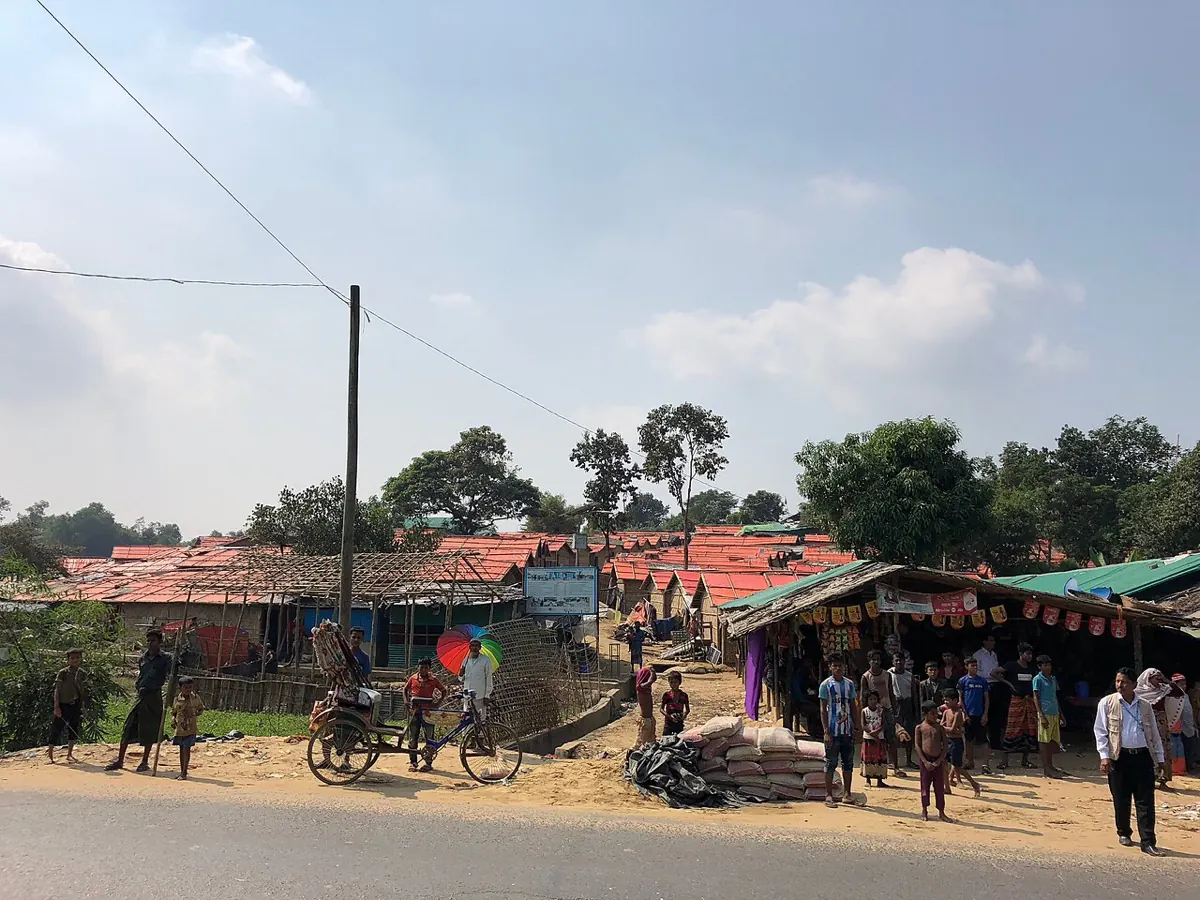
Kutupalong refugee camp in Cox's Bazar, Bangladesh, photographed in November 2018. Photo: Ministerie van Buitenlandse Zaken / Wikimedia Commons, CC BY-SA 2.0.
What Myanmar has been ordered to do
The judgment is final and cannot be appealed. Its main findings and orders, with the votes, are below.
Finding or order | Vote |
|---|---|
Myanmar committed genocide | 9–6 |
Failed to prevent genocide | 9–6 |
Failed to punish genocide | 11–4 |
Failed to pass laws implementing the Convention | 14–1 |
Breached duty over public incitement by private persons | Not found (14–1) |
Destroyed evidence despite the 2020 order | 11–4 |
Investigate, prosecute and punish suspects | 13–2 |
Guarantee non-repetition | 9–6 |
Restitution and compensation | 10–5 |
Report to the court within two years | 10–5 |
Sources: ICJ operative clause of 19 November 2026 as summarised in the Wikipedia case entry, NPR, Just Security, ICJ case file 178.
The six judges who voted against the genocide finding wrote a joint dissent. They were Vice-President Sebutinde, Judges Tomka, Abraham, Xue and Nolte, and Judge ad hoc Kress.
Restitution means putting things back as they were where possible. The orders, as described by The Gambia's lead counsel to Anadolu, require Myanmar to:
- allow refugees to return safely and voluntarily;
- reunite separated families and restore or replace lost property;
- provide physical and psychological rehabilitation;
- help locate the disappeared and ensure dignified burials;
- protect survivors from further discrimination.
"This is the most far-reaching suite of restitution orders that I think the court has ever given," Arsalan Suleman, the counsel, said. The contrast with Bosnia is sharp. There, the court ordered no compensation at all. The court did not order Myanmar to grant the Rohingya citizenship, NPR reported. The amount of compensation will be set in a later phase.
The ruling also follows up the court's provisional measures order of 23 January 2020. That unanimous order told Myanmar to prevent genocidal acts and to preserve evidence. Myanmar filed twelve progress reports under it between May 2020 and November 2025. The judgment now finds that it breached the duty to preserve evidence.
How governments have responded
Myanmar's government rejected the ruling. "This decision is not a unanimous decision by everyone; it is not fair," a government spokesperson told a news conference on 20 November, Al Jazeera reported. Myanmar has always said the 2017 operations answered attacks on police posts by the Arakan Rohingya Salvation Army. Its representative, Ko Ko Hlaing, told the court in January: "Myanmar was not obliged to remain idle and allow terrorists to have free rein."
The ruling's political weight falls on Min Aung Hlaing. He commanded the army during the crackdown. He led the 2021 coup against Aung San Suu Kyi's government. He was installed as president in 2026 after restricted elections.
Other responses split broadly along familiar lines:
- China: Foreign ministry spokesperson Guo Jiakun said on 20 November: "China has concerns regarding such issues as ultra vires jurisdiction and overreach in interpretation".
- United States: The State Department said: "The proper interpretation of the Genocide Convention is of paramount importance, as is preventing politicization of the ICJ." It added: "We are studying the decision to fully assess its implications." Washington formally determined in 2022 that Myanmar had committed genocide.
- United Kingdom: Foreign Secretary Ed Miliband expelled Myanmar's defence attaché, summoned its chargé d'affaires and sought a Security Council session. He said "Myanmar must comply fully".
- United Nations: Secretary-General António Guterres called the judgment "a powerful recognition of the Rohingya victims of genocide."
Rights groups want more. Amnesty International's secretary general, Agnes Callamard, has called for a "global arms embargo" and a referral of Myanmar to the International Criminal Court. Justice for All, a US group, has urged sanctions on Myanmar's oil and gas sector.
What is disputed and unresolved
The six dissenting judges argued that the evidence could equally point to an intent to expel the Rohingya, or to punish them collectively, rather than to destroy them, TIME reported. That is the reading the court accepted in Croatia's case. The split suggests the "only reasonable inference" test remains contested on the bench itself.
Return is the hardest order to carry out. Since 2023 the Arakan Army, an ethnic Rakhine armed group, has taken most of Rakhine State. The UN human rights office has accused both it and the military of abuses against the Rohingya.
Effects on other cases are also disputed. The court is hearing South Africa's genocide case against Israel over Gaza, which Israel denies. Vincent-Joël Proulx, a legal scholar, told TIME that the Myanmar ruling "does not necessarily determine the outcome", or even the analytical direction, of that case.
What happens next
The Associated Press reported that, at the UK's request, the Security Council would hold closed consultations the following Wednesday, 25 November. It would also hold a private meeting on 7 December. France's foreign ministry asked for a council meeting on 21 November, after Myanmar's rejection. Human Rights Watch notes that the council has never used its power to enforce an ICJ judgment. China holds a veto.
Myanmar's report on restitution is due by November 2028. Separately, the ICC prosecutor's 2024 request for an arrest warrant for Min Aung Hlaing awaits a decision. An Argentine court issued warrants in 2025. The open question is whether any government with influence in Naypyitaw will make compliance a condition of dealing with it.
Related coverage: ICJ to Rule Thursday on Whether Myanmar Committed Rohingya Genocide
Featured image: International Court of Justice HQ 2006 by International Court of Justice ; originally uploaded by Yeu Ninje at en.wikipedia ., via Wikimedia Commons, Public domain.


