

The International Court of Justice (ICJ) will rule on Thursday 19 November on whether Myanmar committed genocide against its Rohingya Muslim minority. The Gambia brought the case seven years ago.
The United Nations' highest court has never found a state responsible for genocide. How its judges decide that genocidal intent has been proved is likely to shape other genocide cases still before the court. These include South Africa's case against Israel over the war in Gaza.
A case seven years in the making
The Gambia, a small and mostly Muslim country in west Africa, filed the case in November 2019. It had the backing of the 57-member Organisation of Islamic Cooperation. It accuses Myanmar of breaching the 1948 Genocide Convention. The treaty was drawn up after the Holocaust.
According to The Gambia's lead counsel, the law firm Foley Hoag, the court's president, Judge Iwasawa Yuji, will read the judgment. The public sitting will be at the Peace Palace in The Hague. The ruling will be final and binding. It cannot be appealed.
The ICJ settles disputes between states. It does not try individuals, unlike the International Criminal Court (ICC), which also sits in The Hague.
The case has already passed through several stages. In January 2020 the court unanimously ordered Myanmar to prevent genocidal acts and to preserve evidence. These orders, known as provisional measures, are emergency steps taken while a case is under way. In July 2022 it rejected Myanmar's objections to its jurisdiction. Hearings on the merits ran from 12 to 29 January 2026. They included closed sessions. Rohingya survivors who had travelled from camps in Bangladesh testified.
Eleven states were allowed to intervene on how the convention should be interpreted, Human Rights Watch said. They include the UK, Canada, France, Germany and the Netherlands.
Rival accounts of 2017
The Rohingya have lived for generations in Rakhine state in western Myanmar, which borders Bangladesh. Most have been denied citizenship for decades. In August 2017 a Rohingya armed group, the Arakan Rohingya Salvation Army (Arsa), attacked police posts. The army launched what it called "clearance operations". More than 700,000 Rohingya fled to Bangladesh, according to Human Rights Watch.
A UN fact-finding mission reported in 2018 that it had found "genocidal intent", DVB reported at the time the judgment date was set. It recommended that senior generals, led by Min Aung Hlaing, face prosecution.
The Gambia's justice minister, Dawda Jallow, told the court in January that the case was "about real people, real stories and a real group of human beings". The Gambia wants the court to declare Myanmar in breach of the convention, order it to prosecute perpetrators and pay reparations. It also wants a finding that Myanmar ignored the 2020 orders.
Myanmar denies genocide. Ko Ko Hlaing, a minister in the President's Office, told judges on 16 January that the army had responded to terrorist attacks. "Myanmar was not obliged to remain idle and allow terrorists to have free reign," he said. "A finding of genocide would place an indelible stain on my country and its people." In a statement in January, Myanmar's foreign ministry said: "The allegations made by The Gambia are flawed and unfounded in fact and law."
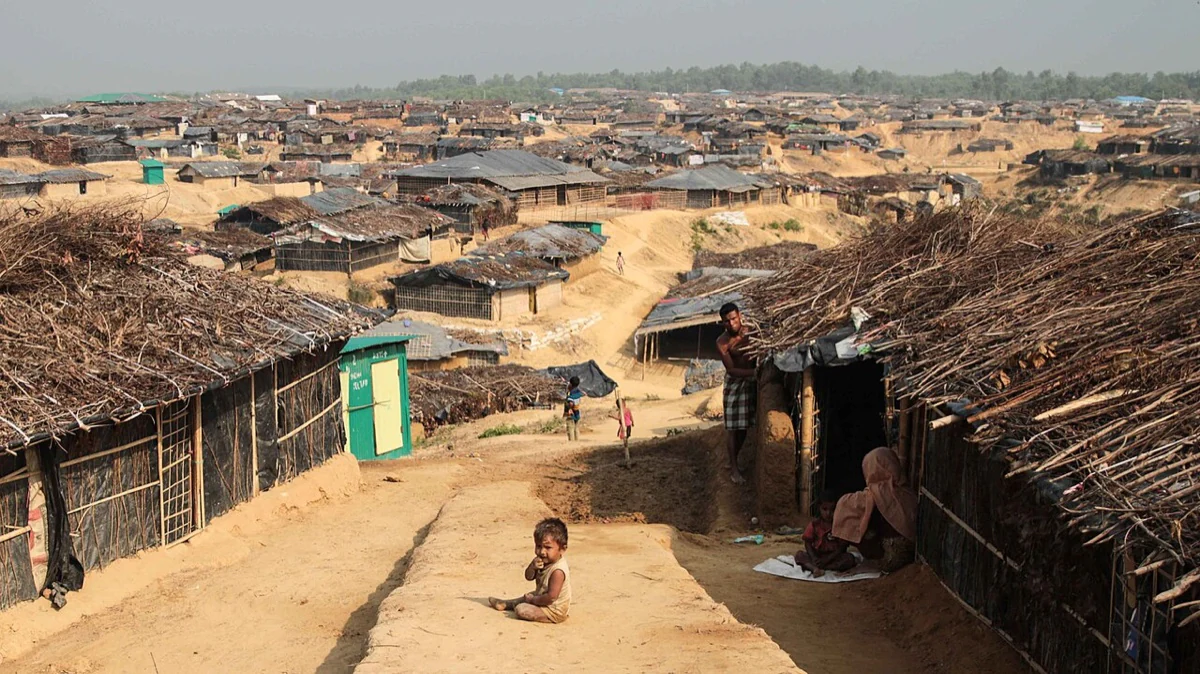
Kutupalong refugee camp in Bangladesh, where many Rohingya live, in a file photo dated March 2017. Photo: John Owens ( VOA ) / Wikimedia Commons, Public domain.
The test for intent
The convention defines genocide as certain acts committed with intent to destroy, in whole or in part, a national, ethnic, racial or religious group. Proving that specific intent is the central legal hurdle.
In two earlier cases arising from the Balkan wars, the court required genocidal intent to be the "only reasonable inference" from a pattern of conduct. Neither case found a state directly responsible for genocide. Serbia was, however, held responsible for failing to prevent the genocide at Srebrenica in 1995.
Antonia Mulvey is founder of Legal Action Worldwide, which represents hundreds of Rohingya survivors. She told The Guardian she was "cautiously optimistic". She said sexual violence would be central to the judgment. "Yes, we would say sexual violence is a critical part to show their intent to destroy the group," she said. She told Middle East Eye: "The Gambia is very clear in its submissions; they are not asking the court to lower the threshold".
Washington has made its concerns public. Mike Waltz, the US ambassador to the UN, warned in a post on X against using the case "to lower the legal threshold for proving genocide so that weakened and false standard can later be weaponized". This is according to the Foundation for Defense of Democracies, a Washington think tank. The Guardian reported that he warned against a standard that could be used against "allied soldiers". The US already considers the Rohingya crisis a genocide. This follows a determination by the Biden administration.
Implications beyond Myanmar
The ruling could indicate how the court might approach South Africa's case against Israel. Israel denies committing genocide in Gaza and has challenged the court's jurisdiction. Its lawyers argue that its war aims have been to "eliminate the military and governing capabilities of Hamas". A timetable set by the court in May runs to May 2029 for written pleadings alone.
The judgment also bears on Myanmar's leader. Min Aung Hlaing commanded the army in 2017. He seized power in a 2021 coup, which set off a civil war. He became civilian president in April after elections that were widely condemned as a sham, The Guardian reported. The ICC prosecutor requested an arrest warrant for him in November 2024, alleging crimes against humanity. Judges have not publicly ruled on it. An Argentine court issued warrants for 25 people, including him, in February 2025.
Enforcement is the open weakness. ICJ judgments are binding under the UN Charter. A state can ask the UN Security Council to enforce one, but the council has never done so, according to Human Rights Watch.
What happens on Thursday
If the court finds Myanmar responsible, it could order reparations and prosecutions. It could also rule only on narrower breaches, such as failing to prevent or punish genocide, or reject the claims.
Either way, the Rohingya remain displaced. More than one million live in camps in Bangladesh, the world's largest refugee settlement. Fewer than 600,000 are estimated to remain in Myanmar, The Guardian reported. Since late 2023 Rakhine state has also seen heavy fighting between the military and the Arakan Army, an ethnic armed group.
Featured image: International Court of Justice HQ 2006 by International Court of Justice ; originally uploaded by Yeu Ninje at en.wikipedia ., via Wikimedia Commons, Public domain.


