

Estonia will close its border crossings with Russia from 1 December, the government said on Sunday. The decision follows what prosecutors describe as a foiled arson attack on a drone manufacturer. Estonian officials say Russian military intelligence ordered it. Eight people living in Latvia have been detained.
The target was Threod Systems, which makes reconnaissance and attack drones at a site in Viimsi, just north of Tallinn. Estonia's Internal Security Service, known as KAPO, attributes the attempt to the GRU, Russia's military intelligence agency. Moscow had not commented by Sunday evening. Land crossings in neighbouring Finland have been shut since December 2023. If the closure goes ahead, neither Estonia nor Finland will have an open road crossing into Russia.
What happened at Viimsi
According to Prosecutor General Astrid Asi, intruders tried to break into Threod's premises at 3.06am on Saturday 14 November. Their aim, she said, was to start a fire. The company's own security staff stopped them.
Margo Palloson, KAPO's director general, told the Estonian public broadcaster ERR that the attackers tried to break windows and pour in flammable liquid. They intended to cause a fire and an explosion, he said. Nobody was hurt. ERR reported that the company suffered no significant damage. Production and deliveries were not affected.
Palloson said counter-intelligence work showed that the GRU had coordinated the operation. "This was yet another attempt by Russia to carry out an act of sabotage in Estonia," he said. KAPO has not published the evidence behind its attribution. It cannot be independently verified.
The eight suspects, all residents of Latvia, were detained by KAPO and the Police and Border Guard Board. None has been named. Prosecutors asked a court to remand five of them. Politico reported that five are now in custody. Asi said the criminal investigation would now try to establish how the attack was organised.
Prime Minister Kristen Michal said on X that "Extensive damage was averted thanks to heightened security measures and a swift reaction by law enforcement." He called the incident "part of Russia's broader hybrid war against Europe, with the aim of decreasing support to Ukraine and pressure on Russia." Hybrid war is the term Western governments use for hostile action that stops short of open military conflict. Examples are sabotage, cyber attacks and disinformation.
What the closure covers
Foreign Minister Margus Tsahkna announced the closure on X. He cited "clear evidence" that the GRU had ordered the attack. He said he had informed his counterparts in Finland, Latvia and Lithuania. "Russia must understand that hostile actions against Estonia come with consequences," he wrote. "Attempts to intimidate, destabilise, or undermine our security will not go unanswered."
Estonia has three road crossings into Russia, at Narva, Luhamaa and Koidula. According to ERR, they currently admit only pedestrians and freight, between 7am and 7pm. There are also railway crossings at Narva and Koidula.
Interior Minister Igor Taro said he would propose closing all road crossings to both pedestrians and vehicles from the start of December. Tsahkna's post referred to all crossing points. But ERR, citing a foreign ministry clarification, reported that the closure applies to road crossings. It was not clear on Sunday whether rail traffic would be affected.
Taro said the government would discuss next week whether the closure should be temporary or indefinite. Estonian residents and lorry drivers who are in Russia have about two weeks to return home. He also argued that shutting the crossings would reduce risks linked to security and to breaches of sanctions.
Michal set out the reasoning in security terms. "If Russia continues its hybrid operations in Estonia, and we know that Russian intelligence services exploit border crossings to exert influence over people, we must be prepared to reduce the risks we face," he said.
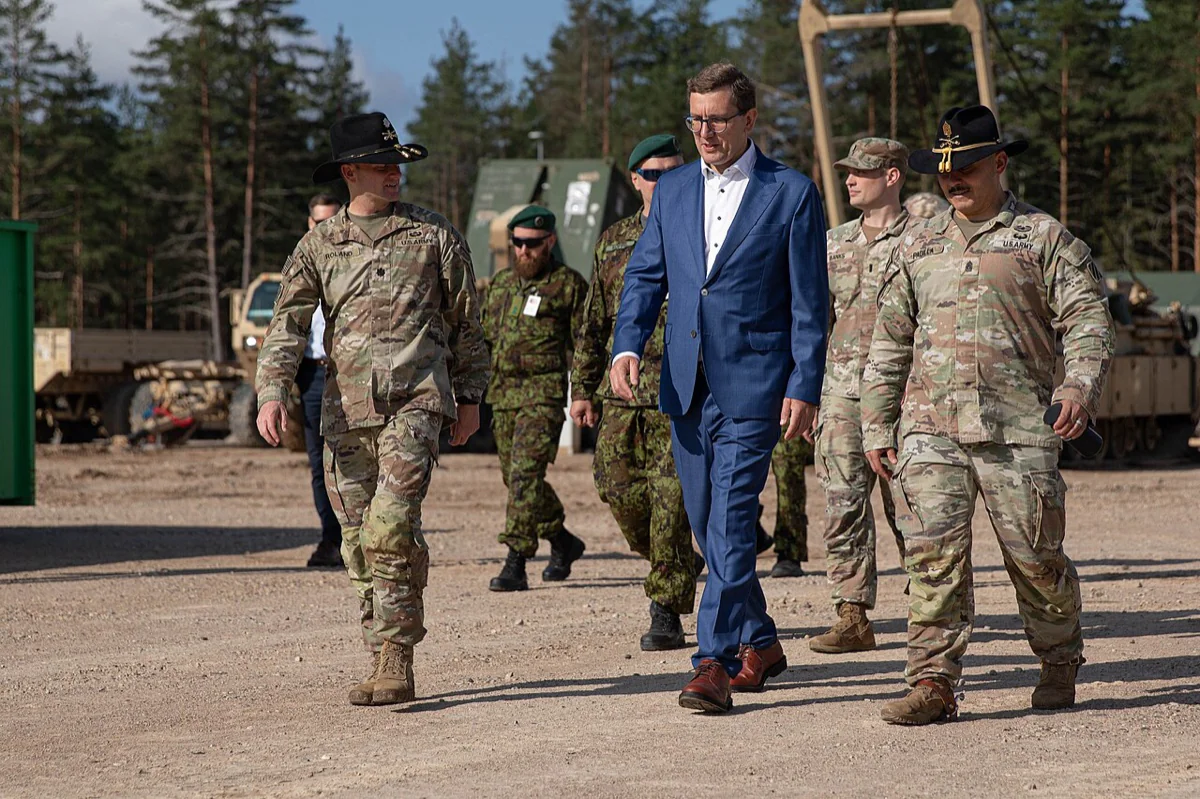
Estonian Prime Minister Kristen Michal visiting Camp Reedo in Estonia in August 2025. Photo: U.S. Army photo by Spc. Nathan Morse / Wikimedia Commons, Public domain.
A pattern of attacks on defence firms
This is the second suspected arson attack on an Estonian defence company this year. In the early hours of 15 August, a fire broke out at a building used by Milrem Robotics on Betooni Street in Tallinn. Milrem supplies unmanned ground vehicles, robotic land vehicles, to Ukraine. No one was injured.
Two Latvian citizens were arrested in Latvia on 17 August and a third the following day. All three were transferred to Estonia in September and remain in custody. On 29 September Michal said the Milrem fire was "an act of sabotage commissioned by the intelligence services of the Russian Federation." Estonia's foreign ministry said it would summon Russia's chargé d'affaires. The chargé d'affaires is the most senior diplomat at its embassy in Tallinn.
Palloson told ERR that the GRU recruits people living in the European Union who can travel freely within the Schengen area. That is the EU's passport-free travel zone. He said recruits often come from criminal circles or from people in difficult financial or social circumstances. KAPO has warned that Russia is increasingly targeting European defence manufacturers. Its aim, according to KAPO, is to disrupt production and deliveries to Ukraine.
Estonia has shut a crossing before at short notice. In October 2025 it temporarily closed the small Saatse crossing after border guards reported an unusual number of Russian military personnel nearby. A full and possibly indefinite closure of every road crossing would be a step of a different order.
Moscow's position
There was no immediate response from Russia to the accusation or the border decision on Sunday. Politico said it had asked the Russian foreign ministry for comment. Moscow routinely denies European accusations that it is behind sabotage operations.
When Estonia blamed Russian intelligence for the Milrem fire in September, Kremlin spokesman Dmitry Peskov rejected the claim. "Such statements are unfounded and ill-considered, bear no relation to reality and are entirely without justification," he said.
What comes next
The measure is a political and administrative response rather than a military one. It can also be reversed, which gives Tallinn room to adjust it later. Estonia has tied the closure directly to an alleged GRU operation. It is signalling that it will impose a cost for such attacks even when they fail. The closure also removes one route that, in the government's account, Russian intelligence uses to reach people inside the country.
The immediate questions are practical. Ministers must decide next week whether the closure has an end date, and whether it extends to rail. Tsahkna has said he will press for tougher sanctions at a meeting of EU foreign ministers in Brussels on Monday, according to Estonian World. The wider test is whether Latvia and Lithuania take similar steps. Tallinn briefed both before the announcement.
Featured image: Fortresses by Narva river, Estonia and Russia by KalervoK, via Wikimedia Commons, CC0.


