

Iran's Islamic Revolutionary Guard Corps (IRGC) says it launched six drones at a US air defence radar at a military base in Bahrain. The attack came early on Sunday 15 November. It was Iran's second attack on the Gulf kingdom in three days. Bahrain's armed forces said their air defences intercepted several Iranian aerial attacks before they reached their targets. Neither side's account could be independently verified. The US military had not commented on Sunday's claim by late morning UK time.
The attack matters because Bahrain hosts the US Navy's Fifth Fleet. It comes as Washington weighs whether to return to major combat. President Donald Trump has said in recent days that he may hold off on attacking Iran if there are no new provocations from Tehran or the Iran-backed Houthis in Yemen. He would also keep a US naval blockade in place, Reuters reported on Saturday, as Hemera has reported. An Iranian claim to have attacked a US facility puts that condition directly to the test.
What each side says
The IRGC said the target was a US radar at the Riffa base. The base is about 30 minutes' drive south of the capital, Manama. Reports have described the site both as Riffa Air Base and as the Al-Rifaa helicopter base. According to the IRGC-affiliated Fars news agency, the Guards called the strike retaliation for "hostile US actions". Their statement, carried by Iranian media, also said the Strait of Hormuz was closed. It warned that "any aggression by the American enemy will be met with an even harsher and more forceful response".
According to Al Jazeera, Bahrain's Interior Ministry issued two alerts within about three hours. The first came at about 4.30am local time (01:30 GMT). It told "residents to remain calm, proceed to the nearest safe location, and follow news through official channels". Residents told AFP they heard blasts at about 4am and again at about 6.30am. These were the first public shelter warnings in Bahrain since September.
The Bahrain Defence Force said its systems had thwarted several Iranian attacks. Bahraini officials accused Tehran of a "systematic hostile approach" towards the kingdom. The foreign ministry said Bahrain "rejects turning its territory into an arena for settling scores" and held Iran fully responsible.
Mohammed Abdallah, a shopkeeper in Manama, told AFP: "I was hoping this period was behind us and wouldn’t happen again."
Two attacks in three days
On Friday 13 November, the IRGC claimed to have destroyed a US early-warning radar in Bahrain. Radars of this kind give advance notice of incoming aircraft, drones and missiles. The Guards said that strike answered what they described as an air attack on a telecommunications tower in southern Iran. US Central Command (CENTCOM) oversees American military operations in the Middle East. It rejected the claim. It said it had shot down two IRGC drones, with no injuries or damage.
Friday's attack was the first Iranian claim against US military assets in a Gulf state since early September, Reuters reported. In the first week of that month, Iran struck US targets in Bahrain, the United Arab Emirates and Kuwait. In recent weeks US forces have carried out a series of strikes on Iranian sites. These include Qeshm Island in the Strait of Hormuz, where the IRGC has a large presence. Trump has called them minor strikes.
The war began on 28 February, when US and Israeli strikes on Iran killed the Supreme Leader, Ayatollah Ali Khamenei. Since then, thousands of Iranian drone and missile strikes have hit Bahrain and other Gulf states, according to AFP. A Pentagon inspector general's report released in September found that Iranian attacks had damaged or destroyed buildings at US installations in eight countries, including Bahrain. This covered the war's first four months.
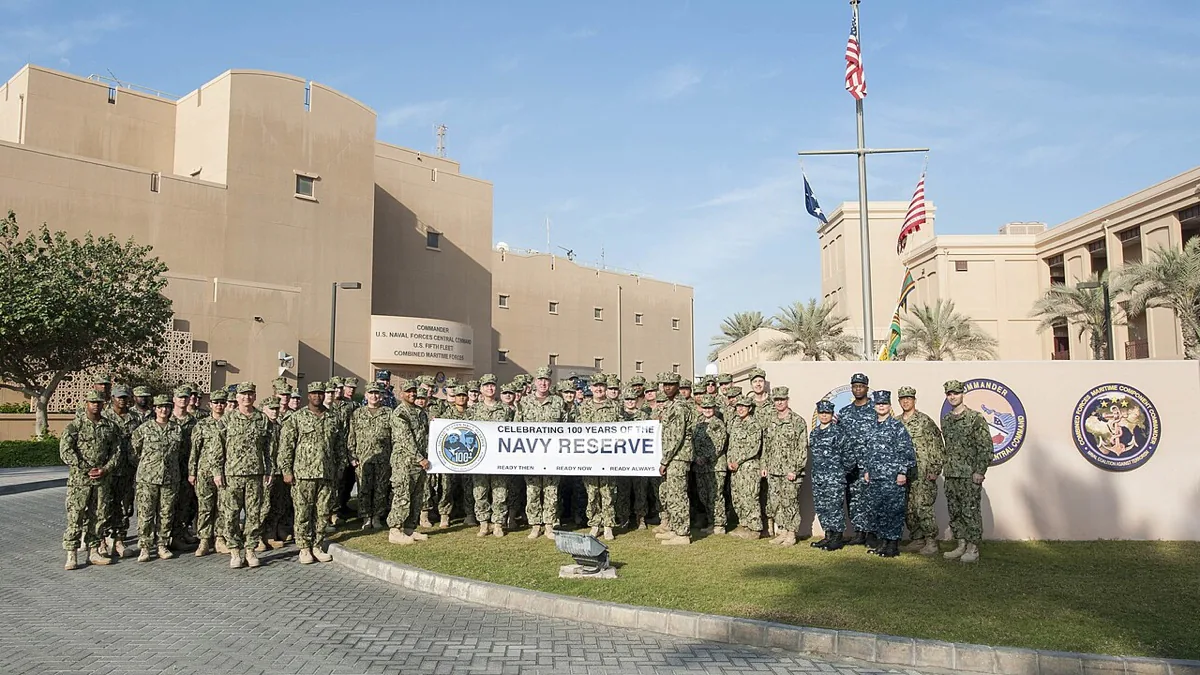
US Navy personnel at Naval Support Activity Bahrain, home of the US Fifth Fleet, in a file photo from February 2015. Photo: Petty Officer 2nd Class Charles Oki / Wikimedia Commons, Public domain.
How much firepower Iran has left
The attacks coincide with a new US intelligence estimate of Iran's arsenal. US officials told The Wall Street Journal that Iran may still have between 1,500 and 2,500 ballistic missiles. This is according to The Times of Israel's account of the report. Officials described the figure as a "low-confidence assessment", because Iran's munitions are hard to track. They were nonetheless clear that a large stockpile remains. Its size has reportedly figured in the administration's debate over whether to strike again.
Other estimates point the same way. Israeli officials reportedly believe Iran has more than 1,500 ballistic missiles. An unnamed Western official told Bloomberg that Iran likely has at least 1,700. The official said Iran is producing up to 50 more each month. Last week Iran unveiled an underground "missile city".
None of these figures can be independently checked. Even so, they suggest Iran keeps the means to sustain pressure for some time. Sunday's strike was small by comparison. By the IRGC's own account, it was six drones aimed at a radar rather than at personnel. That points to calibrated, signal-sending attacks. It does not point to a return to the mass salvoes seen earlier in the war.
Saeid Golkar, an associate professor of political science at the University of Tennessee at Chattanooga, told Al Jazeera that limited exchanges of this kind carry their own risk. "Both sides may prefer to avoid a full-scale war, but the danger lies in miscalculation," he said.
Diplomacy stalled, sea lanes under strain
Tehran insists that a deal remains possible. Mohammad Bagher Ghalibaf, Iran's parliamentary speaker and chief negotiator, said on Sunday: "If Washington accepts our seven logical conditions, the path to an agreement will be open," Rudaw reported. He has said the conditions were passed on through a Qatari mediator. They include lifting the US naval blockade and sanctions, releasing frozen Iranian funds, ending hostilities on all fronts and formally declaring the war over. Iran says it is awaiting an official US reply. The Trump administration has instead tightened sanctions and maintained the blockade of Iranian ports.
Pressure on shipping, meanwhile, is mounting. The IRGC navy said two oil tankers struck sea mines in the Strait of Hormuz on Saturday. It said they had taken what it called an unauthorised route. At least 10 vessels were hit in the first ten days of November, following 37 attacks in October, according to data from the Washington Institute for Near East Policy. October's total was the highest of any month since the war began.
In the Red Sea, Saudi-backed Yemeni government forces have retreated from the Bab el-Mandeb area, according to The Guardian. That gives the Houthis greater control over a strait. Gulf producers had been relying on it to get oil out. The Saudi-led coalition said on Sunday it had intercepted two Houthi ballistic missiles fired towards Riyadh and three drones over the kingdom's Eastern Province.
What comes next
Trump's reported position ties restraint to the absence of new provocations. Within three days, Iran has claimed two attacks on US radars in Bahrain. The Houthis have fired missiles towards Riyadh. How CENTCOM describes Sunday's attack, and whether the White House treats it as a provocation, is the immediate question.
A US official told AFP that Trump plans to discuss the conflict at a trilateral meeting with his Chinese and Russian counterparts this week. Bahrain has called for full implementation of UN Security Council Resolution 2817. The resolution condemned Iranian attacks on the kingdom and its neighbours. The open question is whether Washington answers with the major strikes Trump has so far held back. The alternative is to absorb the attacks and keep Ghalibaf's offer of a path to a deal alive.
Featured image: Manama Manama Skyline 04 by Zairon, via Wikimedia Commons, CC BY-SA 4.0.


