

Timeline
President Donald Trump has told senior advisers he may hold off on further attacks on Iran. The condition is that neither Tehran nor the Iran-backed Houthi movement in Yemen carries out new provocations against the United States. That is according to three people familiar with the matter, cited by Reuters on 14 November. They said he made the remarks in meetings with his national security team and after a series of intelligence briefings. Current and former officials said he has not yet decided how to end the war.
If he holds to it, the shift would leave Washington relying on economic pressure rather than air power. The United States and Israel launched the war in late February. It has driven up global fuel prices. It is unpopular with American voters, who handed control of Congress to the Democrats in the 3 November midterm elections. Trump made no firm commitment. The White House stressed that the decision is his alone.
What the president has said
The private remarks follow a week of public signals pointing the same way. On 9 November, after meeting Qatar's prime minister, Sheikh Mohammed bin Abdulrahman bin Jassim Al Thani, Trump told reporters: "Iran militarily is effectively over." He added: "We're just keeping it the status quo." He also said US forces were "locked and loaded" if fighting had to resume.
On Thursday, 12 November, he wrote on Truth Social: "We don't need a deal with Iran." In the same post he removed Vice-President JD Vance as lead negotiator with Tehran. He told Vance to focus on crime and corruption in Democratic-run cities and states. The same day, he told the sports broadcaster Stephen A. Smith: "I could end it immediately, but at the request of the nations that I am looking to protect, we are doing it a little bit longer way, a bit more civilly."
Asked about the latest report, a White House official said in a statement: "Only President Trump knows what he will do, and when." The CIA and the Office of the Director of National Intelligence did not respond to Reuters' requests for comment.
Regional allies urge restraint
Saudi Crown Prince Mohammed bin Salman and Turkish President Recep Tayyip Erdogan both urged Trump not to resume attacks. They did so in phone calls over the past two weeks, according to a senior US official and another person familiar with the calls. Two further people said Trump told the crown prince on 31 October that he planned to attack after the elections. The crown prince, they said, asked him to wait, arguing that sanctions were working. Saudi Arabia's Foreign Ministry did not respond to a request for comment.
Turkey's presidency has said the two leaders have spoken three times since 28 October. Its readout of a 7 November call stressed that US-Iran tensions must end.
Israel is pushing the other way. Israeli officials have continued to lobby for a new military campaign, according to a US official quoted by Reuters. The Times of Israel, citing a second official, reported that Prime Minister Benjamin Netanyahu has been calling Trump almost daily to urge a return to war.
Blockade over bombs
US intelligence agencies have assessed that the naval blockade of Iranian sea traffic and economic sanctions are damaging Iran's economy, two US officials briefed on the intelligence told Reuters. The same officials said analysts judged that renewed strikes would not significantly change Iran's demands in negotiations. The US military is also trying to stop weapons and other sanctioned goods reaching Iran by land and across the Caspian Sea.
Military options remain open. A third aircraft carrier is due in the region in the coming days to replace one of the two already deployed, according to three people familiar with US planning. They said all three could stay if needed. One person said Trump could choose to bomb Iran's underground nuclear sites again. These sites have already been hit, and it is unclear whether further strikes would achieve much.
Munitions are a constraint. Trump was briefed that some US weapons stockpiles have fallen to worrying levels, according to two people familiar with the briefings. Reuters reported in August that the US had used "virtually all" of its long-range precision munitions. The White House rejected that picture: "The United States Military has enough munitions and ammo to serve all of the Commander-in-Chief’s strategic goals and beyond," the official said.
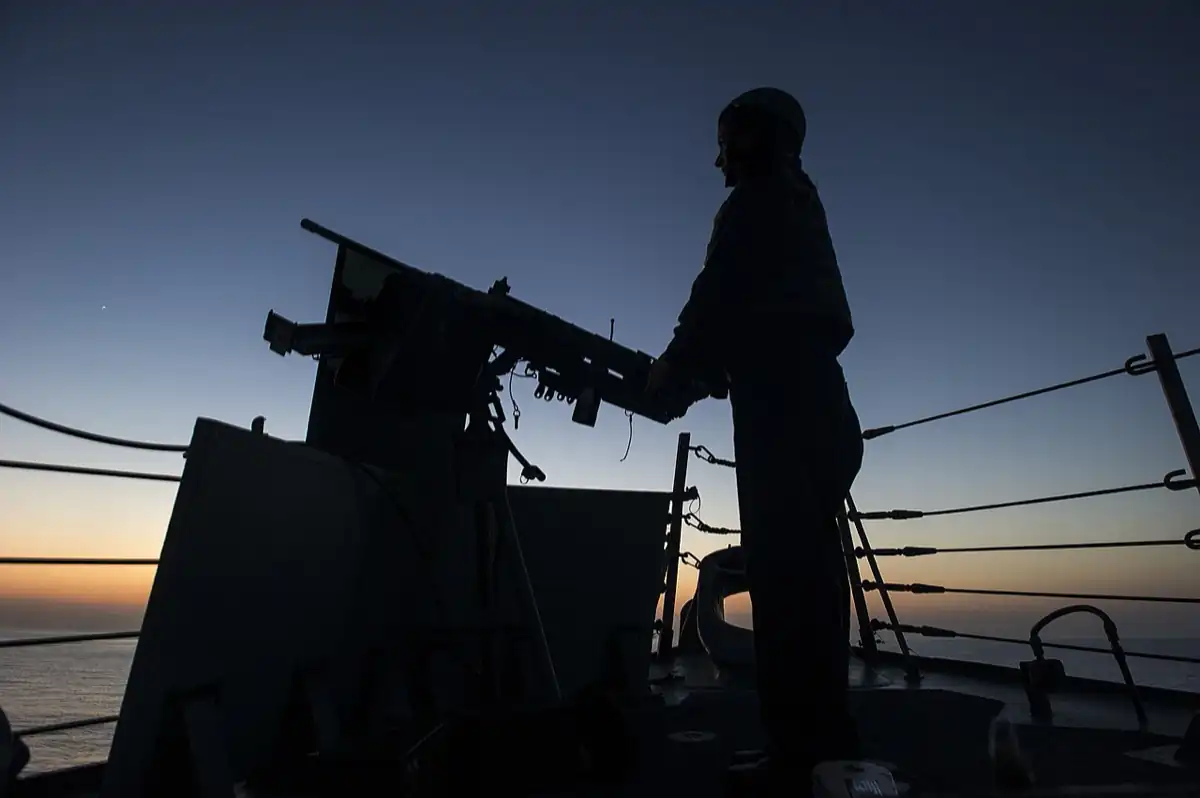
A US Navy sailor mans a .50-calibre machine gun aboard the destroyer USS Truxtun as it transits the Strait of Hormuz, in a June 2014 file photo. Photo: U.S. Department of Defense Current Photos / Wikimedia Commons, Public domain.
Iran's terms and the fight for Hormuz
Tehran has publicly rejected the idea that talks are close. On 9 November, Mohsen Rezaei, secretary of Iran's Supreme National Security Council, told Washington on X to "Stop manufacturing fake news about imaginary talks." According to the Associated Press, Iran's conditions for nuclear talks include ending the blockade, lifting sanctions, releasing frozen assets, paying war compensation and halting regional hostilities. These include Israeli operations in Lebanon.
Hostilities have not stopped. On 14 November, Iran's navy and the Islamic Revolutionary Guard Corps (IRGC) said three oil tankers had struck mines in and east of the Strait of Hormuz. They said the ships had switched off their tracking systems and used unauthorised routes. The vessels were not named. The claims could not be independently verified. The US military says it has cleared the main shipping lanes of mines. Earlier in the week, the IRGC said it had destroyed a US early-warning radar in Bahrain. It said this was in retaliation for a US strike on a telecommunications tower in southern Iran.
The Washington Institute for Near East Policy counted at least ten vessels hit in the first ten days of November, after 37 attacks in October. Hemera reported on 14 November that the UN says 25 seafarers have been killed around Hormuz since the war began.
That pattern points to the central ambiguity in Trump's reported position. It is not clear which of these incidents he would treat as a provocation. In a Reuters column on 11 November, Ron Bousso described the moratorium on major strikes as possibly "a tactical pause" rather than a sign the conflict is ending. He noted that freight and insurance costs for Gulf shipping remain about ten times pre-war levels. An analysis published by Chatham House on 9 November argued that Iran itself might restart the war in an attempt to break the blockade.
Political pressure and the next decision
Domestic politics are pulling in one direction. In a Reuters/Ipsos poll taken shortly before the midterms, 55 per cent of Americans said the war was not worth the cost. A later Reuters/Ipsos poll found 71 per cent of Americans, including 51 per cent of Republicans, would back legislation to end the conflict. The day after the election, Vance wrote: "The reason we lost is the war."
The new Democratic majorities take their seats in January. That will give opponents of the war more power to force votes on it. Before then, the test is whether Iran's mine campaign in Hormuz, or Houthi attacks on Saudi Arabia, cross the line Trump has reportedly drawn. A larger carrier presence in the coming days will keep the option of escalation open while he decides.
Related coverage: US Democrats Arrive at COP31 as Trump Administration Stays Away · Iran Claims Drone Strike on US Radar in Bahrain, Second in Three Days
Featured image: Ahmed al-Sharaa with U.S. President Donald Trump at the White House, November 2025 by Donald Trump, via Wikimedia Commons, Public domain.


