

A delegation of Democratic members of the US House of Representatives arrived at the COP31 UN climate summit in Antalya, Turkey, on Saturday 14 November. They came 11 days after their party won control of both chambers of Congress. President Donald Trump's administration has sent no one. This is the second year running that Washington has stayed away.
The lawmakers told an overflowing panel event that the United States would work to restore its standing with allies. The summit they joined is at its midway point. It is wrestling with a harder question: how to respond to the UN's finding in September that global warming will pass 1.5C above pre-industrial levels.
A delegation with a message but no mandate
AFP counted 18 Democratic lawmakers in the group. The Sustainable Energy and Environment Coalition (SEEC) Institute organised the trip. According to the Daily Caller, the institute's media advisory listed 19 House members travelling from 14 to 16 November.
Kathy Castor, a congresswoman from Florida, said US partners had lost confidence in Washington. "Many of our allies and partners across the world think the United States has not been predictable or dependable," she told AFP. "So we have a lot of trust to earn back."
Raul Ruiz of California pointed to climate policy in US states and cities. "Despite the setbacks that we're experiencing through this Trump administration, climate action is alive in America," he said. Yassamin Ansari of Arizona was more direct: "It is absolutely shameful that the Trump administration operates this way." She described an administration that is "beholden to big oil in the United States".
The lawmakers have no role in the negotiations themselves. Trump returned to office in January 2025. Since then, his administration has rolled back clean energy policies, promoted oil drilling and withdrawn the US from the Paris Agreement.
The trip itself has drawn criticism. The Guardian reported on 9 November that the lawmakers had been refused the State Department travel support members of Congress normally receive. They were relying on philanthropic funding. Sean Casten of Illinois, a vice-chair of the House SEEC caucus, told the paper: "I'm glad we found a way to get there, but it is insane." Craig Rucker, president of the conservative Committee for a Constructive Tomorrow, dismissed the visit as political theatre.
The House members follow a larger non-federal presence. A coalition led by America Is All In, the US Climate Alliance and Climate Mayors said it was bringing more than 120 state, local and other leaders. These include New Mexico's governor, Michelle Lujan Grisham. "America Is All In is showing up in force at COP31 to let the world know that millions of Americans are still in," said its chair, Gina McCarthy. Former vice-president Al Gore and former climate envoy John Kerry also visited earlier in the week.
What the midterms can and cannot change
In the 3 November elections, Democrats flipped seven Republican-held Senate seats, according to an NPR analysis of Associated Press race calls. AFP reported that the Republican defeat came largely because of anger over soaring energy prices and the costly war with Iran. NPR named the cost of living and perceived corruption as the main campaign issues.
Democrats say they will use their majorities to investigate the administration's climate policies. They also plan to propose clean energy legislation. Trump has two years left in office. He has promised to use his veto. Ansari argued the White House "will be very hard pressed to veto legislation that will bring down costs for the American people".
The new Congress takes its seats in January. In practice, whether the US takes part in UN talks is still a decision for the executive. That suggests the midterm result changes the tone in Antalya more than the US negotiating position.
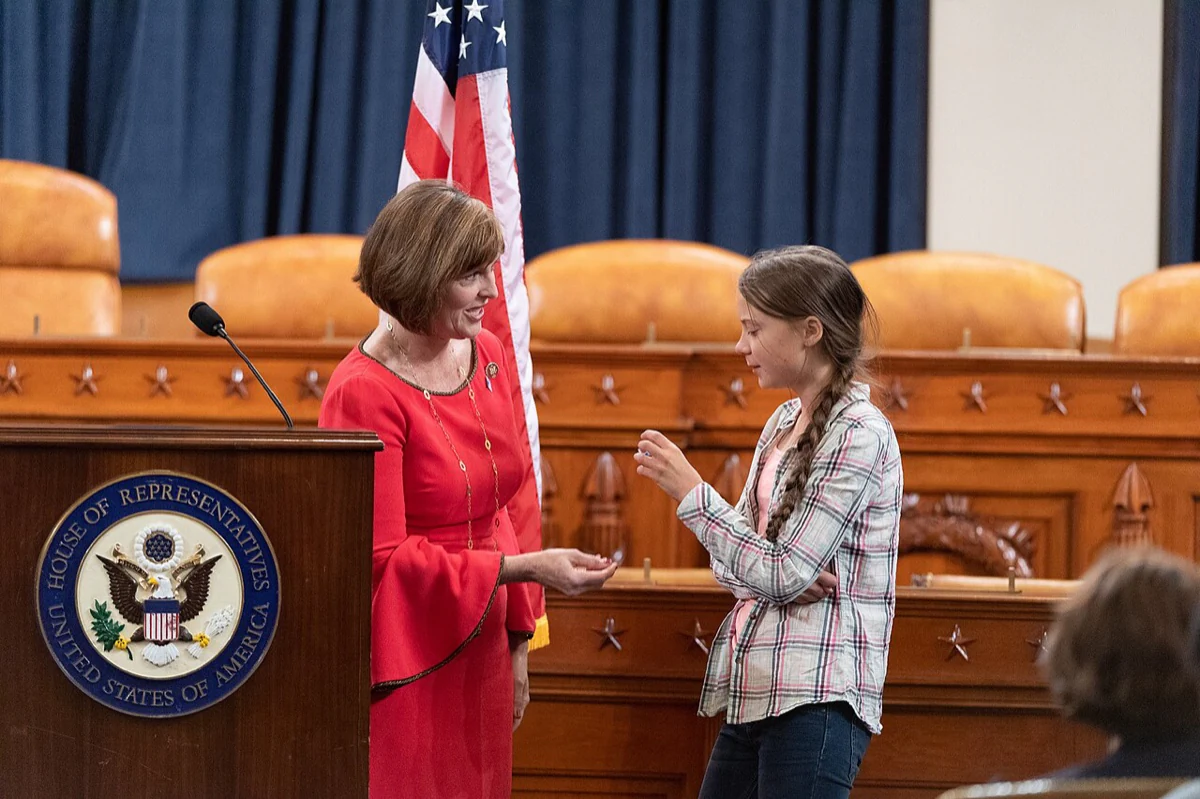
US Representative Kathy Castor talks with climate activist Greta Thunberg in the US Congress in September 2019. Photo: Representative Kathy Castor / Wikimedia Commons, Public domain.
The 1.5C goal under strain
The world has warmed by about 1.4C above pre-industrial levels. On 2 September, the UN Environment Programme (UNEP) published a report on "overshoot". This means a period in which temperatures go above 1.5C before being brought back down. It found the threshold is likely to be crossed within a few years. Even in its most optimistic scenario, warming peaks at 1.8C. "There are no good outcomes if we remain above 1.5°C," said Inger Andersen, UNEP's executive director.
Australia chairs the negotiations while Turkey hosts. It has published a summary of national positions. This shows that some countries want the final deal to affirm that 1.5C remains the "right goal". Palau's president, Surangel Whipps Jr, told leaders: "It is an existential threat to our food, our economies and sovereignty."
Several observers told AFP that the Arab Group and the Like-Minded Developing Countries see a chance to drop the target. These two blocs include Saudi Arabia and India. Jasper Inventor heads Greenpeace's delegation. He said some developing nations fear that stronger wording on 1.5C would mean more pressure to cut emissions without more finance.
António Guterres, the outgoing UN secretary-general, said any overshoot must be "as small as possible for as short a time as possible". Pierre Friedlingstein of the University of Exeter is lead author of the Global Carbon Budget. He said bringing temperatures back down would require removing carbon dioxide from the atmosphere on a vast scale over decades. "It is not something I would call utopian but it is certainly extremely ambitious," he said.
Fossil-fuel coalition loses its founder
Separately, a coalition of countries working to move away from coal, oil and gas is pressing on without Colombia. The group was launched in the Colombian city of Santa Marta in April, with representatives from 57 countries. Colombia pulled out after Abelardo de la Espriella became president in August. He promised to revive oil and gas exploration. His environment minister, Fabio Arjona, has argued that more domestic gas would cut emissions by displacing dirtier fuels.
Ireland and Tuvalu are taking over leadership of the coalition from Colombia and the Netherlands. "This process is bigger than any one country," Ireland's climate department said. Irene Vélez, Colombia's former environment minister, said: "Santa Marta has a life of its own, beyond the change of government in Colombia."
The coalition is expected to publish a progress report this week.
What happens next
COP31 is scheduled to close on 20 November. By then, negotiators must decide how the final text describes the 1.5C goal. They must also decide whether to set up a process to take the fossil fuel road map forward. The Santa Marta coalition will formally hand over to Ireland and Tuvalu during the summit. A second conference is planned for July 2027. In Washington, the new Democratic majorities take office in January. That is when the first test of their climate agenda against a presidential veto begins.
Related coverage: Iran Claims Drone Strike on US Radar in Bahrain, Second in Three Days
Featured image: Expo 2016 Antalya - West View by Hendric Stattmann, via Wikimedia Commons, CC BY-SA 4.0.


