

At least 25 seafarers have been killed in attacks on merchant shipping in the Strait of Hormuz and nearby waters since the US-Israeli war on Iran began in late February. A senior United Nations official gave the figure to the Security Council on Friday 13 November. Khaled Khiari is the UN assistant secretary-general for the Middle East, Asia and the Pacific. He said the International Maritime Organization (IMO) had confirmed 134 incidents up to 11 November. October, he said, was the worst month of the conflict for commercial vessels.
The briefing came as Iran's navy and its Islamic Revolutionary Guard Corps (IRGC) made fresh claims. On Saturday they said three more oil tankers had struck mines and caught fire in the strait. Those claims have not been independently verified. Hormuz is the narrow channel between Iran and Oman. In peacetime about a fifth of the world's oil supply passed through it. Its disruption has pushed up energy, freight and insurance costs worldwide. Khiari told the Council that the situation "cannot be allowed to become the new normal".
October was the worst month for shipping
Khiari briefed the Council by video link. Bahrain had requested the session under the Council's agenda item on the situation in the Gulf. According to Anadolu Agency, he said many more seafarers had been injured or were missing. Many ships and crews had been stranded in the Gulf for months, he added. He repeated a warning from the UN secretary-general, António Guterres: "Civilian vessels and commercial shipping must not become targets."
Reported versions of the IMO count differ slightly. Al Jazeera put it at 136 incidents between 1 March and 11 November. It said 35 came in October and 10 so far in November. Anadolu and other reports give 134. Independent tallies show the same trend. Data from the Washington Institute for Near East Policy, cited by Reuters, recorded 37 attacks in October. That was the highest monthly figure of the war. The same data showed at least 10 ships hit in the first ten days of November.
The human cost has been building for months. In July, the IMO's secretary-general, Arsenio Dominguez, told the agency's council that about 6,000 seafarers remained trapped in the region. An evacuation through alternative routes had been paused, he said, because the safety of ships and crews "could no longer be assured".
Competing accounts of the mine strikes
Since the war began, Iran has required vessels to get its permission before crossing the strait. It has attacked ships it accuses of breaking that rule. On Saturday, the IRGC navy said two tankers had exploded and caught fire in the south of the waterway, AFP reported. It said the ships had "switched off their radar and positioning systems" and were trying to pass "through an unauthorised route". One was a supertanker, it said. Iran's regular navy said a third tanker caught fire after hitting a mine while "navigating through the unsafe and prohibited zone east of the Strait of Hormuz".
None of the vessels was named, and no flag or owner was given. Accounts of the number also vary. One Iranian report carried by financial news outlets put Saturday's total at four tankers. On Friday, the IRGC said a liquefied gas carrier had struck a mine on an "unauthorized and dangerous route", Reuters reported.
Washington tells a different story. The US military says it has cleared the strait's main routes of mines. It says the waterway is open to commercial shipping. In October, US Central Command (CENTCOM), which directs American forces in the Middle East, said an IRGC projectile had hit the container ship GFS Pride, not a mine as Iran claimed. The vessel sank while under tow. "Let me be clear: The Strait of Hormuz is controlled by the United States and our regional partners, not Iran," said Brad Cooper, the CENTCOM commander, at the time.
The distinction is more than technical. Blaming mines on routes it has declared off-limits lets Tehran present damage as the result of ships ignoring its warnings. The US account points instead to deliberate attacks on civilian vessels.
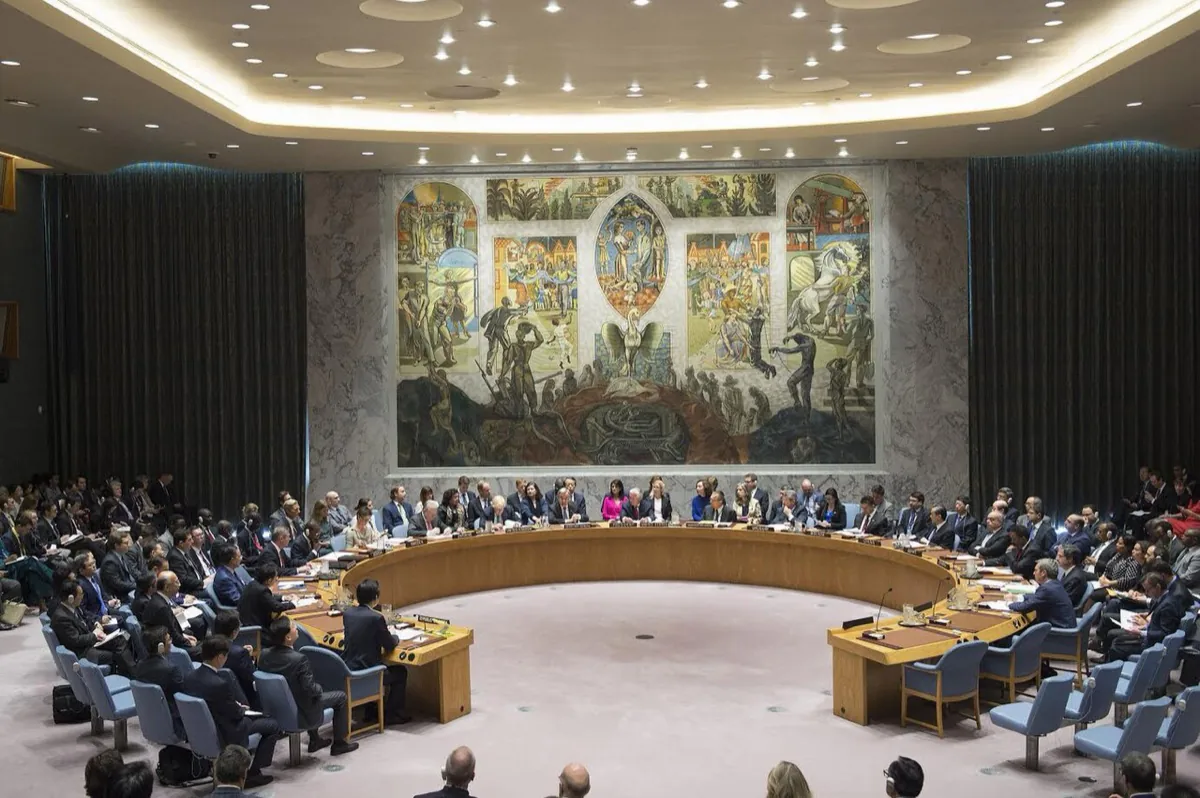
The UN Security Council meeting on North Korea in New York in April 2017, shown as a file photo. Photo: Cancillería Argentina / Wikimedia Commons, CC BY 2.0.
A costly and unpredictable route
Khiari described the current maritime arrangements in the region as "costly, unpredictable, and unsafe". Much of the region's energy exports had resumed through alternative routes, he said. But shipping volumes remain below pre-war levels. The disruption is raising energy, transport and insurance costs and feeding inflation. It also threatens food security, he said, because fertiliser shipments are severely constrained. "The longer these restrictions persist, the greater the economic costs," he said. He added that chokepoints must never be used as tools of coercion.
The UK Maritime Trade Operations centre (UKMTO) is a Royal Navy-run reporting service for merchant ships. In its latest weekly report it counted 170 outbound and 155 inbound transits. According to Gulf News, that is about 65 per cent below pre-conflict levels. Many ships switch off their transponders, so the real figure is probably higher. Oil volumes have recovered faster than ship numbers. Kpler, a commodities data firm, put Hormuz flows at 11.6 million barrels a day in the week to 13 October. That was about 68 per cent of the pre-war level. Hemera examined the wider economic fallout in April.
Diplomacy stalls and the Council divides
At the same session, Jasem Mohamed Albudaiwi, secretary-general of the Gulf Cooperation Council (GCC), said he spoke with a unified Gulf voice. "The GCC states reject any infringement upon their security, sovereignty, and territorial integrity," he said. He urged the Council to act against Iranian attacks on member states. He also called for action against attacks by Yemen's Houthi movement, and for protection of vessels, crews and energy facilities. The Council has struggled to act before. On 7 April, Russia and China vetoed a Gulf-drafted resolution. It would have encouraged states to coordinate defensive measures, including naval escorts.
Iranian officials say the strait will not reopen until Washington meets their demands. These include ending the US naval blockade of Iranian ports, lifting sanctions, releasing frozen Iranian funds, ending fighting on all fronts and formally declaring the war over. On 11 November, Mohsen Rezaei, an Iranian security official, called reports of continuing talks in Qatar "a pure lie". Abbas Araghchi, Iran's foreign minister, has said the strait could reopen within two days if the demands are met.
On the US side, President Donald Trump met Qatar's prime minister, Sheikh Mohammed bin Abdulrahman Al Thani, at the White House on 9 November. Afterwards Trump said he would hold off on fresh strikes for now. He said he would keep the blockade in place. Marco Rubio, the secretary of state, said: "The economic campaign is so devastating that right now there is no need for major combat operations." On 13 November, CENTCOM rejected an IRGC claim to have struck a US radar installation near Bahrain. It said American forces had intercepted two Iranian drones without casualties or damage.
Khiari said there had been no major US-Iranian military exchanges since early September. But he voiced concern about rhetoric pointing to renewed confrontation. He welcomed renewed diplomacy in Doha. "We urge the parties to seize the current opportunities and negotiate in good faith," he said. He warned that another escalation would have "devastating implications" for Iran, the region and the wider world.
The open question
No date has been set for further talks or for a Council vote. The next test is whether Washington gives Iran the "explicit and clear response" to its conditions that Rezaei says Tehran is waiting for. Another is whether Qatar's mediation can close the gap. Until then, shipowners must choose between Iran's permit system and routes the US says are safe. Their crews carry the risk either way.
Related coverage: US Floated Donbas-for-NATO Trade, Zelensky Says After Abu Dhabi Talks · Abu Dhabi Talks Show Where Russia's Leverage Over Ukraine Really Lies
Featured image: United Nations Headquarters - Security Council chamber, angled view (cropped) by Jdforrester, via Wikimedia Commons, CC BY 4.0.


