

Anthropic's shares are still above their offer price, but only just. After two sessions on Nasdaq, ANT closed on Friday 20 November 2026 at $88.91. That is 7.1 per cent above the $83 at which the company sold stock to investors. The shares had opened on 19 November at $111.50, 34 per cent above the offer, and closed that day at $97.17. On 20 November they fell as low as $83.05, five cents above the issue price.
Compared with the landmark listings, that is a weak start but not a failure. Facebook fell below its offer price on its second day in 2012 and stayed there for more than a year. Alibaba in 2014, Saudi Aramco in 2019 and SpaceX in June 2026 were all well above their offer prices a week after listing. SpaceX ended its first week 37 per cent up. On 20 November 2026 it closed at $127.79, below its own $135 offer price.
Hemera's report of 19 November found that Anthropic's $81.3bn base raise was the largest on record. It also found that Anthropic would beat SpaceX on total proceeds only if its banks bought their extra shares. Both open questions now have answers. The banks took the full 147m-share option, lifting the offering to about $93.5bn. And most of the first-day gain has gone, in a week when the Nasdaq Composite lost 5.28 per cent in one session.
From a 34 per cent pop to five cents above the offer
The first trade on 19 November was at $111.50. The stock reached $115.10 during the session, then closed at $97.17, a gain of 17 per cent.
The second session was harder. The shares were down 4.7 per cent in after-hours trading, according to The Guardian. They fell as low as $83.05 and closed 8.5 per cent lower at $88.91. Volume was about 400.7m shares, according to StockAnalysis data cited by FinanceFeeds. Reuters, as reported by Enterprise, put Anthropic's market value at about $1.2tn on shares outstanding and about $1.6tn fully diluted.
Three figures sum up the two days:
- Investors who bought at the $83 offer price were 7.1 per cent up at the close on 20 November.
- Investors who bought at the $111.50 opening price were about 20 per cent down.
- Of the $14.17 a share gained on the first day, $8.26, or 58 per cent, had gone by the second close.
Some outlets, including 24/7 Wall St, reported the second-day close as $88.30. CNBC and MarketScreener reported a fall of 8.5 per cent to $88.91, matching the Nasdaq data cited by FinanceFeeds. Hemera uses $88.91.
How the start compares with the landmark listings
The table below follows each listing through its first two sessions. Percentages show the change against the offer price.
Listing | Offer price | Open | Day-one close | Day-two close |
|---|---|---|---|---|
Anthropic (Nasdaq, Nov 2026) | $83 | $111.50 (+34%) | $97.17 (+17%) | $88.91 (+7%) |
SpaceX (Nasdaq, Jun 2026) | $135 | $150 (+11%) | $160.95 (+19%) | $192.50 (+43%) |
Saudi Aramco (Tadawul, Dec 2019) | 32 riyals | 35.2 riyals (+10%) | 35.2 riyals (+10%) | 36.8 riyals (+15%) |
Alibaba (NYSE, Sep 2014) | $68 | $92.70 (+36%) | $93.89 (+38%) | $89.89 (+32%) |
Facebook (Nasdaq, May 2012) | $38 | $42.05 (+11%) | $38.23 (+0.6%) | $34.03 (−10%) |
Sources: Anthropic, CNBC, FinanceFeeds (StockAnalysis data), Kaohoon International, Al Jazeera, The Nation (Bloomberg), Fortune, IBTimes UK, ABC News, 24/7 Wall St.
Anthropic's opening premium was nearly as large as Alibaba's 36 per cent. SpaceX, Aramco and Facebook all opened 10 to 11 per cent above their offer prices. Anthropic's fade was also the steepest bar Facebook's. Alibaba fell 4.26 per cent on its second day, which IBTimes UK linked to remarks by China's finance minister. Anthropic fell 8.5 per cent. SpaceX rose 19.6 per cent on its second day, and Aramco gained about 4.6 per cent.
Facebook remains the cautionary case. Trading started almost an hour late, and the stock opened at $42.05. Its underwriters were reported to have bought shares to hold the price at $38. It closed its second day at $34.03. According to 24/7 Wall St, it did not close above $38 again until 2 August 2013.
The first week tells a fuller story. Anthropic has had only two sessions so far, so its row shows the latest close.
Listing (date) | Value at offer price | Value after first week | Price versus offer |
|---|---|---|---|
Anthropic (20 Nov 2026, two sessions) | about $1.5tn, fully diluted | about $1.6tn fully diluted; $1.2tn basic | +7% |
SpaceX (18 Jun 2026) | $1.77tn | $2.4tn | +37% |
Saudi Aramco (18 Dec 2019, intraday) | $1.7tn | about $1.97tn | +16% |
Alibaba (25 Sep 2014) | about $176bn | about $240bn | n/a |
Facebook (25 May 2012) | $104bn | n/a | −16% |
Sources: Hemera (values at pricing), Reuters via Enterprise, Bloomberg, Gulf News, FinanceAsia, Associated Press via Wikipedia.
SpaceX shows that a strong first week does not protect later buyers. Its first week ended 37 per cent above the offer, with a market value of $2.4tn, Bloomberg reported. It had reached a record close of $201.80 on 16 June. About a month after listing it fell below $135. Its close of $127.79 on 20 November was 5.3 per cent below the offer, FX Leaders reported. Facebook shows the opposite: a poor start did not decide long-run value. Meta now trades at more than 16 times its 2012 offer price, Yahoo Finance noted.
What has changed since Hemera's first report
The table sets the figures in the report of 19 November against the latest available.
Measure | 19 November report | Now |
|---|---|---|
Shares sold in the IPO | 980m | 1.127bn, including 147m option shares |
Gross IPO proceeds | $81.3bn | about $93.5bn |
Proceeds to Anthropic, before fees | about $79.4bn | about $91.6bn |
Including private placement | $107.3bn | about $119.5bn |
First-day move | trades from 19 Nov | +17%, close $97.17 |
Fully diluted value | about $1.5tn at pricing | about $1.6tn at 20 Nov close |
Net retail buying, day one | about $250m (Vanda estimate) | $60m (Vanda) |
Sources: Anthropic, Hemera, The Guardian, Reuters and Bloomberg via Enterprise.
The record now holds on every measure. Including the option, the public offering of about $93.5bn is above SpaceX's $85.7bn. The fully diluted value is still above its level at pricing. That is because the pricing valuation was struck at $83 and the shares have not fallen below it.
One figure in the first report has not held up. Vanda Research had estimated net retail buying of about $250m on day one, double SpaceX's. Its actual figure was $60m, about half SpaceX's $118m, Vanda's Viraj Patel told Bloomberg. Retail turnover was $772m, the highest for any IPO in Vanda's data back to 2012, and above SpaceX's $669m. The figures suggest that small investors traded heavily and many sold quickly.
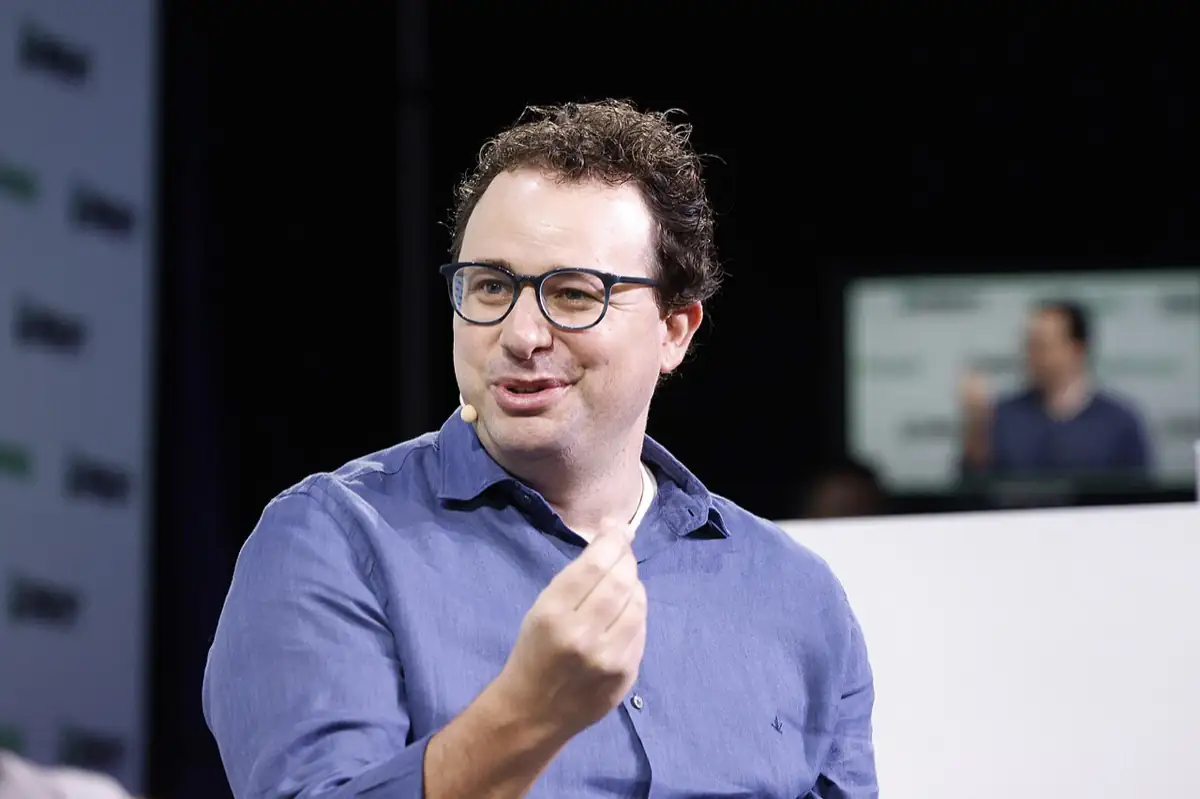
Dario Amodei, Anthropic's chief executive, speaking at TechCrunch Disrupt in September 2023. Photo: TechCrunch / Wikimedia Commons, CC BY 2.0.
The 147m-share option: a record confirmed, a cushion used up
In most large IPOs, banks sell up to 15 per cent more shares than the base deal. This leaves them "short": they owe shares they do not yet own. If the price falls below the offer, they buy those shares back in the market, which supports the price. If the price rises, they instead buy the extra shares from the company at the offer price, using an over-allotment option, also known as a greenshoe.
On 20 November Anthropic announced that the underwriters had exercised their option in full. The offering grew to 1,127,000,000 Class A shares at $83. Anthropic sold 1,103,351,354 of them and received about $91.6bn before fees. In a concurrent private placement it sold 313,253,007 non-voting Class N shares, also at $83, for about $26bn. The buyers were AMD, Broadcom, Google, Micron, Microsoft, Nvidia and TSMC Partners.
A full exercise means the banks closed their short position by buying from Anthropic, not in the market. That matters for the price. The main tool underwriters use to support a new stock below its offer price has now been used. Facebook's banks used that tool in 2012. Anthropic's will not have it if the shares fall below $83. An early full exercise is not unusual when a stock trades well above its offer: Alibaba's banks exercised theirs in full on 22 September 2014, the stock's second trading day.
The deal was cheap for Anthropic in fees and expensive in another way. Fortune reported a fee of about 0.676 per cent, roughly $550m, and no fees on the option shares. Jay Ritter, an IPO specialist at the University of Florida, estimated that about $20bn was "left on the table". This is the gap between the offer price and the first-day close, applied to every share sold. SpaceX's comparable figure was about $14.4bn. At the second-day close the gap was much smaller.
Why the shares fell
Anthropic did not comment on the trading. Analysts and reporters pointed to several causes:
- The wider sell-off. On 20 November the Nasdaq Composite fell 5.28 per cent to 22,617.73, leaving it down 2.7 per cent for the year. The S&P 500 fell 3.7 per cent to 6,910.39 and closed more than 10 per cent below its record, CNBC reported. That is the usual definition of a correction.
- Chip stocks. Nvidia fell about 14 per cent after Reuters reported that the Securities and Exchange Commission was exploring possible accounting issues at the company, according to CNBC.
- Rotation by retail investors. Vanda's Mr Patel told Bloomberg that retail investors sold across AI stocks, led by AMD, to fund purchases of Anthropic.
- Supply of stock. Employees and other holders could sell up to 10 per cent of their shares from the first day, about 315m shares, Enterprise reported. Mr Ritter told Fortune that so many shares with no lock-up period was unique.
Richard Saperstein, chief investment officer at Treasury Partners, told CNBC: "The stock market is going through an AI repricing, reflecting an environment of slowing data center buildouts".
What the slide says about the AI-bubble warnings
The first report set the IPO against warnings about AI valuations. In its Financial Stability Report of 13 November, the Federal Reserve said 87 per cent of market contacts named AI as a salient risk. On 16 November Fed governor Michael Barr put the potential off-balance-sheet AI obligations of seven large tech firms above $3tn.
The week since has been consistent with those warnings. The Wall Street Journal headlined its 20 November market report "Anthropic's IPO Bust Deepens $4 Trillion AI Wipeout on Wall Street". On 20 November Taiwan's market fell 6.7 per cent, taking its weekly loss past 16 per cent, The Guardian reported.
Two days of trading do not show whether AI stocks are overvalued. Anthropic's business has not changed since 18 November: run-rate revenue was about $81bn at the end of October. What has changed is the price. At about $1.2tn, the Motley Fool calculated, Anthropic trades at roughly 18 times annualised revenue. Analysts at banks outside the IPO syndicate are more positive. Reuters reported targets from $105 at New Street Research to $155 at Melius Research, an average of $134 across five firms.
What happens next
Several dates will test whether the shares hold $83:
- Bank research. Finra rules bar the deal's banks from publishing research for 10 days after the offering. Counting from 18 November, that ends around 30 November, FinanceFeeds calculated.
- The Fed. The Federal Open Market Committee meets on 8 and 9 December.
- Index entry. One Finimize estimate has the stock joining the Russell 1000 after the close on 11 December, if it is eligible; this is unconfirmed. Under Nasdaq's fast-entry rule, StockAnalysis projects inclusion in the Nasdaq-100 on 21 December. Nasdaq has not confirmed this.
- Lock-ups. Further tranches of insider shares are due to unlock in stages from mid-December, according to summaries of the prospectus.
Index funds will have to buy the stock when it joins the Nasdaq-100. SpaceX joined the index less than a month after its debut and still fell below its offer price. For investors, the question is no longer whether the IPO was a record. It is whether ANT can hold its offer price without help from its underwriters.
Related coverage: Anthropic's Nasdaq Debut: How UK Investors Can Apply and the Risks · Michael Grimes Returns to Morgan Stanley Amid IPO Speculation
Featured image: NASA Mars Perseverance on Nasdaq MarketSite (NHQ202102180118) by NASA Headquarters / NASA/Emma Howells, via Wikimedia Commons, Public domain.


