

Anthropic, the San Francisco company behind the Claude chatbot, priced its initial public offering (IPO) at $83 a share on 18 November 2026. That is $5 above the top of its $70 to $78 marketing range. The company and its seven co-founders sold 980 million shares for $81.3bn. By base size, that is the largest IPO on record, ahead of the $75bn SpaceX raised in June. Including employee options and restricted stock, the price values Anthropic at about $1.5tn.
The record depends on how it is counted. SpaceX's total rose to about $86bn once its banks bought extra shares. Anthropic only stays ahead on that measure if its own underwriters do the same. Bloomberg's headline figure of $107.3bn adds a separate $26bn share sale to seven technology partners. Older landmarks are far behind: Anthropic's base raise is more than three times the $25.6bn Saudi Aramco raised in 2019, the record until this year.
The deal is the first listing of a stand-alone developer of frontier AI models, the most advanced systems. It comes as the Federal Reserve and many analysts warn that enthusiasm for AI has stretched valuations. Shares begin trading on Nasdaq under the ticker ANT on 19 November. Many investors will treat their performance as a verdict on the wider AI boom.
What was sold, and for how much
Anthropic launched its roadshow, the marketing tour to fund managers. It offered 825 million shares at $70 to $78. Demand let it raise both the price and the size. In its pricing announcement, the company said it was selling 956,351,354 new shares, while selling stockholders offered another 23,648,646. The share count rose by about 19 per cent.
The structure determines where the money goes:
- New shares: about $79.4bn, paid to Anthropic before fees.
- Existing shares: about $1.96bn, paid to the sellers rather than to Anthropic. CNBC reported that each of the seven co-founders is selling 3.38 million shares.
- Over-allotment option: the underwriters, led by Goldman Sachs and Morgan Stanley, have 30 days to buy up to 147 million more shares, worth about $12.2bn at $83. If they exercise it in full, the public offering reaches $93.54bn, Anadolu Agency calculated.
- Private placement: AMD, Broadcom, Google, Micron, Microsoft, Nvidia and TSMC agreed to buy about $26bn of non-voting shares at the IPO price, outside the public offering.
Demand was strong. CNBC, as reported by CNA, put institutional orders at about $400bn and retail orders at about $100bn. Bloomberg reported that the deal was nearly seven times oversubscribed. Nikkei Asia said about $3bn came from investors in Japan.
How it compares with the landmark listings
The table below compares Anthropic with SpaceX and three earlier landmark listings: Facebook in 2012, Alibaba in 2014 and Saudi Aramco in 2019. Amounts are base deals at pricing, before any over-allotment.
Listing | Raised at pricing | Valuation at pricing | Price versus range | First-day move |
|---|---|---|---|---|
Anthropic (Nasdaq, 2026) | $81.3bn | about $1.5tn | $83, above $70–$78 | Trades from 19 Nov |
SpaceX (Nasdaq, 2026) | $75bn | $1.77tn | $135, fixed, no range | +19% |
Saudi Aramco (Tadawul, 2019) | $25.6bn | $1.7tn | 32 riyals, top of range | +10% (daily limit) |
Alibaba (NYSE, 2014) | $21.8bn | about $176bn | $68, top of raised range | +38% |
Facebook (Nasdaq, 2012) | $16bn | $104bn | $38, top of raised range | +0.6% |
Sources: Anthropic, Anadolu Agency, NPR, NBC News, Le Monde, Associated Press, Al Jazeera, Renaissance Capital, Fortune, CNN Money, ABC News.
Including over-allotments, the totals were $85.7bn for SpaceX, $29.4bn for Aramco after its option was exercised in January 2020, about $25bn for Alibaba and $18.4bn for Facebook. Three patterns stand out.
Scale. Each of the two 2026 deals is roughly three times the size of Aramco's. Anthropic's base raise is about five times Facebook's.
Small floats. Aramco sold 1.5 per cent of itself, rising to about 1.7 per cent after the over-allotment. Anthropic's base raise is about 5.4 per cent of its fully diluted value. These records reflect very large valuations, not unusually large stakes sold.
New money. At Facebook, existing holders sold 241.2 million of the 421.2 million shares offered. At Anthropic, existing holders sold about 2.4 per cent of the shares. Almost all of the money is new capital for the company.
Pricing has a more mixed record. Every deal in the table priced at or above the top of its range, apart from SpaceX's fixed price. Facebook raised its range from $28–$35 to $34–$38 in its final week. Alibaba raised its range to $66–$68. Their first days then went very differently. Alibaba closed 38 per cent up at $93.89. Facebook closed 23 cents above its offer price after trading started almost an hour late amid problems at Nasdaq.
Anthropic against SpaceX: a bigger raise at a lower valuation
The two 2026 deals are close enough that the comparison depends on which measure is used, as the table shows.
Measure | Anthropic | SpaceX |
|---|---|---|
Priced | 18 Nov 2026 | 11 Jun 2026 |
Shares in base offering | 980m | 555.6m |
Offer price | $83 | $135 |
Base raise | $81.3bn | $75bn |
Over-allotment option | 147m shares | 83.3m shares |
Raise with option exercised | $93.54bn, if exercised | $85.7bn |
Concurrent private placement | $26bn | none reported |
Valuation at pricing | about $1.5tn | $1.77tn |
Sources: Anthropic, Anadolu Agency, Bloomberg via Yahoo Finance, CNBC, NBC News, Wikipedia (citing Seoul Economic Daily).
Anthropic raised about 8 per cent more than SpaceX's base deal, at a valuation about 15 per cent lower. The mood was also different. Vanda Research's Jai Malhi told CNBC that positioning and sentiment were high when SpaceX listed in June. Anthropic, by contrast, arrives after a sharp tech sell-off. It followed the 3 November midterm elections, which gave Democrats control of both chambers of Congress. The Magnificent Seven, the largest US tech stocks, lost more than $1tn of value in a single day, DW reported. On 12 November Nvidia's chief executive, Jensen Huang, resigned abruptly.
Earlier estimates had put Anthropic's valuation as high as $2tn, according to AFP. These estimates fell as AI stocks slid. Retail demand may still exceed SpaceX's. Vanda estimates about $250m of net retail buying on the first day, double the SpaceX figure. "That would be far and away the largest amount of net retail buying of any stock that we've seen in our data on the first day of its listing," Mr Malhi said.
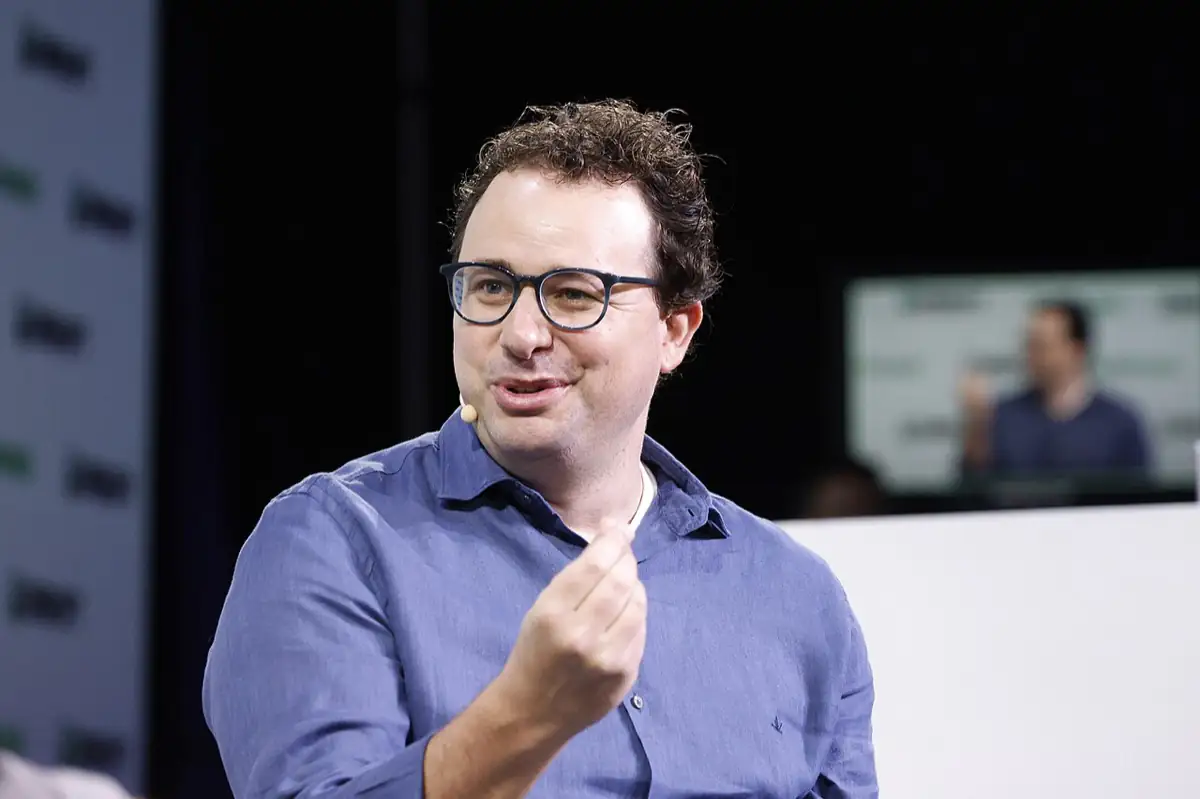
Dario Amodei speaking at TechCrunch Disrupt in September 2023. Photo: TechCrunch / Wikimedia Commons, CC BY 2.0.
What investors are buying
Anthropic's revenue has grown at a pace few large companies have matched. Its filing shows third-quarter revenue of about $17bn, compared with $1.4bn a year earlier. Revenue for the first nine months of 2026 was $33.2bn, roughly 13 times the same period of 2025. CNBC reported annualised run-rate revenue of about $81bn at the end of October. The valuation is therefore more than 18 times that run rate.
The losses are also large. Anthropic reported a $104bn net loss for the nine months. Of that, $94.3bn came from revaluing financing agreements, mainly convertible notes. These are loans that convert into shares, and their book value rose with the company's valuation. The filing also lists about $895.4bn of commitments for computing capacity and data centres, with roughly $70bn due within 12 months. Raising equity rather than more debt helps fund those commitments.
Shareholders also accept unusual governance. Anthropic is a public-benefit corporation, which means it must balance profit against a stated public purpose. A Long-Term Benefit Trust can elect or remove a majority of the board. The prospectus warns that its AI models could pose a "catastrophic or existential risk to humanity".
Analysts disagree about the price. Dennis Dick of Stock Trader Network told DW that the valuation rests on Goldman Sachs's forecast of more than $600bn in revenue by 2030. "If you get to a company with $600 billion in revenue, [a] $1.3 trillion [valuation] doesn’t sound that bad," he said. Jay Ritter, an IPO specialist at the University of Florida, told Al Jazeera that the valuation was unprecedented for such a young company. "Thirty years ago, the internet was the next big thing. It has changed our lives. Today, artificial intelligence is the next big thing," he said.
Who gains
The listing creates large paper gains, though lock-up periods prevent most holders from selling immediately.
- Founders. Fortune reported that each of the seven co-founders held between 231.8 million and 244.2 million shares at 30 September. At $83, each stake is worth about $19bn to $20bn. All seven have pledged to give 80 per cent of their Anthropic equity to charity. The S-1 says the pledges are not legally binding.
- Strategic backers. CNBC reported that Amazon's and Google's stakes are each worth more than $100bn at the offer price.
- Late private investors. The spring Series H round was priced at a split-adjusted $58.90 a share. The IPO price is about 41 per cent higher.
- UK savers. Baillie Gifford's Scottish Mortgage, Schiehallion and US Growth trusts have held Anthropic since 2025, City AM reported. Hemera explained on 14 November how UK investors could apply and what risks they face.
Pension and index-fund savers will gain exposure gradually. CNBC reported that index providers will add the stock on different timetables. Inclusion in the S&P 500 requires 12 months of trading and profitability, so it is at least a year away.
The bubble warnings
The Fed published its Financial Stability Report on 13 November. It said that "Broad equity valuation metrics continued to be elevated, partly driven by market enthusiasm for superintelligence". In its survey of market contacts, 87 per cent named AI as a salient risk, up from 50 per cent in the spring. The largest US banks have close to $1tn of exposure to tech firms, data-centre developers and related lenders, the report found.
On 16 November Fed governor Michael Barr said the "potential maximum nominal value" of off-balance-sheet AI obligations at seven large tech firms exceeds $3tn. He also said: "Given the still-limited amount of debt backing the current boom, I'm less concerned about direct losses." The Fed, now chaired by Kevin Warsh, raised rates in September, and markets widely expect another rise next month. Hemera covered Mr Warsh's hawkish start in June.
Market strategists are divided on whether the IPO changes much:
- Dan Ives of Yorkville Ives & Co said "Anthropic’s IPO is a big near-term win for the tech sector and should help restore some investor confidence that the AI Revolution growth thesis is not waning".
- Kyle Rodda of Capital.com was more cautious: "I don’t think [Anthropic’s IPO] necessarily going to assuage all the fears about AI".
Senator Elizabeth Warren said the company "fails to answer for the potential threats to Americans’ retirements and the entire financial system if this IPO goes awry".
What happens next
- 19 November: ANT begins trading on the Nasdaq Global Select Market. The first-day move will be compared with SpaceX's 19 per cent gain.
- 20 November: the offering is expected to close.
- By mid-December: the underwriters decide whether to exercise the 147 million-share option. Full exercise would lift the public offering above SpaceX's $85.7bn total.
- Late November to December: index inclusion begins. Morningstar indices could add the stock by the end of November and MSCI in early December. FTSE Russell will add it on 14 December, and the Nasdaq-100 after its review ends on 18 December.
- December: the Fed's next rate decision.
- 2027: OpenAI, Anthropic's main rival, is expected to pursue its own listing.
For investors, the strong pricing shows there is still demand for AI at scale despite recent market turmoil. Whether the stock holds its value will depend on Anthropic converting very fast revenue growth into profits, while meeting nearly $900bn of computing commitments.
Related coverage: Anthropic's Nasdaq Debut: How UK Investors Can Apply and the Risks · Warsh's Hawkish Debut: The Fed Holds Rates, but the Cut Bets Are Now Hike Bets
Featured image: NASDAQ Market Site 201506 by Luca Marfè at Italia all'ONU, via Wikimedia Commons, CC BY 2.0.


