

Taiwan's stock market suffered one of the heaviest falls in its history on Monday 16 November, and South Korea's dropped by more than 3 per cent, as a selloff in US chipmakers spread to Asia's technology exporters. Taiwan's benchmark Taiex closed down 2,635 points, or about 6 per cent, at 41,040, according to Investing.com. It said this was the index's second-largest points drop on record. Seoul's Kospi lost 3.59 per cent to 5,100.5, its third straight decline, Yonhap reported.
The falls came as China reported that its economy lost momentum in October. Industrial output, retail sales and fixed-asset investment all missed economists' forecasts. Metals that depend on Chinese demand fell too. Bloomberg reported that copper sank to its lowest in more than four months and that Chinese iron ore futures hit a four-year low.
Chipmakers bear the brunt
The selling centred on companies that supply the artificial intelligence (AI) boom. Taiwan Semiconductor Manufacturing Co (TSMC), which makes most of Nvidia's AI processors, fell 5.7 per cent, Investing.com reported. In Seoul, SK hynix, a leading maker of memory chips used in AI servers, slid 7.89 per cent to 1.12 million won. Samsung Electronics, South Korea's largest listed company, lost 4.47 per cent, according to Yonhap.
Foreign investors sold a net 1.38 trillion won of Korean shares. Local retail investors absorbed most of that, buying a net 1.34 trillion won, Yonhap said. Kang Jin-hyuk, an analyst at Shinhan Securities, told the agency: "The market came under pressure from persistent concerns over Nvidia, which weighed on semiconductor and other AI-related stocks, as investors awaited Nvidia's earnings report and Anthropic's planned listing later this week."
Japan's Nikkei 225 closed more than 2 per cent lower. Chip-testing equipment maker Advantest fell about 10 per cent in early trade and Tokyo Electron 5.2 per cent, Investing.com reported. Australia's S&P/ASX 200 fell 0.4 per cent to 9,045, with the miner BHP down 2.8 per cent, according to ABC News. Hong Kong bucked the trend: the Hang Seng rose about 0.8 per cent. The Shanghai Composite slipped by around half a per cent.
The pressure began in the US. Nvidia, whose chips power most AI data centres, has been unsettled by the departure of chief executive Jensen Huang last week. Chief financial officer Colette Kress has taken charge on an interim basis. Investing.com reported that Nvidia's market value had fallen from $5.8tn in early October to $3.9tn by Friday 13 November. The Nasdaq Composite fell 0.9 per cent that day, the Associated Press reported.
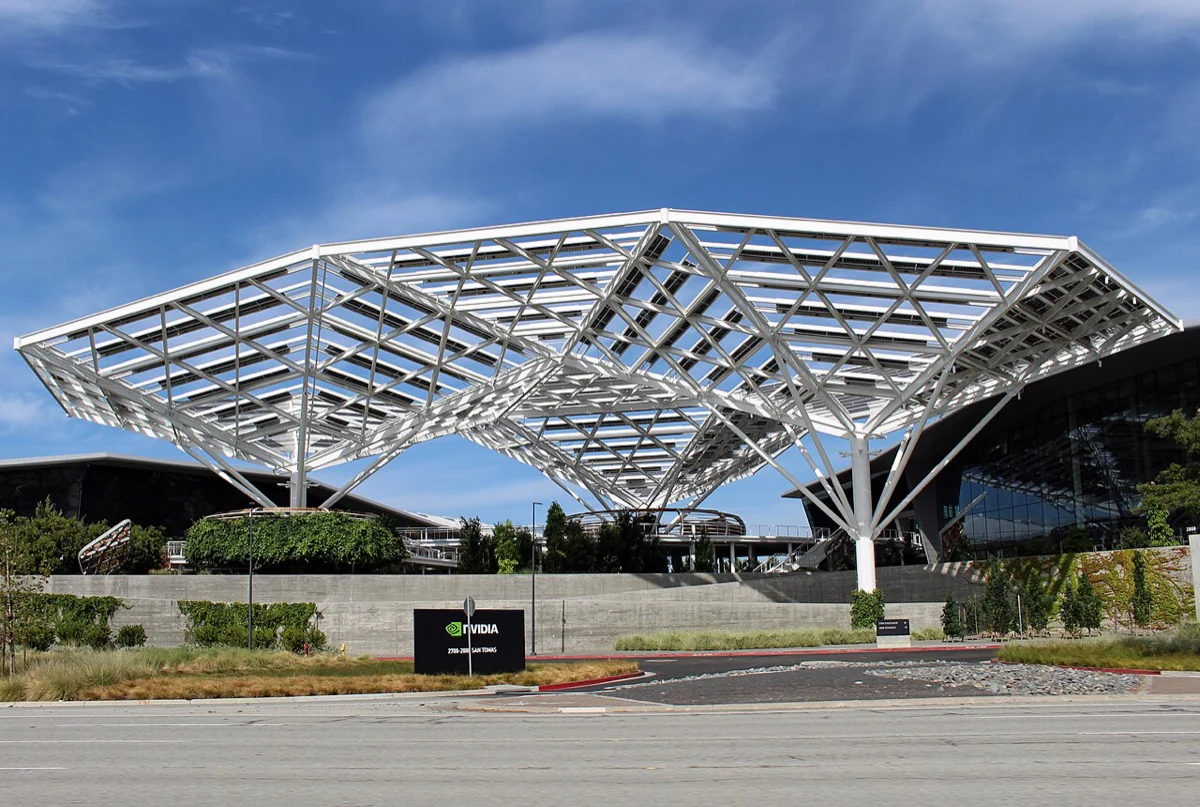
Nvidia's headquarters on San Tomas Expressway in Santa Clara, California, photographed in July 2023. Photo: Coolcaesar / Wikimedia Commons, CC BY-SA 4.0.
China's home demand weakens further
China's National Bureau of Statistics (NBS) said industrial output rose 4.8 per cent in October compared with a year earlier. Economists polled by Reuters had expected 5.3 per cent, and growth in September was 5.5 per cent. Retail sales, the main gauge of consumer spending, grew just 0.4 per cent year on year. That compared with a forecast of 0.8 per cent and 1.1 per cent in September.
Fixed-asset investment, which covers spending on factories, infrastructure and property, fell 8.1 per cent in the first ten months of the year. Analysts had expected a 7 per cent fall, and the decline over the first nine months was 7.2 per cent. Property investment dropped 21.6 per cent over the same period, and new home prices fell again in October, Reuters reported. The urban unemployment rate edged down to 5.1 per cent from 5.2 per cent.
Officials stressed the positives. NBS spokesperson Fu Linghui said high-end and intelligent manufacturing accounted for more than half of industrial output growth in the first ten months, according to Reuters. A second spokesperson, Wang Guanhua, said he was confident China would meet its annual growth target.
Independent economists were less sanguine. Lynn Song, chief economist for Greater China at ING, called the figures "a worrying start" to the fourth quarter. "The persistently soft consumer confidence remains the main issue preventing a consumption recovery," he said.
The weakness at home contrasts with booming trade. Exports rose 35.2 per cent in October, CNBC reported, and China's trade surplus passed $1tn by October, the fastest it has ever reached that mark. Much of that export strength has come from global demand for AI-related equipment. That leaves China exposed to any pullback in AI spending. Zhiwei Zhang, president and chief economist at Pinpoint Asset Management, said: "The market was already worried about this risk before what happened at Nvidia." He added: "Now the risk has become even more serious."
Metals fall and Beijing holds back
Copper, used in wiring, power grids and data centres, fell to almost a four-month low on the London Metal Exchange, according to ABC News. Iron ore is the main ingredient in steel, and Chinese steel demand has been hit hard by the property slump.
Investors hoping for fresh stimulus received little encouragement.
Zhaopeng Xing, senior China strategist at ANZ, said: "No new stimulus measures are expected to be introduced for the remainder of the year." He added that "Data for the single month of October are unlikely to alter the overall growth trajectory for the year". Macquarie analysts Larry Hu and Yuxiao Zhang were similarly cautious about the outlook. "In 2027, policymakers are likely to continue doing just enough to meet the growth target," they wrote.
What it means and what comes next
Taken together, Monday's moves show how much of Asia's recent growth rests on a single theme. South Korea and Taiwan have ridden demand for AI chips. China's export surge has leaned on the same cycle while its own consumers hold back. Japan offered little cushion: its economy shrank at an annualised 0.1 per cent in the third quarter, below expectations. A wobble in the AI trade therefore hits the region on several fronts at once.
The gap between markets and the real economy is not new. Hemera reported in April that AI-related investment had propped up growth even as wider activity stayed weak. Monday's data suggest that pattern now extends to China.
Goldman Sachs expects Chinese growth to slow to 4.6 per cent this year from 5 per cent in 2025, and to 4.5 per cent in 2027, CNBC reported. Citi Research warned that further European Union trade restrictions were a key risk to China's exports next year.
For investors, the next test comes quickly. Nvidia reports fiscal third-quarter results on Tuesday 17 November, with analysts expecting revenue of about $109bn, according to Investing.com. Anthropic's Nasdaq debut is also expected later this week. Anthony Saglimbene, chief market strategist at Ameriprise Financial, was cited by ABC News, relaying Reuters, on the outlook for technology stocks.
Featured image: TSMC AP2 building May 2025 by 4300streetcar, via Wikimedia Commons, CC BY 4.0.


