

Timeline
The United States and nine partner governments have signed a declaration. They include the UK, India, Japan and Singapore. They pledge to jointly protect the technologies, materials and infrastructure needed to build advanced artificial intelligence. The San Francisco Declaration on the Secure Foundations of Enduring Prosperity was signed on 15 November at a retreat of Pax Silica, a US-led technology alliance, according to the US State Department.
The text does not name China. But Pax Silica is widely seen as Washington's attempt to reduce its partners' reliance on Chinese supply chains for chips, critical minerals and AI infrastructure. The signing came four days before Donald Trump is due to meet Xi Jinping, and then Vladimir Putin. The talks are in the Chinese city of Shenzhen, which is hosting this year's Asia-Pacific Economic Cooperation (APEC) summit.
What the declaration commits signatories to
In plain terms, the declaration is a statement of shared intent. Signatories agree to identify which technologies and facilities matter most for advanced AI. They also agree to coordinate on keeping them secure. According to the Financial Times, as relayed by other outlets, members will draw up a joint list of critical AI-related technologies and supply chains that need greater protection. That list has not been published.
The scope is broad. Reports of the text say sensitive technologies include goods, software and technical knowledge. Critical infrastructure stretches to ports, communications networks, energy facilities, logistics and digital platforms.
The declaration states that "economic security is fundamental to national security". It calls for more diversified and trusted supply chains to reduce excessive dependencies. Signatories also pledge to cooperate against economic coercion and market-distorting policies. They also pledge to protect private investment.
Five working groups are proposed. They cover pro-innovation policy, AI adoption in key sectors, supply chain coordination, "safe harbours" and supply chain security hubs, and security and resilience. Reports have not yet set out how the safe harbours would work.
The text repeatedly refers to "super intelligence". The Trump administration favours this term for future AI systems that would outperform humans across most tasks. A footnote acknowledges that some participants use "artificial intelligence" instead. The State Department framed the pact in those terms: "No nation can secure the foundations of the SI era alone."
Jacob Helberg is the US under-secretary of state for economic affairs. He convened the retreat. He told the Financial Times that AI technologies and infrastructure often span multiple countries. That, he argued, makes their security a shared responsibility.
Who signed, and who held back
Alongside the US, the signatories are Australia, India, Israel, Japan, South Korea, Qatar, Singapore, the United Arab Emirates and the UK. Most were early members of Pax Silica. Australia, Israel, Japan, South Korea, Singapore and the UK signed its founding declaration in Washington in December 2025. Qatar and the UAE joined in January. India joined in February, at an AI summit in New Delhi.
Europe is notably absent. Helberg told the Financial Times that Germany, Sweden, the Netherlands and the European Commission were expected to sign next week. That remains an expectation rather than a confirmed signature.
Euronews reported on 12 November that European governments had given the Commission a mandate to negotiate the text on 11 November. They did not necessarily give it a mandate to sign in time for the ceremony. Some member states objected to the broad definitions of sensitive technology and infrastructure. They feared the wording would give Washington wide discretion to impose restrictions and press allies to follow. Others raised the "super intelligence" terminology. The EU's AI Act, the bloc's law regulating artificial intelligence, already defines AI. The Commission proposed a note saying it reads the term as "artificial intelligence".
India had not commented publicly when the signing was first reported. Indian coverage linked its decision to scrutiny of US chip export policy towards China. That scrutiny intensified after Jensen Huang stepped down as Nvidia's chief executive on 11 November.
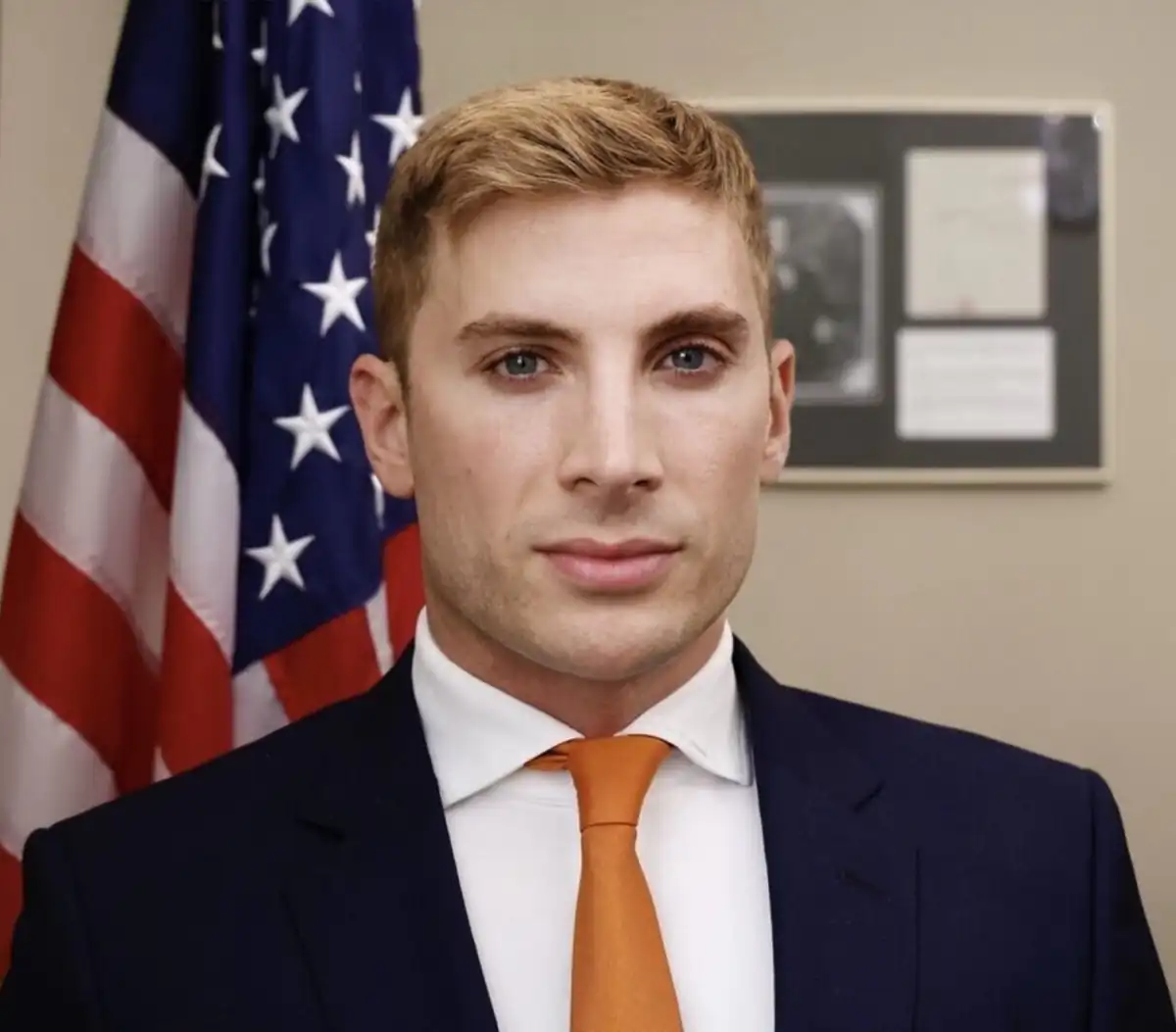
Jacob Helberg, US Under Secretary of State for Economic Affairs, in a 2025 official portrait. Photo: Us goverment / Wikimedia Commons, Public domain.
China, chips and the Shenzhen summit
No Chinese government response to the San Francisco text had been reported by Monday morning. When Pax Silica launched in December 2025, foreign ministry spokesperson Guo Jiakun said: "All parties should adhere to the principles of a market economy and fair competition". Zhou Mi is a researcher at a Chinese government-affiliated trade institute. He told the Global Times: "Excluding China effectively removes a significant portion of the global market."
The timing matters. On Thursday 19 November, Trump is due to hold a bilateral meeting and working lunch with Xi in Shenzhen. It is their fourth meeting since Trump returned to office. A three-way meeting with Putin, the first of its kind, is set to follow. Washington has accused Beijing of failing to meet commitments under a trade truce agreed in late 2025.
US officials have said export controls on sensitive chip technology are not planned for discussion in Shenzhen. "We do not negotiate American export controls," one official told CBS News. Analysis: by gathering allied signatures days earlier, Washington can arrive in China presenting technology security as a matter settled among partners. It would not be one open to bargaining with Beijing.
The money and the track record
Pax Silica has grown quickly. Its membership now exceeds 20 countries, including the EU, which joined in June. Earlier this year, the US said it would contribute $250m to a supply chain investment fund. Quad foreign ministers, from Australia, India, Japan and the US, have pledged more than $85m for trusted AI infrastructure in the Indo-Pacific.
The initiative's first big physical project has drawn resistance. The Philippines joined in April. Plans then emerged for a 4,000-acre AI and advanced manufacturing hub in New Clark City, north of Manila. Farmers' and environmental groups criticised the plan. In May, the head of the Philippine state agency overseeing the site said the US had requested that US law and diplomatic immunity apply in the zone. Manila rejected the request.
Published accounts of the San Francisco text describe commitments to cooperate and to set up working groups. They do not describe enforcement mechanisms or binding obligations. Whether the alliance changes where chips, minerals and data centres are actually built will depend on what those groups produce. It will also depend on how much money follows. Hemera examined in April how conflict is already reshaping global supply chains.
What happens next
- European signatures: Germany, Sweden, the Netherlands and the European Commission are expected to sign next week, according to Helberg.
- Quad leaders: Leaders of Australia, India, Japan and the US are due to meet in Manila on Tuesday, their first such meeting in two years.
- Shenzhen: Trump meets Xi, then Xi and Putin together, on Thursday 19 November.
- The protection list: The open question is which technologies and facilities the joint list will name. It is also unclear whether it will lead to new national restrictions.
Featured image: Semiconductor Wafer of Microelectronics by DrHughManning, via Wikimedia Commons, CC BY-SA 4.0.


