

United Launch Alliance's Vulcan rocket failed on Sunday 15 November, about ten minutes after lifting off from Florida with 40 Amazon Leo internet satellites on board. None of the satellites reached orbit. It is the first outright mission failure for the company, a joint venture of Boeing and Lockheed Martin, since it was formed in 2006.
The loss reaches well beyond one launch. Vulcan is the heavy-lift rocket that United Launch Alliance (ULA) is relying on to replace its Atlas V. Amazon has bought 38 Vulcan flights to build a satellite network meant to compete with SpaceX's Starlink. The US Space Force had also been waiting on this flight before deciding whether to let Vulcan carry national security satellites again.
What went wrong, and when
Vulcan lifted off from Space Launch Complex 41 at Cape Canaveral Space Force Station at 12:40pm Eastern time (17:40 GMT), at the very end of its launch window. Attempts on Friday and Saturday had been called off, CBS News reported. The first was stopped by a fault at a gaseous nitrogen plant that serves several launch companies. The second was halted by network problems between the rocket and ground systems. On Sunday, controllers also paused the countdown 20 seconds before launch to fix a technical issue.
The rocket flew with six solid-fuel boosters made by Northrop Grumman. They were strapped to a first stage powered by two BE-4 engines from Blue Origin, the space company owned by Amazon's founder, Jeff Bezos. The boosters burned out and fell away after about a minute and a half. Northrop Grumman said its preliminary data showed they "performed as expected and successfully separated from the Vulcan launch vehicle before today's anomaly", according to the trade publication Via Satellite.
The trouble appears to have come later. Once the first stage dropped away, the Centaur upper stage took over. This is the hydrogen-fuelled second stage that carries the payload towards orbit. Its first burn was planned to last 12 minutes and 15 seconds. CBS News reported that ULA's update placed the problem during that firing.
CBS News also observed that the first stage appeared to burn longer, and separate later, than ULA's pre-launch timeline indicated. Animation driven by flight data showed the Centaur making unusual changes in orientation early in its burn. ULA's commentators did not mention a problem, and the webcast ended without confirming the burn was complete.
About 50 minutes after liftoff, ULA confirmed the failure on X:
"Based on data received by our Launch Director, we confirm that the Vulcan vehicle launched from Space Launch Complex 41 suffered an anomaly 10 minutes into the flight and failed to deliver the Amazon mission to orbit."
The company said it did not yet know why. "Since the anomaly just occurred, we don't have any specific data yet to understand what occurred today," it said. Referring to its benchmark for mission success, it added: "Today, we did not meet that standard."
A rocket already under scrutiny
This was only Vulcan's fifth flight since its debut in January 2024, and its first in nine months. The long gap followed problems with the nozzles of Northrop Grumman's boosters on two earlier flights, in October 2024 and February 2026. Both missions still reached their intended orbits. But after the February flight, which carried a Space Force payload, the Space Force put Vulcan launches of national security satellites on hold.
Before Sunday's launch, ULA's chief executive, Mark Peller, told Aviation Week & Space Technology: "We've identified three credible causes". He said the company had taken steps to address all of them. The boosters appeared to work normally on Sunday.
A second question hung over the main engines. Blue Origin's own New Glenn rocket, which uses seven BE-4s, exploded on its launch pad in May. CBS News reported that the cause was an oxygen valve in one of those engines. Blue Origin fitted a fix to the BE-4s on Sunday's Vulcan. Reuters, in a report carried by CNA, said it was unclear whether the engines played any part, because the failure appeared to occur after the first stage had separated. ULA has not said whether the countdown hold on Sunday had any bearing on what followed.
An Atlas V rocket carrying Amazon's Kuiper 3 mission, the Amazon Leo constellation's earlier name, launching from Cape Canaveral on 25 September 2025. Photo: U.S. Space Force photo by Gwendolyn Kurzen / Wikimedia Commons, Public domain.
Another setback for Amazon Leo
Amazon Leo is a planned network of satellites in low Earth orbit that beam broadband internet to customers on the ground. Its first-generation design calls for more than 3,200 satellites. Before Sunday, Amazon had deployed 398 of them across 14 launches since 2025, about 12 per cent of its plan, according to Reuters. Starlink, by comparison, has more than 11,000 satellites and millions of customers.
Unlike SpaceX, Amazon does not have its own rocket, and several of its launch providers have been grounded or have failed. Besides the 38 Vulcan flights, it has booked 24 launches on New Glenn, 24 on Europe's Ariane 6 and 13 on SpaceX's Falcon 9, CBS News reported. ULA has already flown eight Leo missions on its older Atlas V. The New Glenn explosion in May came days before that rocket was due to carry Leo satellites.
Vulcan was meant to do much of the work. Melissa Wuerl, Amazon Leo's launch systems director, told Via Satellite that Vulcan would launch "close to 1,500 satellites", nearly half the network. Sunday's 40 satellites were the most Amazon had put on a single rocket. Amazon had hoped to begin initial service this year, Reuters reported.
There is a regulatory clock as well. Amazon's licence from the US Federal Communications Commission (FCC) required half the constellation to be in orbit by 30 July 2026. In June the FCC waived that milestone, over SpaceX's objections, but attached conditions. Amazon temporarily lost priority over some radio frequencies until it reaches the halfway mark, or until 30 March 2028. The deadline for the full network, 30 July 2029, is unchanged, and Amazon has said it is on track to meet it.
Amazon publicly stood by its supplier. "There is risk with any launch, and that's especially true for inaugural missions like LV-01," it said on X, using its name for the first Leo flight on Vulcan. "ULA has been a trusted partner for Amazon, and we believe they'll learn from this mission and deliver on their long-term plans for Vulcan."
What it means for SpaceX's rivals
The failure leaves both of the new heavy rockets that SpaceX's main American competitors were counting on, Vulcan and New Glenn, tied up in the aftermath of failures. That strengthens SpaceX's position in commercial launches and complicates the government's reliance on more than one provider for military missions.
ULA's order book is large. Aviation Week reported a backlog of more than 70 missions, enough to fill Vulcan's calendar until the end of the decade. Those include national security launches that had been waiting on Sunday's result.
NASA's administrator, Jared Isaacman, offered the agency's help on X. "Artemis, Moon Base, and the nation need ULA," he wrote. "We are in your corner and here to help."
What happens next
ULA will lead an investigation into the failure. "We will work closely with our customer and other appropriate organizations to find the cause, determine the appropriate corrective action and return to flight as quickly as possible," the company said. It promised Amazon visibility into the process but gave no timetable.
The open questions are what failed in the Centaur, whether it is linked to earlier problems or Sunday's countdown hold, and how long Vulcan will be grounded. The answers will determine when Amazon's biggest block of launches can resume, and when the Space Force decides whether to trust Vulcan with national security payloads again.
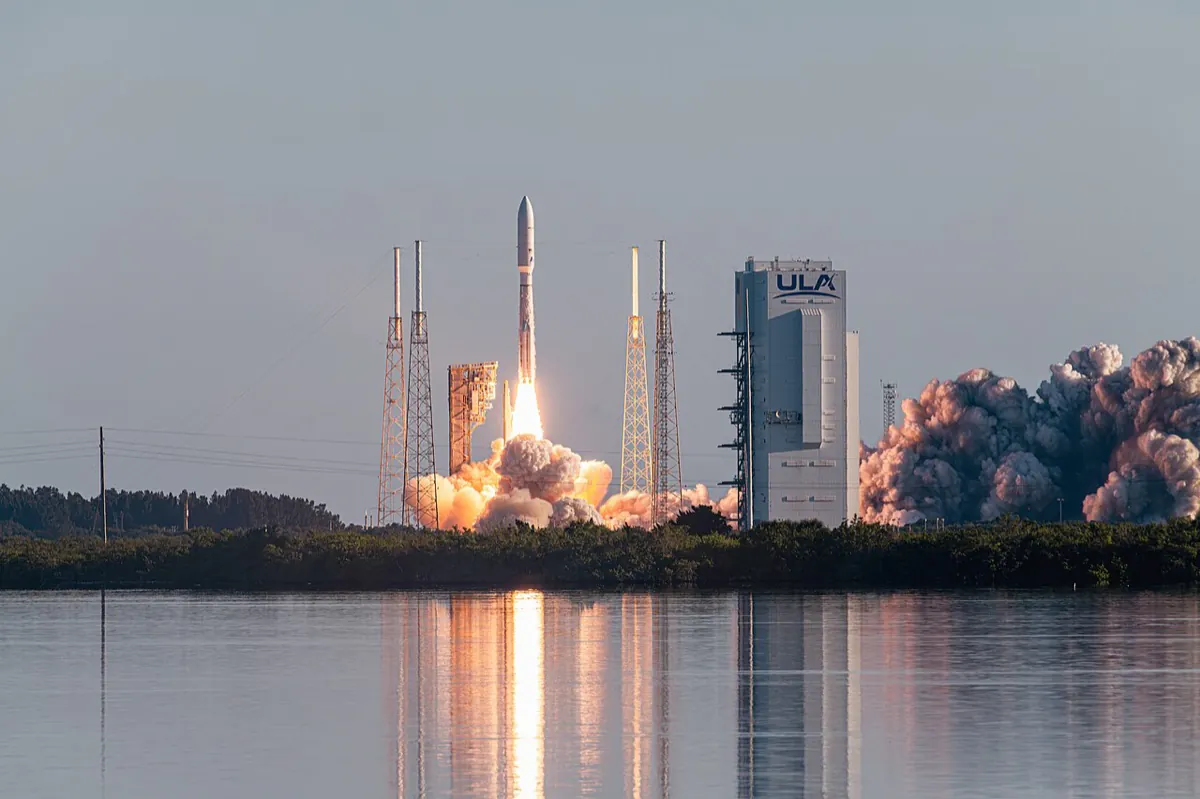
Featured image: ULA's Vulcan VC2S rocket launch (8192710) by U.S. Space Force photo by Airman 1st Class Spencer Contreras, via Wikimedia Commons, Public domain.


