

Asia-Pacific leaders adopted a declaration called the Shenzhen Outlook on 19 November 2026. At the same summit in southern China, Donald Trump, Xi Jinping and Vladimir Putin held their first three-way meeting.
The gathering matters beyond the Asia-Pacific because of who came. A year earlier, at Gyeongju in South Korea, the US president left before the leaders' meeting began. The Russian president stayed away. In Shenzhen the leaders of the world's three largest nuclear powers sat at one table. Afterwards they issued a four-point "Declaration toward Peace". It covers nuclear risk, energy, the United Nations and international courts.
The comparison also shows the limits. Neither the Shenzhen Outlook nor the three-way declaration contains a figure, a deadline or a binding commitment. No tariff changed. The US-China trade truce agreed in Busan in October 2025 still expires on 10 January 2027. Neither text mentions Ukraine or the Iran war. Western capitals most wanted those two conflicts discussed.
What happened in Shenzhen
APEC, the Asia-Pacific Economic Cooperation forum, has 21 "member economies" rather than member countries. The term covers Hong Kong, and Taiwan, which takes part as Chinese Taipei. Decisions are voluntary and non-binding. They are taken by consensus, a principle the Shenzhen declaration restates.
China was hosting for the third time, after 2001 and 2014. President Xi chaired the leaders' meeting at the Shenzhen International Communication Center on the morning of 19 November, according to China's foreign ministry. Kristalina Georgieva, managing director of the International Monetary Fund, briefed leaders on the world economy.
Other events took place around that session. The APEC CEO Summit on 17–18 November drew more than 2,000 business and political representatives. Executives from 115 Fortune Global 500 companies were expected to attend, according to China Briefing, a business advisory publication. Xi greeted Trump in person at Shenzhen's airport. Reuters contrasted that welcome with the handshake from a foreign ministry official that greeted Japan's prime minister, Sanae Takaichi.
On 19 November Trump and Xi held a bilateral meeting of about an hour, CBS News reported. Putin then joined them. CBS News put that meeting at about an hour and a half. Malaysia's Bernama news agency, citing Anadolu, put it at about 80 minutes. Trump also held a separate meeting with Putin.
Who was there, and how that differs from Gyeongju
The best yardstick is the previous year's summit. The table compares Gyeongju, where leaders met on 31 October and 1 November 2025, with Shenzhen.
Measure | Gyeongju 2025 | Shenzhen 2026 |
|---|---|---|
Leaders' meeting | 31 Oct–1 Nov 2025 | 18–19 Nov 2026 |
Chair | President Lee Jae Myung | President Xi Jinping |
United States | Treasury Secretary Scott Bessent | President Donald Trump |
Russia | Deputy PM Alexei Overchuk | President Vladimir Putin |
Mexico | Economy Minister Marcelo Ebrard | President Claudia Sheinbaum |
Leaders' declaration | Gyeongju Declaration | Shenzhen Outlook |
Also endorsed | AI Initiative; demographic framework | Trade digitalisation framework; Connectivity Blueprint; tech statement |
WTO named in declaration | No | No |
Trump–Xi meeting | 30 Oct, Busan, about 1 hr 40 min | 19 Nov, Shenzhen, about 1 hr |
Next host | China (Shenzhen) | Viet Nam (Phu Quoc) |
Sources: APEC, Korea Times, PBS NewsHour/AP, Al Jazeera, CBS News, China Briefing.
The main change is at the head of the US and Russian delegations. In 2025 Trump met Xi in Busan on 30 October. He left South Korea that day, before the leaders' meeting opened. Bessent took his seat.
Putin had not attended APEC since 2017, according to Radio Free Europe/Radio Liberty (RFE/RL). The International Criminal Court (ICC) issued an arrest warrant for him in 2023. South Korea is a party to the treaty that created the court. In 2025 Russia sent Overchuk instead.
The documents are similar. Both declarations commit members to market-driven integration. That includes work towards a Free Trade Area of the Asia-Pacific (FTAAP), a proposed region-wide trade zone. Neither sets a timetable for it. Neither names the World Trade Organization (WTO). In 2025 that omission was new, since earlier declarations had mentioned multilateralism and the WTO. Heo Yoon of Sogang University in Seoul said at the time that it reflected "a paradigm shift in the global trade order".
Shenzhen repeats the omission. Xi called in his own speech for safeguarding the WTO-centred trading system, China Briefing noted. That suggests the final text was shaped by consensus among all 21 economies, including the US, rather than by the host's preferences.
What the Shenzhen Outlook says
The declaration is organised around four pillars: economy and trade, connectivity, innovation and development, China Briefing reported. Its subtitle, "Building an Asia-Pacific Community to Prosper Together", was China's theme for the year. The main commitments are:
- Trade: leaders welcomed an APEC Trade Digitalization Cooperation Framework for 2027–2030. It covers paperless trade and cross-border e-commerce.
- Supply chains and energy: leaders stressed the importance of keeping the region interconnected and trade corridors open, especially for energy and essential goods.
- Connectivity: they endorsed an APEC Connectivity Blueprint built on physical, institutional and people-to-people links.
- Technology: they backed cross-border data flows with data protection. They endorsed the APEC AI Initiative (2026–2030) first adopted at Gyeongju. They also endorsed a statement on digital technologies and jobs.
The energy language has a context. Attacks on shipping in the Strait of Hormuz continue to weigh on oil markets, China Briefing noted.
China also put up money and set up new bodies. Xi announced US$20m for APEC's practical cooperation and a Center for Asia-Pacific Community Studies in Shenzhen. He also announced new cooperation bodies on digital technology, cross-border data, clean energy and small businesses, China's foreign ministry said. "The digital economy and artificial intelligence (AI) are the engines of innovation-driven growth," he told leaders.
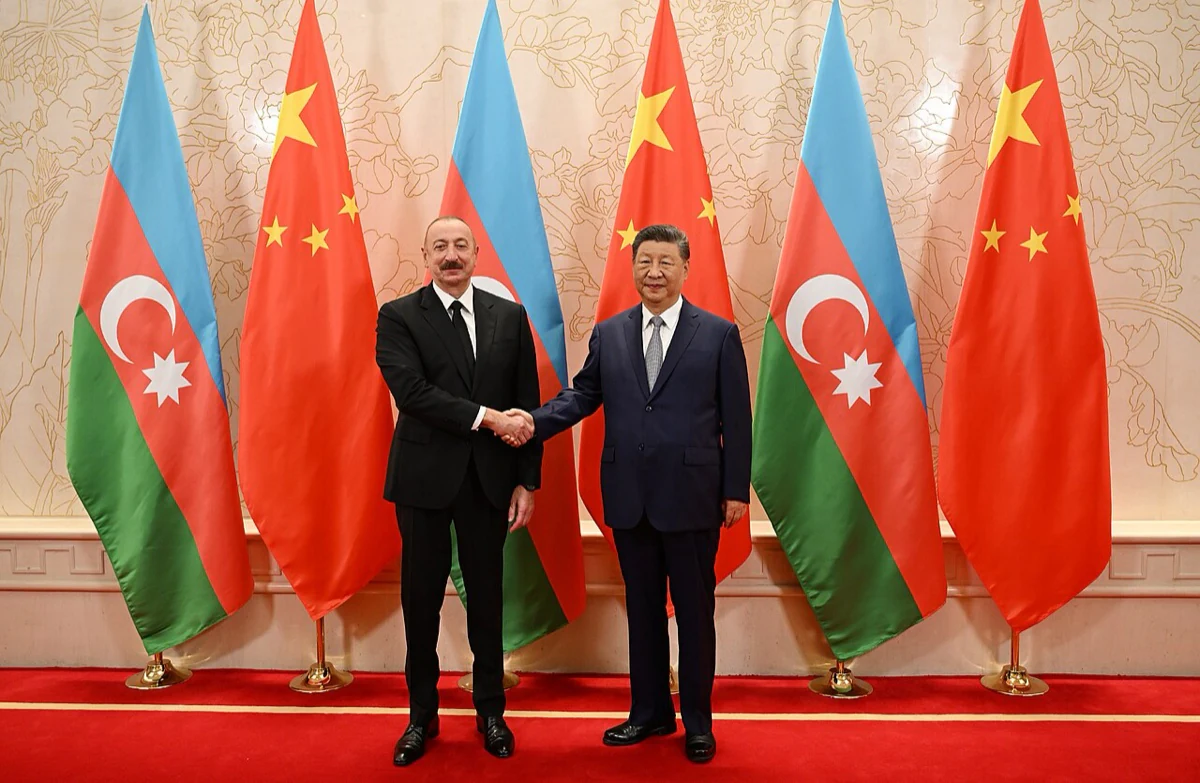
Chinese President Xi Jinping shakes hands with Azerbaijan's President Ilham Aliyev at a meeting in Tianjin in August 2025. Photo: Press Service of the President of the Republic of Azerbaijan / Wikimedia Commons, CC BY 4.0.
The three-way meeting: four points, no figures
China's Xinhua news agency published the declaration in full. The Kremlin released the same text. It has four points:
- Nuclear weapons: the three reaffirmed that "a nuclear war cannot be won and must never be fought". They agreed to a dialogue on reducing nuclear risks and preventing proliferation.
- The United Nations: as permanent members of the Security Council, they committed to reforming the UN.
- Energy: they plan to increase production and supply of refined petroleum products. They stressed the importance of stable energy flows.
- International courts: they said state consent and the immunities of state officials are "of paramount importance". The ICC and similar bodies "must not abuse their jurisdiction", the text says.
Each point leaves the hard questions open. The nuclear dialogue has no date, format or agenda. China is estimated to hold about 620 warheads, against more than 5,000 each for the US and Russia, RFE/RL reported. Beijing considers joining disarmament talks premature. As Hemera reported on 14 November, the New START treaty expired in February 2026. It had capped deployed US and Russian strategic warheads.
The energy pledge gives no volumes. Analysts quoted by RFE/RL read it as support for Russia's struggling oil sector. The court clause matters to one leader in particular, because the ICC's 2023 warrant is for Putin.
Ukraine is not in the text. Putin ruled out direct talks with Kyiv, telling reporters: "We will not negotiate after the attacks on the Crimean bridge." Shortly before the summit, a Ukrainian drone and missile strike brought down part of the road span of the bridge. The bridge links Russia to Russian-occupied Crimea, according to RFE/RL.
The Iran war is not named either, although Trump had wanted to raise it. On 18 November Iran struck Gulf states, including Bahrain and Kuwait, RFE/RL reported. Neither Putin nor Xi mentioned the war publicly during the summit.
Trump and Xi: the truce holds, but no new deal
Busan produced concrete steps. Trump halved a fentanyl-related tariff from 20 per cent to 10 per cent. China paused rare-earth export controls. It also agreed to resume purchases of US soybeans, Al Jazeera reported.
Shenzhen produced an agreement to write a plan. Xi and Trump agreed to draft an action plan for what Beijing calls a "constructive China-U.S. relationship of strategic stability". No timeline has been published, according to China Briefing. The table shows where the 2025 measures stood after the summit.
Measure | Status after Shenzhen |
|---|---|
China's extra 24% tariff on US goods | Suspended to 10 Jan 2027; 10% tariff remains |
China's October 2025 rare-earth export controls | Suspended to 10 Jan 2027 |
China's port fees on US-linked vessels | Suspended to 10 Jan 2027 |
US export-control "Affiliates Rule" | Suspended to 10 Jan 2027 |
US Section 301 forced-labour tariff | 12.5%, in force since 24 Jul 2026 |
US IEEPA tariffs | Struck down by Supreme Court, 20 Feb 2026 |
Board of Trade tariff talks | About US$30bn of goods each way; no deal at 13 Nov meeting |
Sources: China Briefing (Dezan Shira & Associates).
A great deal of trade is affected. US-China goods trade reached 3.18tn yuan (US$473.7bn) in the first three quarters of 2026, China Briefing reported. None was announced. Chip export controls were dealt with separately and were not part of the talks.
How the summit was received
European leaders were sceptical. Germany's chancellor, Friedrich Merz, called the talks a "photo op". France's president, Emmanuel Macron, said the summit would not "lead to a reorganisation of the world", France 24 reported. Ukraine had feared the meeting would be used to discuss settling the war without Kyiv.
Analysts largely agreed on who gained most. "Putin came away with a lot. He was the biggest winner at this meeting," Elizabeth Wishnick of the CNA Corporation, a US research organisation, told RFE/RL. Yun Sun of the Stimson Center called it "high-profile and well-choreographed". She said it was a success for China.
Trump rated the three-way meeting 12 on a scale of zero to 10, CBS News reported. He gave the Busan talks the same score in 2025. In Shenzhen he defended meeting adversaries: "No problems were ever solved under the old school, refusing to talk about it," he said, according to NPR.
Japan's experience was different. Takaichi held no one-to-one talks with Xi. The two countries have been in dispute since her 2025 remarks that an attack on Taiwan could prompt a Japanese military response. Her only bilateral meeting was 30 minutes with Putin, Reuters reported. Japan's chief cabinet secretary, Minoru Kihara, rejected the idea of a snub. China's foreign ministry said it had "made appropriate protocol arrangements for all participants in APEC".
Several economies also signed deals of their own during the week. China agreed to cut tariffs on some Canadian goods, including meat and seafood. The estimated savings are about C$400m. The Philippines and Chile signed an economic partnership agreement covering 8,632 product categories, China Briefing reported.
What happens next
- 14–15 December 2026: the US hosts the G20 leaders' summit at Trump National Doral, near Miami. A Moscow-based analyst quoted by Hemera on 14 November suggested it could be a venue for follow-up.
- Before the end of 2026: an agricultural working group under the US-China Board of Trade is due to meet.
- 10 January 2027: the Busan truce expires. Without an extension, China's 24 per cent tariff and its port fees on US-linked vessels would return, according to China Briefing.
- No date set: the three-way nuclear risk dialogue and the Trump-Xi action plan.
- 2027: Viet Nam chairs APEC and will host the leaders' meeting in Phu Quoc.
Shenzhen settled who would come to the table. Neither declaration says what happens there next. Until the nuclear dialogue has a first meeting, it remains a statement of intent.
Related coverage: Trump, Xi and Putin to Hold First Three-Way Meeting in Shenzhen
Featured image: Commercial area of futian to east2020 by Charlie fong, via Wikimedia Commons, CC BY-SA 4.0.


