

At a summit in Brussels on 20 November 2026, Andy Burnham's government and the European Union agreed three deals that take Britain closer to the bloc than at any time since Brexit. The UK will follow EU food and animal-health rules, and in return most border checks will go from 1 March 2028. The two carbon markets will be linked from 1 January 2028. Up to 100,000 young people a year from each side will be able to live in the other for up to three years, with the first expected to travel by January 2030.
The 2020 Trade and Cooperation Agreement (TCA) removed tariffs but left food trade facing full checks. Compared with that, the new package is the first time the UK has accepted "dynamic alignment": applying the same rules as the EU, at the same time, on an ongoing basis. Most of the outline, though, was set in the reset Keir Starmer's government agreed in May 2025. What November 2026 adds is the legal detail, start dates and a fixed cap on youth visas.
The price tags are shakier than either side admits. The government's headline gain of up to £17bn a year is nearly double the two gains its own documents itemise. The Conservatives' claim that the deal will cost families £281 a year rests on petrol and household gas. The government's published text says the carbon deal does not cover either. And tuition fees for EU students remain unresolved, with a six-month deadline.
What was agreed in Brussels
The summit was the second formal UK-EU meeting of leaders. The first was on 19 May 2025. The joint statement and government explainers set out three agreements:
- Food and farming. A "Common SPS Area" (sanitary and phytosanitary, meaning animal, plant and food-safety rules). Export health certificates, which cost businesses up to £200 each, will no longer be needed. Routine border checks on meat, dairy and fish will go. Wine, spirits and EU fisheries policy are excluded, and the UK keeps its ban on live animal exports for slaughter.
- Carbon pricing. The UK and EU emissions trading systems (ETS), markets in which polluters buy permits for each tonne of carbon, will recognise each other's permits. UK goods will be exempt from the EU's Carbon Border Adjustment Mechanism (CBAM), a levy on carbon-heavy imports such as steel and aluminium.
- Youth Experience Scheme. People aged 18 to 31 can work, study, au pair, volunteer or travel for up to three years. They get no access to benefits and cannot bring dependants.
No legal text was signed on 20 November. Each side must complete its own procedures. Foreign Secretary Ed Miliband told the BBC there would be no new UK contributions to the EU budget. He said the UK's return to the Erasmus+ student exchange programme in 2027 was a separate, earlier decision.
From the 2020 treaty to the 2026 deal
The table below follows six policy areas through the three agreements that now define the relationship.
Policy area | 2020 TCA | May 2025 reset | November 2026 deal |
|---|---|---|---|
Food and agriculture | Zero tariffs; separate rules and full checks | Agreed to negotiate SPS area with dynamic alignment | Most certificates and checks end 1 March 2028 |
Carbon pricing | Separate systems | Agreed to work towards a link | Link from 1 January 2028; £6.5bn exports spared CBAM |
Electricity | New trading arrangements due by April 2022 | Explore joining EU power market | Talks to end in 2027; tied to UK payment |
Youth mobility | None; short business visits only | Scheme agreed in principle, no cap | 100,000 a year each way, by January 2030 |
Tuition fees | Not covered | Not mentioned | Talks with six-month deadline |
Fisheries | 25% of EU catch value shifted to UK | Reciprocal access to 30 June 2038 | 2038 access restated; joint stock management |
Sources: UK government TCA summary, European Commission, UK-EU Common Understanding (May 2025), UK-EU Joint Statement and explainers (November 2026).
The pattern is that 2025 set the direction and 2026 filled in the terms. The May 2025 text had already accepted the price of the food deal. It said the Court of Justice of the European Union would be the "ultimate authority" on EU law, and that the UK would make an "appropriate financial contribution". The November explainers do not restate either point. Neither had a final legal text been published by 22 November 2026.
The youth scheme shows the clearest change. In 2025 the two sides agreed only that numbers must be "acceptable to both sides". The 2026 deal fixes the figure at 100,000 a year each way, split among member states by population.
Norway and Switzerland
The electricity talks show where the UK model meets those of Norway and Switzerland. The joint statement links any UK place in the EU power market to a UK payment towards reducing gaps between richer and poorer EU regions. Norway and Switzerland already pay into funds of this kind:
- Norway provides almost 98 per cent of the €3.268bn EEA and Norway Grants for 2021 to 2028.
- Switzerland will pay CHF 350m a year from 2030 to 2036 under a package. The package also has Switzerland adopt updated EU rules in its market-access agreements. Swiss voters may still have the final say in a referendum.
The UK deal is narrower than either. It covers named sectors only. Labour's manifesto red lines still rule out the single market, the customs union and free movement for this parliament.
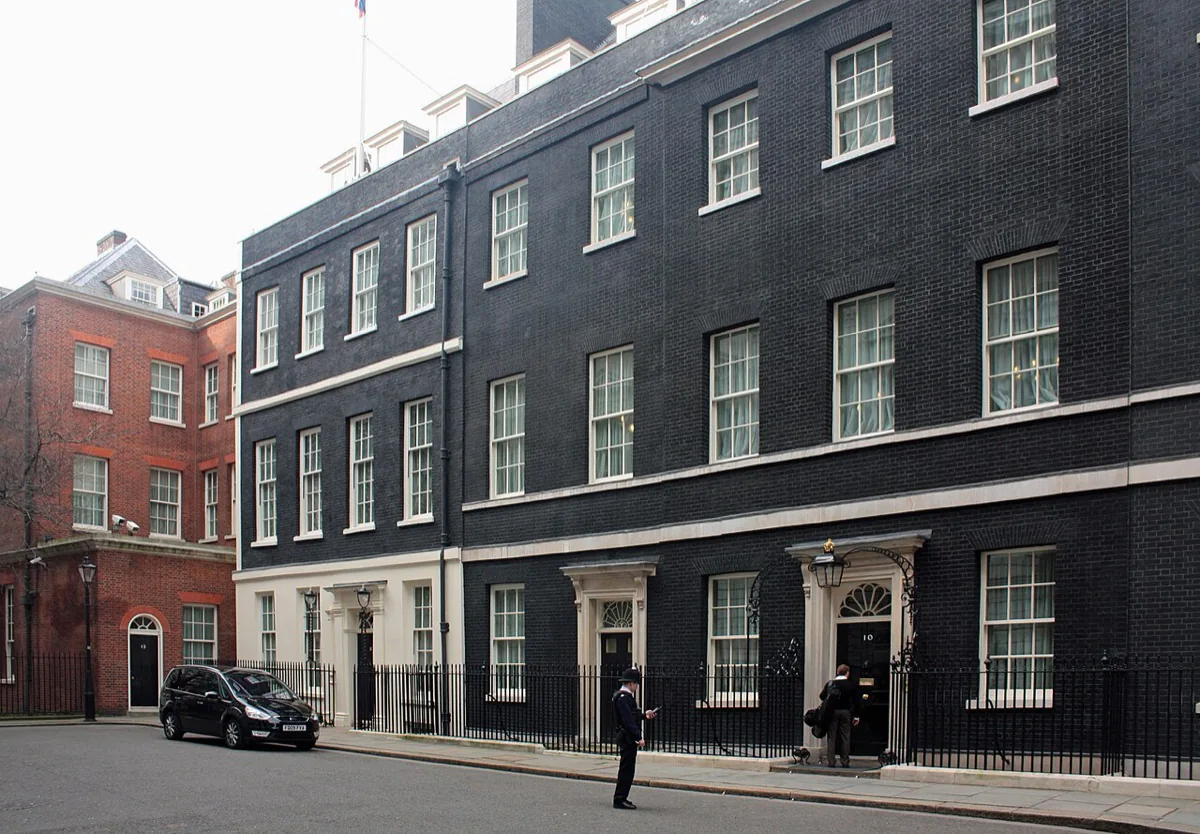
10 Downing Street, the Prime Minister's official residence in London, photographed in March 2010. Photo: robertsharp / Wikimedia Commons, CC BY 2.0.
The numbers, tested
Five figures dominate the argument. The table sets each against what the published documents show or who disputes it.
Claim | Made by | Figure | Challenge |
|---|---|---|---|
Whole package | Burnham, Treasury | Up to £17bn a year (0.5% of GDP) | Badenoch disputes the estimate |
Food trade (SPS) | UK government | Up to £5.1bn a year by 2040 | Retailers do not expect lower shelf prices |
Carbon link | UK government | Up to £3.8bn a year by 2040 | Conservatives and Reform would scrap it |
Household fuel and gas | Conservatives | £281 a year (£156 fuel, £125 gas) | Conservatives have not published their method |
Sources: UK-EU Summit explainers (gov.uk), BBC, RTÉ, Sunday Telegraph via Daily Express and London Evening Standard.
The £17bn
Burnham told the press conference the Treasury had confirmed the deal would add up to 0.5 per cent to GDP, which he put at £17bn. The government's explainers itemise only two parts of that: up to £5.1bn a year from the food deal and up to £3.8bn from the carbon link, both measured against 2040 levels. Together those make £8.9bn. That is nearly the same as the "nearly £9 billion" by 2040 which Starmer's government claimed for the same two deals in May 2025.
The documents published so far do not break down the remaining £8.1bn or so. Hemera could not confirm the breakdown. Kemi Badenoch disputed the £17bn estimate.
The £281
The Conservatives' figure, first reported by the Sunday Telegraph, is the sum of two estimates. They say higher petrol and diesel prices would add about £6 to filling a car such as a Volkswagen Polo, or £156 a year. They say a household using 15,000 kWh of gas, typical of a larger home, would pay about £125 more.
The government's linking explainer, published on 20 November 2026, matters here. The EU runs a second carbon market, known as ETS2, for buildings and road transport. The explainer says ETS2 "is not in scope of this agreement". It also excludes heating of individual homes. On the published text, then, neither part of the £281 is covered by the deal. The Conservatives have not published their method or said whether they expect dynamic alignment to bring ETS2 in later.
Electricity generation is covered. Linking could therefore affect power prices, and so household bills. Neither side has published a figure for that effect.
Food prices
Ministers say removing paperwork will ease pressure on shop prices. The British Retail Consortium welcomed the lower costs but told the BBC it did not expect shelf prices to fall as a result. On 22 November, Miliband declined to name any item that would get cheaper. He said the deal reduced retailers' costs, adding: "They're the things that go into prices". The government says UK agri-food exports to the EU have fallen 32.5 per cent since 2019.
The open question: tuition fees
EU member states want their students at UK universities to pay home fees rather than international rates. Reports put those at up to £38,000 a year, against £9,970 for home students in England and Wales and £4,985 in Northern Ireland. Scottish students pay nothing. The joint statement commits both sides to a separate agreement covering all students "irrespective of the immigration pathway", to be concluded within six months.
EU sources had suggested the bloc might delay the wider package until fees were settled. Miliband said von der Leyen had been clear that the three agreements were separate from the fees issue. On BBC Radio 4's Today, the presenter Justin Webb said European officials had told him otherwise. The Environment Secretary, Angela Eagle, replied that "negotiations will go on".
The universities' case is about who pays. Professor Dame Sally Mapstone of St Andrews put the cost of teaching each student at about £15,000 a year.
Where the parties stand
The government's main argument is that exporters already follow EU rules and the deal removes duplicate paperwork. Miliband said businesses selling into Europe were already "rule takers". He said that under the deal the UK would, for the first time, be able to shape EU decisions.
The Conservatives say they would scrap the deal. Their deputy leader, Alex Burghart, said about 90 per cent of farmers do not trade with the EU but would still carry the extra burden. He told the BBC: "I also don't think it is a good idea for a country like Britain to hand over control of its rules to another power and have no say over how those rules are created right into the future." Critics point to the roughly one million Britons aged 16 to 24 who are not in work, education or training; Hemera reported on 17 November 2026 on the government's plan for that group.
Reform UK has also promised to repeal the deal. The Liberal Democrats want to go further.
Burnham faces pressure inside Labour from both directions. Emily Thornberry, who chairs the Commons foreign affairs committee, wants the UK back in the EU. The Guardian reported that some Labour MPs are wary of the fight that rejoining could start. Former prime minister Theresa May told the BBC: "Brexit is done. Just accept Brexit and move on."
Rejoining: what the polls say
Burnham said three-quarters of people favour closer ties with Europe. He has also said he hopes to see the UK rejoin in his lifetime. Hemera reported on 16 November 2026 that he planned to argue Brexit had not worked. Miliband told the BBC that "all the options will be on the table" for the future relationship. He added: "It's not about this parliament, we're respecting the red lines in this parliament." The polls below were all published in the past three months.
Pollster (client) | Fieldwork | Sample | Finding |
|---|---|---|---|
YouGov | 13 Oct–2 Nov 2026 | 12,150 (GB) | Rejoin 52%, stay out 27% |
YouGov | 2–13 Nov 2026 | About 2,000 per wave (GB) | 54% find a referendum within five years acceptable |
YouGov | 2–13 Nov 2026 | About 2,000 per wave (GB) | Rejoin the right priority: 37% yes, 45% no |
Sources: YouGov, The Independent.
Support for rejoining in principle is clear, but it depends on the terms. In YouGov's experiment, rejoin's lead ranged from 33 points to an eight-point deficit across 18 scenarios. If membership meant adopting the euro, rejoin and stay out tied at 40 per cent each. The same polls show more people saying rejoining should not be a priority than saying it should. Rejoining would also need the unanimous approval of all 27 member states.
What happens next
Burnham said the package was "probably the limit of what we can achieve in this parliament, given what needs to be done to implement it". The next steps are:
- 26 November 2026: legislation is due to be introduced in Parliament. Ministers have called it the Cutting Costs Bill; a government explainer names a European Partnership Bill.
- December 2026: Burnham is expected to set out a 10-year plan for Britain, including next steps on Europe.
- By about 20 May 2027: the six-month deadline for a tuition fees agreement.
- 2027: UK carbon-linking legislation, a target to conclude electricity talks, and a year of "brainstorming" with the EU on long-term options.
- 1 January and 1 March 2028: the carbon link and the food deal are due to start.
- January 2030: the latest date for the first youth scheme participants.
The deal's long-term future depends on the next general election, due by 2029. Both the Conservatives and Reform UK say they would repeal it. Labour, meanwhile, is considering whether to put rejoining in its manifesto. That would make the next election the first since 2019 in which EU membership is on the ballot in all but name.
Related coverage: Burnham to Say Brexit Has Not Worked as He Sets Tests for EU Deal · Milburn's Neets Plan: £5.8bn a Year, and What Past Schemes Delivered
Featured image: Berlaymont building 2022 by Euro Pictures, via Wikimedia Commons, CC BY 2.0.


