

Alan Milburn's review of youth inactivity, published by the Department for Work and Pensions (DWP) on 17 November 2026, asks ministers to build a new system of support for 16- to 24-year-olds. By 2036/37 it would cost about £5.8bn a year. Much of that would be recovered by replacing sickness and disability benefits for under-25s with a new, tighter "youth allowance".
The aim is to cut the share of young people not in education, employment or training, known as Neets, from 13% to around 5% within a decade. The review's own sums put welfare savings at £3.6bn a year and other fiscal gains at £2.4bn by 2036/37. That leaves a small net saving at the end of the decade. It also means paying up front, starting with £500m in 2027/28.
Britain has paid for youth job schemes before. The Future Jobs Fund of 2009 and the Kickstart scheme of 2020 each left participants 11 percentage points more likely to be in work two years later. On DWP's figures, neither scheme earned back its cost to the Treasury. Milburn's plan differs in one central respect: it ties new support to less generous benefits. That link is where its savings come from, and where its political risk lies.
What the review proposes
The report is titled From a Welfare State to a Working State. Pat McFadden, the work and pensions secretary, commissioned it in November 2025 under Keir Starmer, and an interim report followed in May 2026. Launching the final report, Milburn said: "We are at a fork in the road and half measures will not do. A complete system reset is needed."
Its main recommendations are:
- A Youth Opportunity Service in every part of England by the end of 2029. It would be run locally under mayors and council leaders, and each young person would get a named adviser and a personal plan.
- Two legal guarantees. The first is a route into education, training or work. The second is the health and practical help needed to take it up. Anyone still Neet after a year would be offered a paid six-month job.
- A Youth Jobs Grant of £3,000 to employers who hire someone who has been Neet for six months. A further £2,000 would go to employers taking on young people who face greater barriers, and another £2,000 to small firms.
- Lower employer national insurance (NI) on workers aged 21 to 24, phased in over five years. Retail and hospitality would come first.
- More apprenticeships: about 270,000 starts a year by 2036/37, up from about 172,000 in 2024/25. Further education would take 150,000 more 18- to 24-year-olds.
- Mental health help without first waiting for a diagnosis.
- A youth allowance replacing the health element of universal credit (UC) and personal independence payment (Pip) for 16- to 24-year-olds.
The review also sets a timetable for each young person. They would see an adviser within two weeks and have a plan within four weeks. Within four months they should have a firm offer of college, training, an apprenticeship or work.
The scale of the problem, and where 440,000 comes from
The Office for National Statistics (ONS) estimates that 981,000 people aged 16 to 24 were Neet in April to June 2026. That is 13.0% of the age group. Of these, 393,000 were unemployed and looking for work. The other 588,000 were economically inactive, meaning they were neither working nor looking. The January to March figure of 1.01m was the highest in more than 12 years. The record remains 1.24m, or 16.9%, in July to September 2011, after the financial crisis.
The youth unemployment rate stands at 15.1%, against under 4% for older workers, Reuters reported. Before publication, Milburn had warned that without action the Neet count could reach 1.25m by 2031, or one young person in six.
The 440,000 figure needs care. DWP said that reaching the 5% ambition would mean 600,000 more young people in education, employment or training each year, and about 440,000 of them in sustained work. The review's analytical annex costs something smaller. It finds that the recommended reforms on their own would bring the Neet rate to around 6.8%. That would mean about 400,000 more young people in work and about 500,000 more in work or education. Milburn says the rest of the way to 5% would depend on faster economic growth and new momentum in the youth labour market.
What it would cost, line by line
The annex sets out gross annual costs by 2036/37 in 2026/27 prices. The table sets each line against what it changes and the nearest earlier policy.
Recommendation | Annual cost by 2036/37 | What it replaces or changes | Nearest precedent and result |
|---|---|---|---|
Opportunity and support guarantees, including six-month paid job | £1.9bn | Jobcentre-led youth offer | Kickstart: +11 points in work after two years |
Education: apprenticeships and further education | £2.1bn | About 172,000 apprenticeship starts (2024/25) | n/a |
Youth hiring incentives (jobs grant, NI cut) | £1.1bn | Employer NI of 15% above £5,000 for 21-24s | Current grants and jobs guarantee: about £36,000 per extra job |
Health: early mental health support | £0.7bn | Access led by diagnosis | n/a |
Local system reform | Under £0.1bn | Separate jobcentre, careers and health services | n/a |
Youth allowance and new disability payments | £3.6bn saving | UC health element and Pip for 16-24s | 2025 disability benefit cuts: abandoned after Labour revolt |
Sources: DWP analytical annex to the Milburn review, DWP Kickstart impact assessment, Resolution Foundation, The i Paper, The Guardian.
Education is the biggest single line, not job subsidies. The plan's logic shows in a ratio the review highlights. In 2024/25 the state spent about £25 on youth benefits for every £1 it spent on helping young people into work or education. The review would move that to about £2 for every £1 by 2036/37. Reuters reported that spending on back-to-work measures has fallen to 0.1% of national income, from 0.3% in 2010/11.
Taken together, £3.6bn of welfare savings and £2.4bn of other offsets slightly exceed the £5.8bn cost. Any NI cut is the open-ended item. The Resolution Foundation estimates that scrapping employer NI for 21- to 24-year-olds at once would cost about £5.1bn, almost five times the review's whole hiring-incentive line.
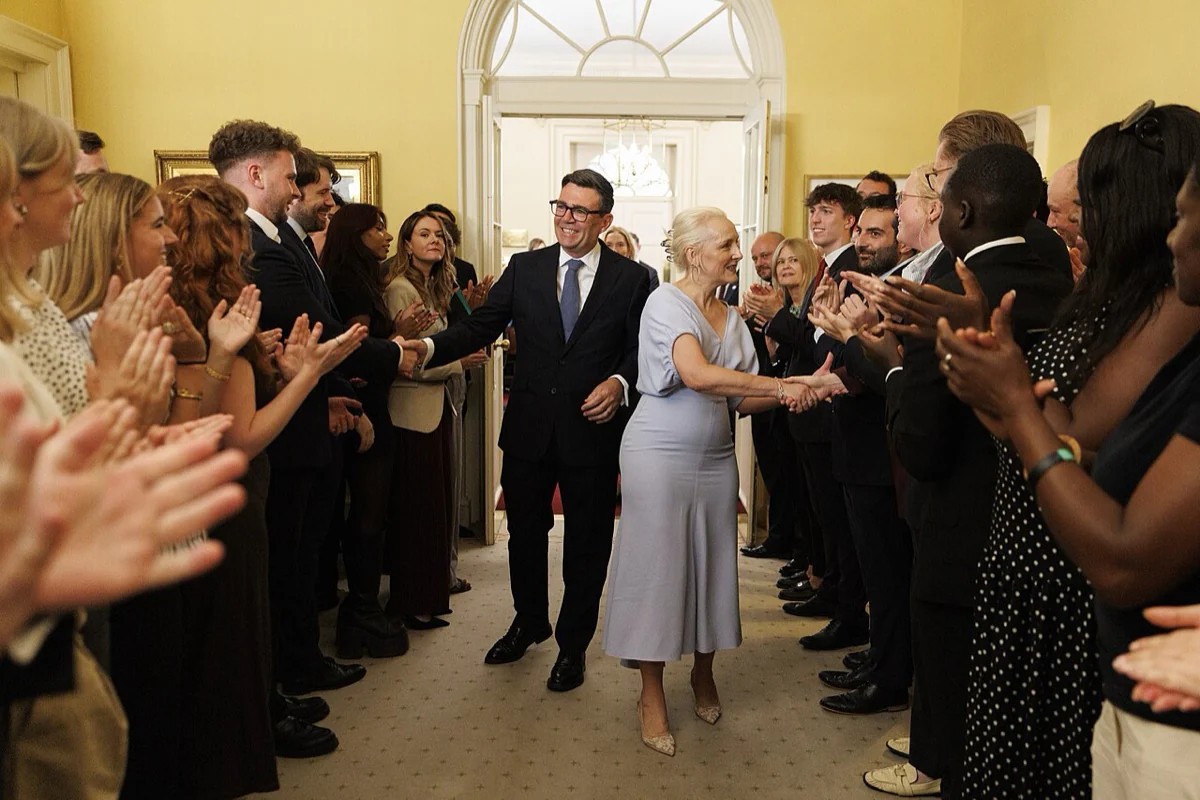
Prime Minister Andy Burnham and his wife, Marie-France van Heel, are applauded by staff as they arrive at 10 Downing Street on 20 July 2026. Photo: UK Prime Minister / Wikimedia Commons, CC BY 4.0.
How earlier youth schemes performed
The review's annex sets its spending against earlier programmes. Evaluations by DWP, the National Audit Office (NAO) and the National Institute of Economic and Social Research (NIESR) show how those programmes performed.
Scheme | Launched | Money | Employment effect | Return to the Treasury |
|---|---|---|---|---|
New Deal for Young People | 1998 | £3.15bn over five years (about £1.3bn a year in 2026 prices) | n/a | £3 back per £5 spent (NIESR estimate) |
Future Jobs Fund | 2009 | n/a | +11 points in unsubsidised work after two years | Net cost about £3,100 per participant |
Kickstart | September 2020 | £1.9bn budget; 163,000 placements | +11 points in work after two years | £0.49 back per £1 over five years |
Youth Guarantee | Current | About £600m a year | n/a | n/a |
Milburn plan | 2027/28 | £500m, rising to £5.8bn a year by 2036/37 | Modelled: about 400,000 more in work | n/a |
Sources: DWP analytical annex, NIESR, National Audit Office, DWP Kickstart impact assessment, Hansard, The Guardian.
Gordon Brown's government launched the Future Jobs Fund in 2009, during the recession. It paid for six-month jobs for young people out of work. The coalition closed it, and David Cameron called it "expensive, badly targeted and did not work". In November 2012 DWP's own analysis found that participants were 11 points more likely to be in unsubsidised work two years on. Benefit receipt was 7 points lower. It put the net cost to the Treasury at about £3,100 a participant, against a net gain to society of about £7,750.
Kickstart, Rishi Sunak's pandemic scheme, followed a similar pattern. It aimed for 250,000 starts and achieved 163,000 placements. In November 2021 the NAO put its cost at about £7,000 per participant and said: "DWP has limited assurance that Kickstart is actually having the positive impact intended." DWP's 2024 impact assessment found an employment gain of 11 points at 24 months. Over five years it estimated £3.15 of benefit to society for every £1 spent, but only £0.49 back to the Treasury.
Three lessons follow from the record:
- Subsidised jobs for young people have raised employment, by similar margins under governments of both parties.
- They have not paid for themselves through tax and benefit savings within five years, so Milburn's fiscal case rests mainly on welfare redesign, not on job effects alone.
- The scale is new. At £5.8bn a year, the plan would cost more than four times as much each year as the New Deal in today's prices, and nearly ten times the current Youth Guarantee.
The benefits trade-off
Under the review, young people would receive a youth allowance at the standard UC rate for under-25s. Pip would be replaced by a new "additional cost allowance", and fewer young people are expected to qualify. A smaller group who will never be able to work would receive "severe and complex needs insurance", paid above today's maximum benefit rates. Every young claimant would be able to earn the equivalent of 16 hours a week at the minimum wage before their benefit started to be withdrawn.
DWP figures show 453,495 people aged 16 to 24 in England and Wales were entitled to Pip in July 2026. Milburn has been direct about the effect. "There will be some young people who are worse off at least initially as a consequence of benefit changes. But in the end, the best thing for people is to get them into work," he told Sky News.
The annex estimates the full package would leave about 50,000 fewer people in relative poverty, because more young people would be in work. The Resolution Foundation, a think tank, has estimated that UC health payments and Pip currently keep 120,000 young people out of poverty. It also found that about one in five young Pip recipients reported no additional costs.
Charities have welcomed the employment support but objected to the cuts. James Taylor of Scope said: "PIP helps with the extra costs of disability, whether someone is in work or not." Katie Schmuecker of the Joseph Rowntree Foundation said "cutting sick and disabled young people’s benefits should not be part of this package". Six Labour MPs on the party's left, including John McDonnell and Clive Lewis, wrote: "What young people need is not more punishment, but more opportunity."
Ministers argue the package differs from Starmer's 2025 disability cuts. McFadden told Labour MPs on 16 November: "This is not last year’s proposal with better PR." Milburn warned against the alternative: "if you do crude cuts in benefits, all that happens is that young people show up somewhere else on the government ledger."
The national insurance argument
The report notes that in April 2025 Rachel Reeves raised the employer NI rate from 13.8% to 15% and cut the threshold at which it starts from £9,100 to £5,000. It says this added around £800 a year to the cost of a full-time worker on the National Living Wage. Workers under 21 and apprentices under 25 are largely exempt, which leaves 21- to 24-year-olds the most exposed.
The Conservatives say Labour's tax and employment law changes have deepened the crisis. Kemi Badenoch argued that hiring young people should be made cheaper and less risky, rather than funding new state schemes. Downing Street's spokesman countered that the Neet count rose by 250,000 between the end of the pandemic and the 2024 election, before the NI rise. The spokesman said Milburn himself had judged "untargeted and unaffordable cuts in employer NICs isn’t a silver bullet to the Neets crisis, which is decades in the making".
Employers want the cut. Shevaun Haviland of the British Chambers of Commerce said young people were "arriving in the jobs market with little workplace experience, while the costs and risks of taking them on continue to rise". One government insider told The i Paper that business support might depend on whether the NI cut is adopted. The Resolution Foundation's view is that "Targeted job schemes are better than broad tax breaks."
How the decision will be made
The youth allowance would need primary legislation, so Labour MPs will have the final say. In 2025 a backbench revolt forced Starmer to abandon his disability benefit changes. Burnham, now prime minister, urged MPs to vote against them at the time. He has said the "status quo clearly isn’t working".
Some of the 2025 rebels now sit in cabinet, including Louise Haigh. Dame Meg Hillier, chair of the Treasury committee and another rebel, has called the new plans "very different to what was happening a year and a half ago". Milburn told Sky News that Labour MPs "have to vote for it".
Opposition parties attack the plan from different sides. Helen Whately, the shadow work and pensions secretary, said it "fails to bring down the welfare bill, proposes billions more in government spending". For Reform UK, Suella Braverman called the 10-year timescale a "huge missed opportunity".
In the Commons on 17 November, McFadden announced a new youth opportunities unit reporting directly to the prime minister. He did not commit to the cost of the full package.
What to watch
- 26 November 2026: the ONS publishes Neet estimates for July to September, the first test of whether the slight fall in the spring has held.
- Timms review of Pip: the separate review by Sir Stephen Timms, the disability minister, is due this autumn. Sources told The i Paper it may not back ending Pip for under-25s.
- Within 100 days: Milburn has asked the government to commit to the 5% ambition by late February 2027.
- Early 2027: the government's formal response, with legislation expected in April or May, according to government sources.
- 2027 spending decisions: whether the Treasury, under the chancellor John Healey, funds the £500m first-year downpayment.
- 2029/30: the first welfare savings, if the law passes in time, and the deadline for a Youth Opportunity Service across England.
Featured image: "Clitheroe Jobcentre Plus" 31 Lowergate, Clitheroe, Lancashire BB7 1AE - geograph.org.uk - 2389125 by Robert Wade, via Wikimedia Commons, CC BY-SA 2.0.


