

Organisers say between 350,000 and 450,000 people gathered at Letná Park in Prague on Sunday afternoon to oppose the Czech government's plan to abolish the licence fee and fund public television and radio from the state budget. If that estimate is accurate, the Czech News Agency (ČTK) said, it would be the country's largest demonstration since 1989.
Police do not publish crowd figures and did not give one. The rally was organised by Million Moments for Democracy, a civic group whose chairman, Mikuláš Minář, presented a petition calling for the bill to be withdrawn. Prime Minister Andrej Babiš said people had the right to protest, but that the fees would be scrapped regardless.
What the bill would change
Czech households currently pay 205 crowns (about £7) a month to fund Czech Television (ČT) and Czech Radio (ČRo). The government bill would cancel that fee and pay the two broadcasters directly from the state budget instead.
The change would also reduce their income by about 15 per cent. According to the public broadcaster ČT24, Czech Television would receive about 1bn crowns less than now and Czech Radio about 400m crowns less. Reuters reported that the cut would take television's nominal budget back to its 2008 level and radio's to 2005. The broadcasters say that is unworkable.
Several European countries have already dropped the licence fee. Norway moved its public broadcaster into the national budget in 2020. France abolished its fee in 2022 and now funds public media from a share of VAT receipts.
The government's case
Mr Babiš leads a coalition of his ANO movement, the hard-right Freedom and Direct Democracy party (SPD) and the Eurosceptic Motorists for Themselves. He returned to office in December 2025. He denies that the reform is about control.
"The funding system is changing, no one wants to control public media, no one wants to dictate to them what they should say and do, no one wants to nationalise them," he told ČTK.
"We are doing this because the system is already outdated and most of Europe is going the same way today and others are joining in," he added. In an opinion piece last week, he wrote: "Under no circumstances will we interfere in editorial work." He has also presented abolition as a promise to reduce the financial burden on voters.
In a post on X on 24 October, Mr Babiš said the broadcasters' funding would be fixed in law as mandatory spending and that their finances would be overseen by the Supreme Audit Office. The culture minister, Oto Klempíř, has argued that only the funding method changes and that the broadcasters will save money by no longer collecting fees. He has also asked why a similar model in Denmark is treated as a European solution while the Czech version is described as the end of democracy.
Why critics object
Opponents argue that broadcasters funded through annual budget decisions would be exposed to political pressure. The European Broadcasting Union, the European Federation of Journalists, Reporters Without Borders and the International Press Institute have all criticised the plan. Several have compared it with the treatment of public media under Slovakia's prime minister, Robert Fico, and Hungary's former prime minister, Viktor Orbán.
"Political attacks against private and public media have become one of the hallmarks of Andrej Babis' premiership," Pavol Szalai, Prague bureau director of Reporters Without Borders, said in June.
Overall trust in news in the Czech Republic is low, at about 30 to 33 per cent, according to the Reuters Institute Digital News Report 2026. But the report found that "Public service broadcasters remain the most trusted brands, despite increasing attempts by various political actors to undermine their credibility".
The issue has also reached Brussels. During a European Parliament debate on Wednesday, the EU justice commissioner, Michael McGrath, said national laws must give public broadcasters "adequate, sustainable and predictable financial resources."
"We need to keep media independent. The government is taking steps to control them, cut their funding and affect what they broadcast," Jan Snasel, a computer programmer, told AFP at the rally.
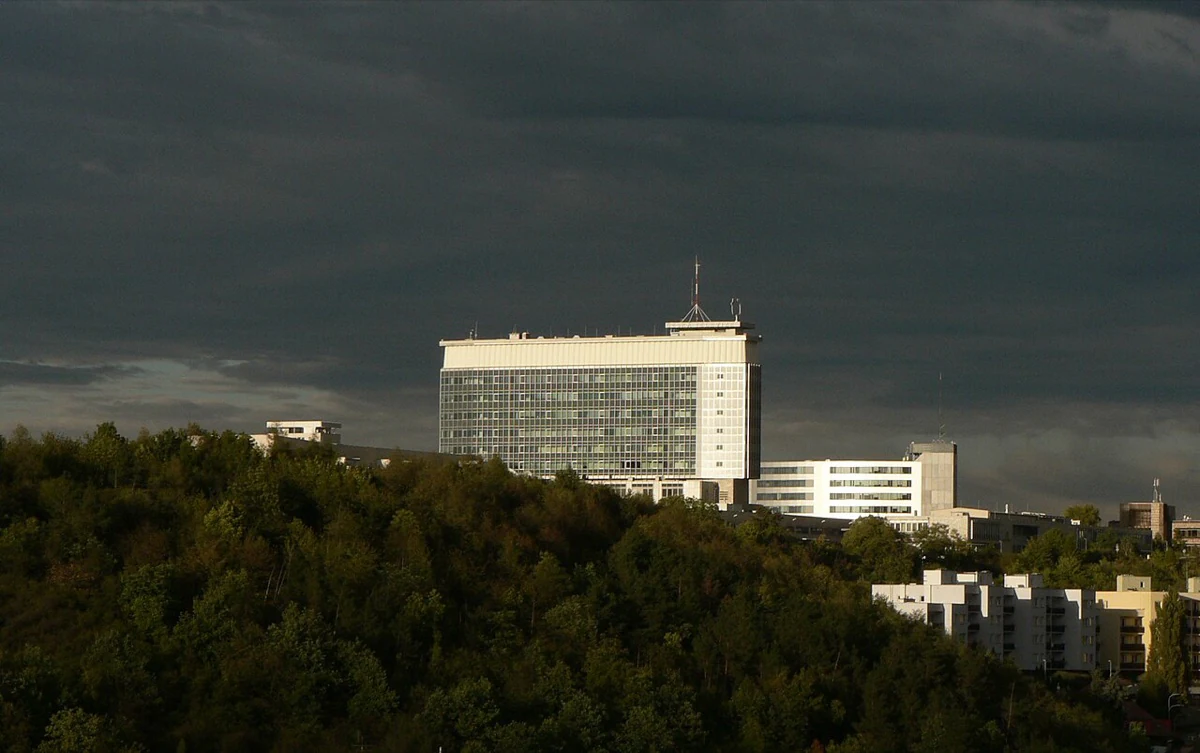
The Czech Television building at Kavčí hory, Prague, photographed in 2012. Photo: sandwort / Wikimedia Commons, CC BY-SA 3.0.
A protest that went beyond the media
The rally was billed as "Letná against 4:36". The name refers to the time of an overnight vote on 24 October. The coalition, which had limited the opposition's speaking time, then passed the bill at its first reading at 4:36am. Thousands protested the following day, and staff at both broadcasters held a one-day strike on 3 November.
"We are here to stand up against the rule by force in the style of 4:36," Mr Minář told the crowd. Speaking to Reuters, he said: "An elected government has the right to govern but it does not have the right to do whatever it wants and to dismantle democratic institutions."
The organisers' demands went further than the bill. They also want an apology for the overnight sitting and the removal of the SPD leader, Tomio Okamura, as speaker of the Chamber of Deputies. The group also wants the SPD stripped of the defence ministry, saying the party endangers national security. ČTK said it was still waiting for Mr Okamura's response.
Coalition figures rejected the protest's premise. The foreign minister, Petr Macinka of the Motorists, described it as an opposition event. Radek Vondráček, ANO's deputy chairman, said it lacked substance and called the organisers agitators.
Many in the crowd wore folded newspaper hats, a tribute to Večerníček, the cartoon character who has introduced Czech Television's bedtime stories for decades. Police reported only minor conflicts. Medics treated 27 people, two of whom were taken to hospital.
The same group drew an estimated 250,000 people to an anti-government rally in March. AFP reported that ANO still has about 30 per cent support in opinion polls.
What happens next
The bill now sits with the Chamber's media and culture committee, which has adjourned its debate until 10 December so that MPs can table amendments. Mr Babiš said on 2 November that the second reading could take place around 15 January. A third and final reading would follow.
The bill would then go to the opposition-controlled Senate, which can send it back. President Petr Pavel can veto it. He has already called for calm and criticised the speed of the first vote. Both obstacles can be overridden by an absolute majority of the 200-seat Chamber, meaning at least 101 votes. The three coalition parties hold 108 seats.
Analysis: those numbers mean the opposition cannot defeat the bill through parliamentary procedure alone. The pressure from the streets is therefore aimed mainly at the coalition's unity and at the details of the final text. Sunday's turnout, if the organisers' estimate is accurate, shows the scale of that pressure. The government's early response suggests it will not change course.
The next tests come quickly. Tuesday, 17 November, is the national holiday marking the start of the Velvet Revolution. Million Moments has called a nationwide action for 4:36pm on 2 December. It has also invited ministers to a public debate at Prague's Švandovo divadlo theatre that evening. The committee meets again on 10 December.
Featured image: Prague Metronome - panoramio by Mister No, via Wikimedia Commons, CC BY 3.0.


