

About 70,000 police officers and gendarmes were deployed across France on Saturday 14 November. Protesters marched for a fifth weekend in a row. In Paris, students, Yellow Vest activists, trade unionists and campaign groups joined a single march over wages, education and policing.
It comes a day after school principals held rallies of their own against violence. That violence is linked to nearly two months of high-school blockades. President Emmanuel Macron will not stand at the presidential election in April. His centrist camp no longer has a majority to pass major legislation. The unrest is testing how far a weakened government can give ground on pay and policing.
One march, several causes
Interior Minister Laurent Nuñez said he expected 50 to 60 marches nationwide, France 24 reported. In Paris, the police prefecture approved one shared route from Place de la République to Place de la Nation via Bastille. A Paris police intelligence memo seen by franceinfo forecast 30,000 to 60,000 marchers. It expected 200 to 400 Yellow Vests and 500 to 1,000 campaigners against violence towards children. A police source told AFP that 300 to 600 high-risk individuals might attend.
The transport operator RATP closed 21 métro stations at the prefecture's request. According to France 24, the route was designed to let families with children leave before the march broke up. Clashes with police have often begun at that point.
The Yellow Vests' national coordination has helped organise Saturday protests against the high cost of living since 17 October. This week the youth inter-union alliance of Union étudiante, Union syndicale lycéenne, Unef and Fage joined it. Child-rights campaigners, climate activists and opponents of a police firearms bill also took part. The main union confederations did not file a route for Saturday. They are focusing on a strike on Tuesday 17 November, franceinfo reported.
Turnout has been falling. Authorities counted about 146,000 demonstrators nationwide on 7 November, far fewer than on earlier weekends, according to AFP. Karl Ghazi, the CGT union's general secretary for Paris, told AFP there was "real activist fatigue" after six weeks of protests.
Principals say they have become targets
On Friday 13 November, headteachers and their deputies gathered outside schools and education offices at around 30 sites. SNPDEN-Unsa, the main union for school leaders, called the rallies. In Paris they met outside the Collège de France. The union's general secretary, Bruno Bobkiewicz, said principals had last mobilised nationally in this way in 2006.
Bobkiewicz said 81 heads or deputy heads are among 245 education staff injured since the movement began in late September. About 50 principals have asked to be transferred, he said. On 9 November a headteacher in Bègles, near Bordeaux, was hit on the head by a paving stone and taken to hospital. The same day, former pupils set off fireworks inside a classroom in Chelles, east of Paris. Four pupils were slightly injured, The Telegraph reported.
The union wants police deployed outside schools before trouble starts. It is also asking for absent teachers to be replaced and vacant posts filled. It has urged ministers to answer pupils' demands, including a cap of 28 pupils per class. Union representatives met the education minister's chief of staff on Friday evening. No outcome had been reported by Saturday afternoon.
Education Minister Édouard Geffray told BFMTV on 11 November that France faced "extraordinary violence in a handful of schools, which has continued to escalate over the past ten days." He blamed organised, radicalised groups, including people from outside the schools. On 12 November Prime Minister Sébastien Lecornu said attacks on education staff would be systematically referred to prosecutors. The Union syndicale lycéenne, a pupils' union, condemned the attacks. It blamed the government for ignoring students' grievances. The education ministry said only 49 of France's roughly 3,700 lycées (upper secondary schools) were still blockaded on 10 November.
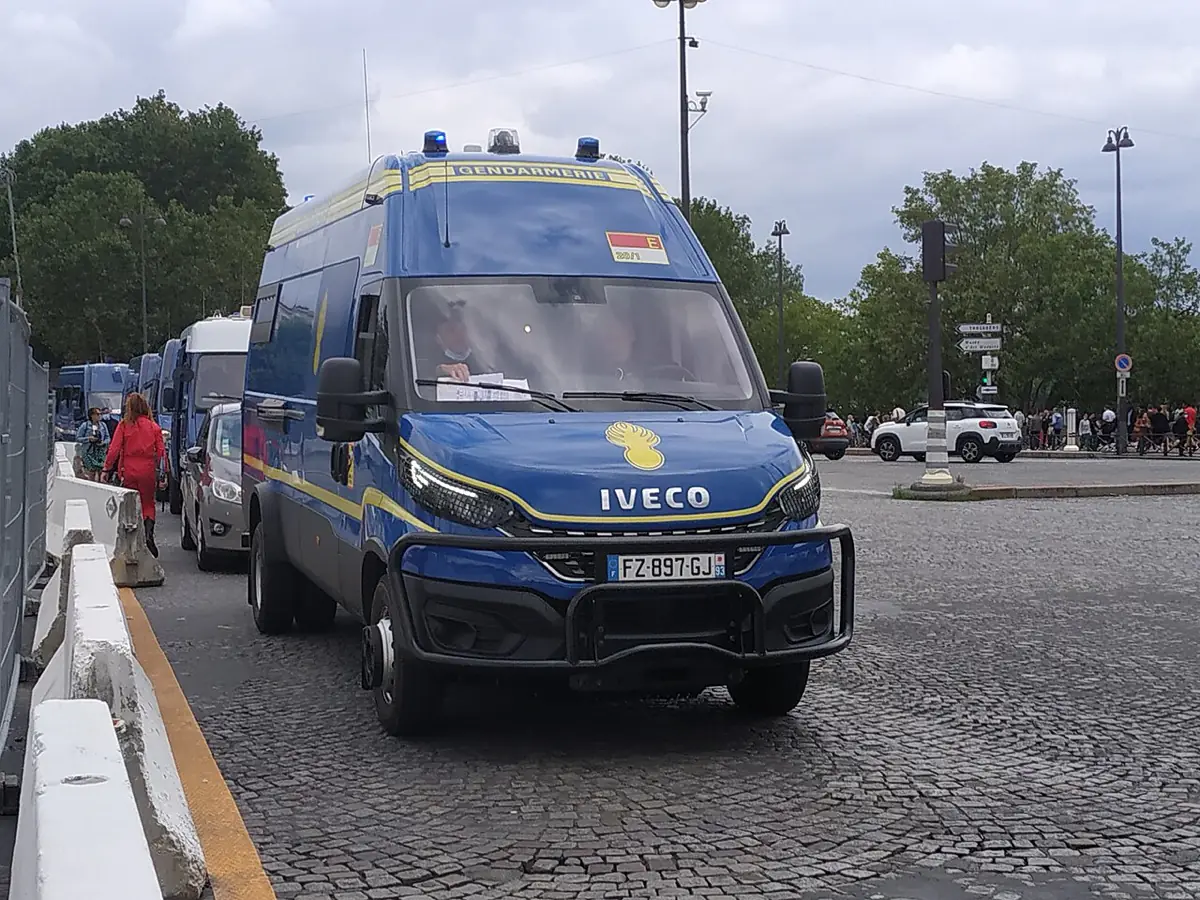
A Gendarmerie Mobile Iveco Daily van, photographed in 2021; file photo, not from the current protests. Photo: Kevin.B / Wikimedia Commons, CC BY-SA 4.0.
Policing under scrutiny
The movement began in September over conditions in state schools. It grew into wider anger over living costs. On 17 October more than half a million people demonstrated nationwide, according to Nuñez. A Reuters investigation found that police lost control of whole neighbourhoods in Paris, Marseille and Lyon that day. About 3,000 businesses were ransacked over 24 hours. Nuñez told MPs that the authorities had not foreseen the scale of the violence. He credits the 70,000-strong deployment with keeping order since. But he says security forces still face "a great deal of violence".
Justice Minister Gérald Darmanin said on 3 November that more than 4,900 suspects had been taken into custody since 17 October. He said 404 had been jailed. United Nations and other human rights experts have questioned the arrest of nearly 7,000 minors during school blockades, Reuters reported. Internal police watchdogs have opened 161 investigations into alleged violence by officers since September. Amnesty International has warned of a slide towards "authoritarianism". Officials say they are upholding the rule of law.
Macron has promised to "listen to the anger" and to "impose respect of the Republican order." Fabien Jobard, a sociologist at the French National Centre for Scientific Research, told Reuters: "Escalation happens when black blocs provoke with violence, and law enforcement are ordered to respond with violence." Black blocs are groups of protesters who dress in black and cover their faces.
Public opinion is mixed. An Odoxa poll for Le Figaro, reported by The Telegraph, found that 79 per cent of respondents thought the government's handling of the riots was inadequate. Majorities also backed police use of crowd-control weapons such as stun grenades. The report did not give the poll's fieldwork dates or sample size.
A police bill and a pay offer
One part of Saturday's march targeted a bill on police use of firearms. Its single article would presume that police officers and gendarmes who fire a weapon did so in a situation the law permits. It would also presume that they met the tests of absolute necessity and strict proportionality. According to the Senate, evidence to the contrary found during an investigation could overturn that presumption.
The National Assembly sent the bill to the Senate on 7 July. The Senate's law committee approved it without amendment on 10 November. The full Senate will debate it on Thursday 19 November. Supporters, including Marine Le Pen's National Rally, say it stops officers from being automatically suspected of excessive force. Critics call it a "licence to kill". They say it would make police harder to hold to account.
On pay, Lecornu announced on 9 November that the minimum wage would rise by 1.6 per cent from 1 December, to €1,502 a month after tax. According to AFP, only 0.6 percentage points of that is new money. The rest is an automatic increase that had been expected anyway. CGT leader Sophie Binet dismissed the offer as crumbs. The CFDT's Marylise Léon welcomed bringing the rise forward but called it insufficient. Public-sector unions have called a strike on 17 November. It is over pay and the freeze on the index point used to set civil servants' salaries.
What to watch
The Interior Ministry had not published Saturday's turnout figures by mid-afternoon. Next week brings three tests. First, the public-sector strike and demonstrations on Tuesday 17 November will show whether unions can still bring out large numbers. Second, the Conseil d'État, France's highest administrative court, is expected to rule during the week. It will hear a challenge by civil liberties groups over the short-notice publication of prefectoral protest orders. Third, the Senate debates the police firearms bill on 19 November. If senators pass it in the same wording as the Assembly, it will have cleared both chambers of Parliament.
Featured image: Avocats de la République (8903824163) by Jeanne Menjoulet from Paris, France, via Wikimedia Commons, CC BY 2.0.


