
A day after Keir Starmer announced his resignation, the contest to succeed him as Labour leader, and therefore as Britain's prime minister, has begun to take shape, and it is already framed as a battle between the party's two wings. On one side stands Andy Burnham, the soft-left mayor turned frontrunner; on the other, Wes Streeting, the centrist former health secretary. The choice Labour now faces is less about personalities than about how it answers the force that toppled Starmer: the rise of Reform UK.
Starmer, who informed King Charles III of his decision on Monday, remains in office as caretaker prime minister while the party runs its contest under the timetable he set out, nominations opening on 9 July, closing as Parliament rises on 16 July, and a new leader chosen by 1 September if more than one candidate stands.
The frontrunner: Andy Burnham
Burnham enters as the clear favourite, and the manner of his arrival tells its own story. The former mayor of Greater Manchester engineered a return to the House of Commons only last week, winning a by-election on 18 June with 54.8 percent of the vote, four days before Starmer announced he would go. The sequence was widely read at Westminster as positioning for precisely this moment.
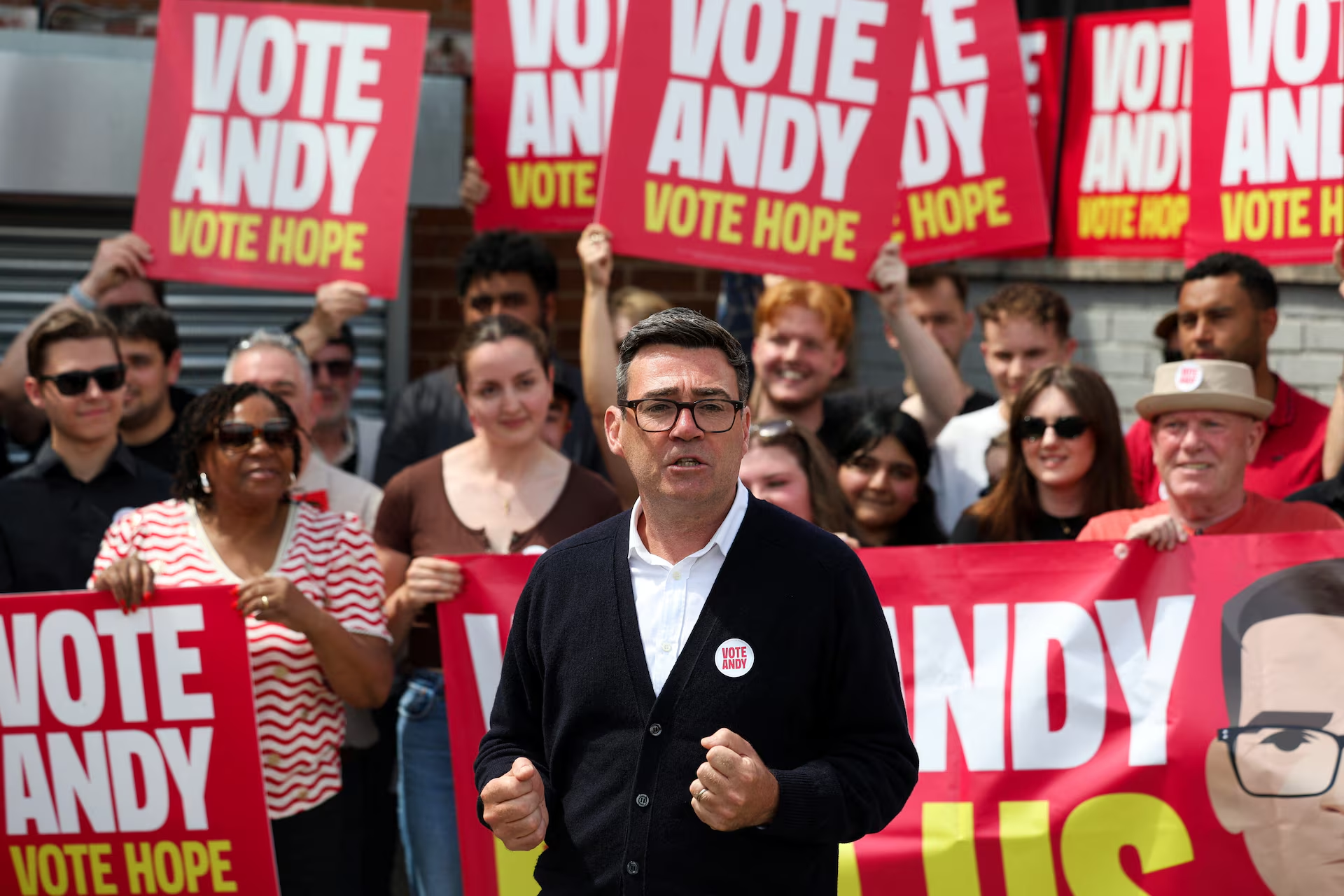
His appeal rests on a record outside the capital. By August 2025, polling had identified Burnham as the most popular senior Labour figure, and he sustained high approval across nine years running Greater Manchester. Crucially, he built a profile as a plain-spoken politician with reach into the working-class and northern English communities where Labour has been bleeding support to Reform UK, exactly the voters the party's rebels feared Starmer was losing. For MPs who concluded that Labour's problem was a failure to connect beyond its metropolitan base, Burnham is the obvious answer.
The challenger: Wes Streeting
Standing against him is Wes Streeting, who resigned as health secretary last month and now represents the party's centrist, more Blairite tradition. Where Burnham offers a populist, soft-left pitch aimed at winning back defectors to Reform, Streeting is expected to argue that Labour holds the centre ground by governing competently and avoiding a lurch leftward, that the route back to the voters runs through delivery and fiscal credibility, not repositioning.
The contrast is the substance of the contest. This is not merely a choice between two ambitious politicians but between two theories of why Labour is in trouble and two prescriptions for fixing it. One says the party lost touch with its traditional heartlands and must speak to them again; the other says it must not abandon the disciplined centrism that won it power in the first place. Whichever wins will set Labour's direction for the rest of this parliament.
How the contest works
The mechanics matter, because they shape the outcome. Under Labour's rules, candidates must first clear a threshold of nominations from fellow MPs to get on the ballot; if more than one qualifies, the decision passes to the wider party membership in a vote. That two-stage structure means the parliamentary party acts as a gatekeeper before members have their say — and it is why the number and identity of candidates who declare before 16 July will be so closely watched.
There is also a scenario in which the contest is short-circuited. If rivals conclude Burnham's lead is unassailable and stand aside, he could be installed as leader, and prime minister, without a drawn-out membership ballot, sparing Labour a divisive summer campaign at a moment of national uncertainty. Whether Streeting and others force a full contest or yield will be the first decisive choice of the race.
Why it matters
The stakes extend well beyond Labour's internal politics. The winner becomes prime minister of a nuclear-armed G7 power without a general election, inheriting the defence-spending dispute that broke Starmer, Britain's strained public finances, and a security environment unsettled by conflict in Europe and the Middle East. The party's choice of direction, populist soft-left or disciplined centre, will shape its stance on spending, tax, and how it confronts Reform UK, with consequences for British policy at home and abroad.
It is also a test case for Europe's centre-left more broadly. Labour's dilemma, whether to meet the hard-right's rise by reconnecting with working-class voters or by holding the centre, is the same one confronting social-democratic parties across the continent. How Britain's governing party answers it will be studied well beyond Westminster.
The Reform UK backdrop
Hanging over the whole contest is the party that arguably forced it. Reform UK's surge was the proximate cause of Labour's panic: its gains in the May local elections, where Labour shed more than 1,000 council seats, convinced rebels that the government was on course to lose the next general election outright. That backdrop shapes how each candidate's pitch will be judged. Burnham's case is, in effect, that only a leader who can speak to the voters Reform is peeling away can blunt its rise; Streeting's is that chasing Reform on its own terms is a trap, and that competence and stability will ultimately win those voters back. Neither theory has been tested in office, and the new leader will have little time to prove one before the electoral clock starts again. Whoever wins inherits not just the leadership but the specific problem of Reform UK that ended Starmer's tenure.
What's next

The decisive moments come fast. Watch which candidates clear the nomination threshold by 16 July, and whether anyone of stature joins Burnham and Streeting; watch whether Streeting presses a full membership contest into September or stands aside; and watch what the front-runners signal on defence spending and the economy, the issues an incoming prime minister cannot dodge. Starmer's exit settled who will not lead Labour into the next election. The contest now beginning will settle the far larger question of what kind of party, and government, Britain gets next.