
Prime Minister Andy Burnham will tell a City of London audience on Monday evening that Brexit "has not worked", according to advance excerpts of his speech released by Downing Street. He will use the address, at the Lord Mayor's Banquet, to set three tests for any new agreement with the European Union.
The speech comes four days before a UK-EU summit in Brussels on Friday 20 November. There, Burnham hopes to sign agreements on food and farm trade, emissions trading and youth mobility. It is his clearest attempt yet to reframe the 2016 referendum result while keeping the limits his party set out at the last general election.
"It's like the emperor's new clothes – where no one is prepared to say the obvious truth. Well, I say it as I see it. And to be frank, the emperor has nothing on. The Brexit we were given has not worked. We have lost more than we gained."
The banquet speech is traditionally a prime minister's set-piece address on foreign policy. He will describe the Brexit deal negotiated under Boris Johnson's Conservative government as a "hard Brexit that no one ever seriously argued for in the referendum".
Three tests for any agreement
According to the excerpts, any deal with Brussels must meet three conditions.
- The red lines. It must be consistent with Labour's 2024 manifesto. That rules out rejoining the EU single market or customs union, or restoring free movement of people. Reuters reported that these commitments bind Labour until the next general election, due by 2029.
- A better deal. It must improve on the agreement the UK signed when it left the bloc.
- The "Makerfield test". Named after the Greater Manchester seat Burnham won at a by-election, this requires, in Downing Street's words, "delivering real, tangible improvements in people's everyday lives".
Burnham will present the approach as a change of tone towards Europe. "It illustrates our new approach. Not adversarial. No longer burning bridges," he is expected to say.
Beyond Friday, Burnham has signalled he is open to a wider debate about the UK's long-term place in Europe. PA Media reported that he has said voters would ultimately decide any longer-term relationship. The Evening Standard reported that he would like to see the UK back in the EU in his lifetime. Reuters noted that this willingness to discuss broader options reopens a question that upended British politics after 2016.
What is on the table in Brussels
The centrepiece is a sanitary and phytosanitary (SPS) agreement. SPS rules cover food safety and animal and plant health. Under the deal, the UK would follow EU rules in these areas, cutting checks and paperwork at the border.
Hamish Falconer, the minister for EU relations, told the BBC that the UK would have a "voice in the room" but no vote on EU food rules. He said there would be no upfront payments. He also indicated the agreement could include an "exit clause" in case a future government reversed the alignment. "The EU is worried about that and you can see why," he said. The BBC reported that Brussels is concerned about the cost of rebuilding border inspection facilities if the deal were undone.
Falconer said the food element alone would be worth an additional £5bn. The full package, which also covers linking the two sides' emissions trading systems and a youth mobility scheme, is calculated to add 0.4 per cent to UK GDP. Speaking at a Marks & Spencer site in central London, he said some of the retailer's lorries need more than 300 pages of documents to export food. "This will mean less cost for supermarkets, and I hope that less cost then turns into cheaper produce on the shelves," he said.
The deal could also remove checks on goods moving from Great Britain to Northern Ireland and end separate "Not for EU" labelling, Falconer said.
The summit was due in July but was postponed when Keir Starmer resigned, as Hemera reported in June. The negotiations stem from the first UK-EU summit in May 2025. That meeting committed both sides to work towards new legal agreements on food standards and emissions trading.
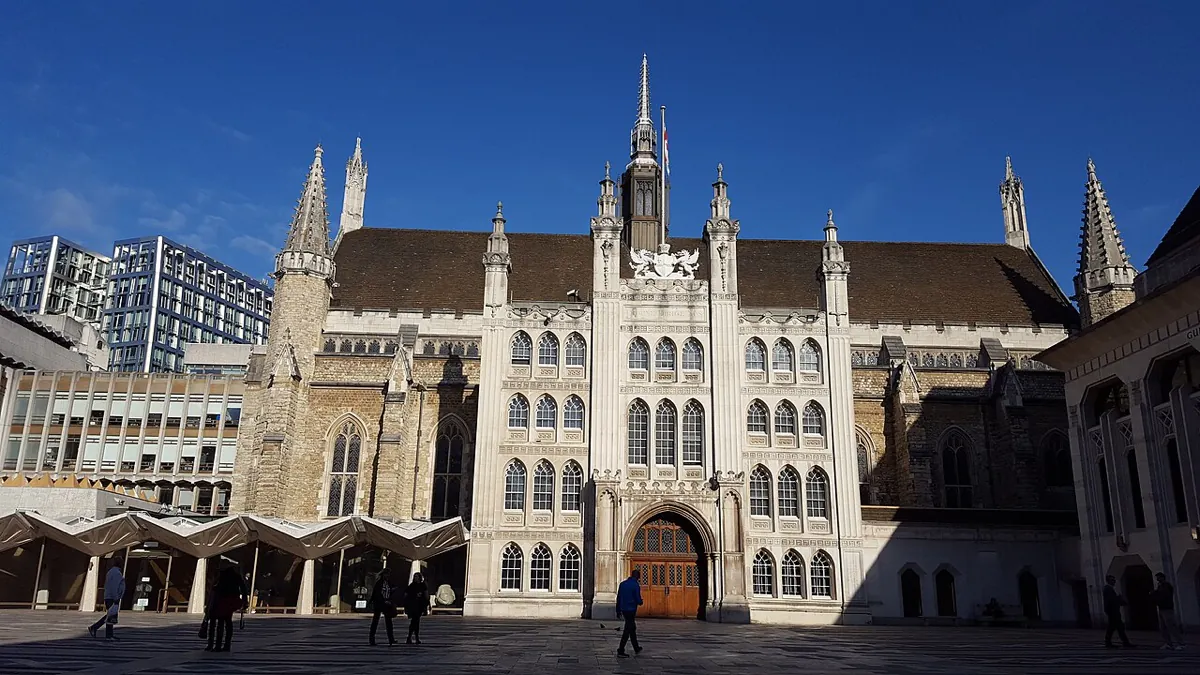
Guildhall in the City of London, pictured in 2016. Photo: Christine Matthews / Wikimedia Commons, CC BY-SA 2.0.
The case against
The Conservatives and Reform UK have both said they would undo the reset if elected. Critics, the BBC reported, say the UK would become a "rule taker", following EU law without a vote on it. In September the Conservatives said they were "raising the alarm", warning the arrangement would leave consumers and businesses "dangerously exposed, with no input on how regulations are made or power to reject them".
Alex Burghart, the Conservative deputy leader, said Burnham was "reopening a debate the country settled long ago, while ignoring the challenges facing Britain today". He pointed to welfare spending, the economy and defence funding as more pressing priorities. "A Conservative government would work to take this country forwards, not backwards," he said.
Oliver Lewis, a former deputy Brexit negotiator under Johnson who now chairs the Stay Out campaign group, turned the prime minister's own test against him. "The Prime Minister keeps reaching for his Makerfield test, but he won that seat by promising not to undo Brexit," he said. Lewis argued the deal would send more money to Brussels and expand immigration.
Nigel Farage, the Reform UK leader, has argued that Burnham's European stance will help his party in Leave-voting areas. Speaking in Doncaster on 1 October, he said Burnham had "opened the door to Reform in the most extraordinary way". The Evening Standard reported that some cabinet ministers share concerns about alienating Labour supporters who voted Leave.
Farmers weigh the trade-offs
Business reaction has been more mixed than hostile. Tom Bradshaw, president of the National Farmers' Union, welcomed the prospect of fewer inspections and less paperwork. He told the BBC that food export volumes to the EU had "fallen significantly - by over a third" since 2019.
But he called the deal "a moment of opportunity and risk". Farmers want to see what exemptions and transition periods are agreed. Bradshaw singled out pesticides and gene-edited crops, where UK rules have been looser than the EU's. Falconer said people would have to "wait and see the detail" in those areas.
What to watch
The first test is the speech itself on Monday evening, and whether Burnham goes further than the excerpts in describing the UK's long-term options. The second is the summit on Friday, where the texts on food, emissions trading and youth mobility should become public. Their carve-outs, the exit clause and any financial contribution will shape the political argument at home.
Signing is not the end of the process. A House of Lords committee has said an SPS agreement would need primary legislation, meaning a bill passed by both Houses of Parliament. Because the UK would track future EU rules, a joint UK-Commission committee would decide how new EU law is taken on. Parliament would scrutinise those decisions. On the EU side, the Council of member states must formally adopt any agreement, with European Parliament approval where required.
Featured image: Berlaymont building 2022 by Euro Pictures, via Wikimedia Commons, CC BY 2.0.


