

Canada could turn to Chinese carmakers if trade talks with the United States fail to keep North America's car industry integrated, the Canadian prime minister, Mark Carney, said on Monday 16 November. He told reporters in Phnom Penh, Cambodia, that European and Japanese manufacturers were also options. A deal with Washington, he said, was still his priority.
The remarks matter because they came just before Carney's meeting with the Chinese president, Xi Jinping, in Shenzhen, where car manufacturing is expected to be on the agenda. Canada's car industry was built on cross-border production with the US. Since President Donald Trump put 25 per cent tariffs on cars built in Canada and Mexico, that model has been under strain. The two governments have talked for months about cutting those tariffs, but there is no deal yet.
What Carney said
"We have the best auto workers in the world, and we want them fully deployed, full opportunity, in an integrated North American market," Carney said. "That market has become less integrated because of US trade actions."
He described a joint Canada-US car sector as "the best result for Canadian workers, for Canadian businesses, and for US consumers", according to Bloomberg. But he said that if the talks went the wrong way, "there’ll be other options, European options, Asian options, of course".
Asked whether the prospect of Chinese investment was leverage in the US talks, he said: "It’s not leverage. But action, reaction." Speaking of Canada's car workers and factories, he added: "If they’re not fully utilized in a North American context, that provides other opportunities. Canada is going to move forward either way."
Carney set conditions on any Chinese investment. Factories would have to carry out substantial manufacturing in Canada, not just assemble imported parts. They would also need to meet Canadian labour standards. Their supply chains would have to grow locally over time, including the use of Canadian critical minerals in electric vehicles (EVs). "It’s not just about kit cars," he said. "There has to be a manufacturing aspect involved."
The January deal and its unmet investment goal
Carney and Xi met in Beijing on 16 January and agreed a trade deal. Canada had imposed a 100 per cent surtax on Chinese-built EVs in October 2024, under Carney's predecessor, Justin Trudeau. Under the January deal, up to 49,000 Chinese EVs a year can now enter Canada at a tariff of 6.1 per cent. In return, China agreed to lower tariffs on Canadian farm goods. Carney said at the time that China's combined tariff on canola seed would fall from 84 per cent to about 15 per cent by 1 March, Al Jazeera reported.
The quota is not a large opening. China exported 41,678 EVs to Canada in 2023, before the surtax. Bloomberg reported in May that the quota is below 3 per cent of Canada's new-car market and rises each year. From 2027, a growing share is reserved for vehicles priced at C$35,000 or less, reaching half of the quota by 2030.
The first cars under the deal began arriving in late May. They included Tesla models built in Shanghai and a small shipment of Lotus Eletre SUVs; Lotus is owned by China's Geely. Carney said at the time that Teslas would make up most of the quota at first.
The January pact also set a goal to "drive considerable new Chinese joint-venture investment" in Canadian car manufacturing within three years. No such investment has been announced, according to Bloomberg.
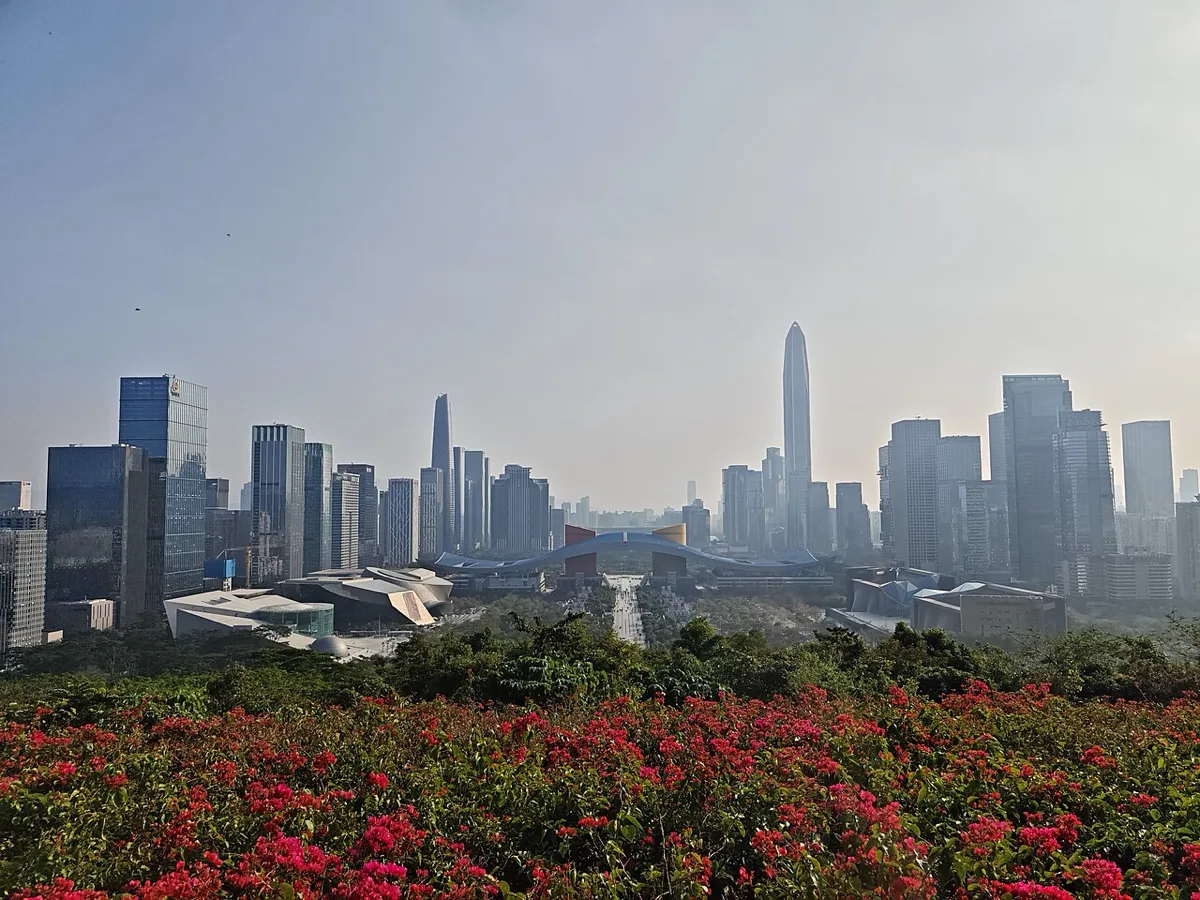
The Civic Centre and Futian business district in Shenzhen, China, photographed in December 2025. Photo: Pathfinbird / Wikimedia Commons, CC BY-SA 4.0.
Pressure from Washington and Ontario
Trump administration officials have criticised Ottawa for opening its market to Chinese carmakers. Trump has repeatedly urged manufacturers to move production from Canada to the US. Ford, General Motors and Stellantis, known as the Detroit Three, run plants in Canada, the US and Mexico. Parts can cross borders several times before a car is finished. The car dispute is one of several between Ottawa and Washington. Others include a border security row in which the US issued warnings to Canada's aviation sector, as Hemera reported in February.
The tariffs are already affecting Canadian plants. Stellantis moved planned Jeep Compass production from Brampton, Ontario, to Illinois, and Ottawa threatened legal action. The company has since agreed to sell its idled Canadian assembly plant, according to the Associated Press.
There is also opposition at home. Doug Ford, premier of Ontario, the centre of Canada's car industry, warned that letting in Chinese EVs could put Canadian jobs and access to the US market at risk. General Motors' chief executive, Mary Barra, has also questioned the decision, Bloomberg reported.
On Saturday 14 November in Manila, Carney said he had spoken at length with Trump and senior US officials. He said the two sides were making progress towards a deal, though differences remained. He also said any agreement must leave Canada with a viable car industry.
Analysis: the logic, and the UK contrast
Carney's conditions show what Ottawa wants: Chinese investment in factories, jobs and minerals processing, not just cheaper imported cars. His comments suggest Chinese investment is a fallback if US talks fail, not the main plan. The risk is the one Ford described.
Britain has taken a different path. The EU imposed tariffs on Chinese-built EVs in 2024, after concluding that they benefited from unfair state subsidies. The UK has not followed. Chinese-owned brands, led by MG, BYD and Chery's Jaecoo and Omoda, now take about 15 per cent of UK new-car registrations, according to Society of Motor Manufacturers and Traders (SMMT) data cited by Reuters in July. The SMMT's chief executive, Mike Hawes, said Chinese competition was driving heavy discounting. He added that any trade investigation would need complaints from UK manufacturers, and that he knew of none.
Canada, then, is using a capped quota and making local production a condition of access. The UK has largely left its market open. Where Chinese carmakers choose to build outside China will affect UK jobs and supply chains as well as Canada's.
What to watch
- The Xi meeting: Carney's separate meeting with Xi is due in Shenzhen this week, on 17 November according to Bloomberg. Watch for any named Chinese carmaker or joint-venture plan.
- APEC summit: leaders meet in Shenzhen on 18 and 19 November. Trump is expected to attend, but it is not clear whether he and Carney will meet. Mexico's president, Claudia Sheinbaum, has said she plans to meet Carney.
- US tariff talks: any Canada-US agreement on the 25 per cent car tariffs would change how much Ottawa needs alternatives.
- Quota changes: the share of the EV quota reserved for cheaper cars starts rising in 2027.
Featured image: Prime Minister Mark Carney and President Donald Trump - 20251007 by White House, via Wikimedia Commons, Public domain.


