

Tesla has started inviting selected customers in the United States to buy its Cybercab for private use. The list price is $29,990 (about £22,400). The two-seater has no steering wheel or pedals. It will not move unless the owner also pays a $299 (about £223) monthly "Autonomy Subscription". It will operate only inside the zones where Tesla runs its Robotaxi service.
The company announced the offer on Friday 13 November through its Robotaxi account on X: "Select customers are now being invited to purchase Cybercab for personal use." It is the first time Tesla has offered consumers a car designed to drive itself without supervision. It also shows how Tesla intends to make money from autonomy. The plan is a recurring fee set by the company, not a one-off sale.
What buyers are signing up to
Tesla shared screenshots of the order page. Electrek and Not a Tesla App reported on them. They show that buyers must pay a $1,000 non-refundable deposit. The page gives an estimated delivery of December 2026 in Austin, Texas. The subscription is pre-selected, with the first month included. Tesla's invitation email states: "Only available in supported service areas. Subscription required for operation."
Tesla's "Cybercab Autonomy Subscription Agreement" appeared on its online configurator late on Friday, Electrek reported. Its central line is blunt: "Your Cybercab will not operate without an active Autonomy Subscription."
The agreement, as described by Electrek, The Verge and Teslarati, gives Tesla wide control after the sale:
- Tesla can change the subscription price with one month's notice.
- The car works only inside Tesla's Robotaxi geofences. These are the mapped boundaries of its service areas. Tesla says it "may expand, reduce, relocate, or otherwise modify the operating area at any time."
- Three or more "strikeouts" for improper or unsafe use trigger a one-week suspension, with no pro-rata refund.
- Use is personal only. Owners cannot put the car on Tesla's own Robotaxi network, ride-hailing, delivery or rental platforms without written authorisation.
- Resale requires Tesla's written permission, according to Teslarati.
- Tesla keeps images from the cabin camera for 30 days by default, Electrek reported.
The subscription covers autonomous driving, some maintenance and towing, but not insurance, according to Teslarati. Over five years, the purchase price plus 59 paid months comes to $47,631 (about £35,500), on Electrek's calculation. That excludes insurance, registration, charging and tax.
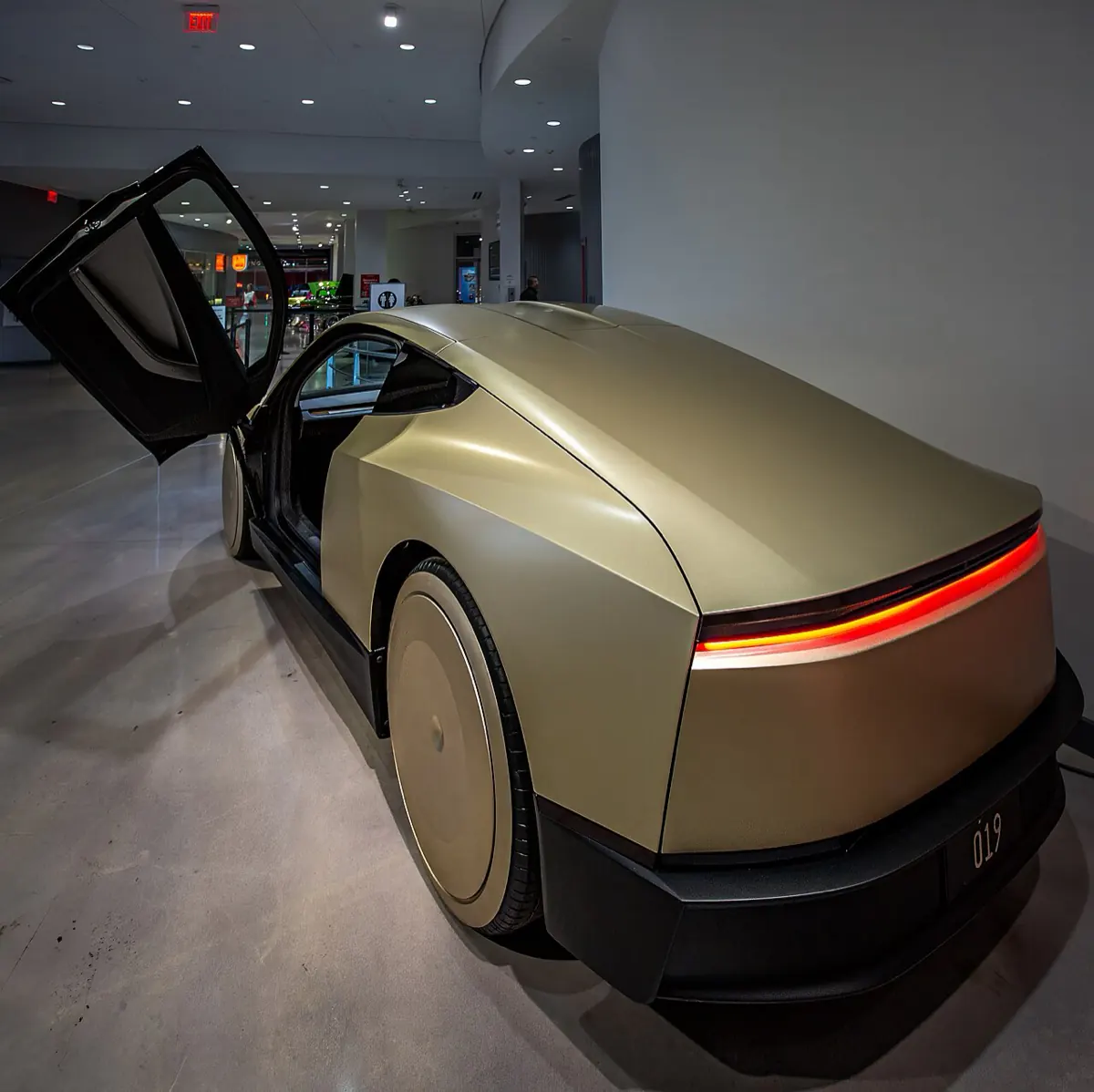
A Tesla Cybercab prototype on display at the Petersen Automotive Museum in Los Angeles, photographed in November 2024. Photo: RON RAFFETY / Wikimedia Commons, CC BY-SA 2.0.
A subscription business with a car attached
Elon Musk, Tesla's chief executive, unveiled the Cybercab in October 2024. He promised a price below $30,000. He did not mention a subscription. Tesla already charges $99 a month for its Full Self-Driving (FSD) software. That system still requires a driver to supervise at all times. Since February it has been sold only as a subscription, Electrek reported.
Musk himself appeared to question the new fee. Replying on X, he wrote that "the monthly fee is too high". He suggested it should be more like ~$115/month, in line with FSD plus connectivity on other models. Tesla has not announced any change to the $299 price. Reuters reported that Musk said the offer would be available nationwide once regulators approve it.
The personal-use clause clashes with a long-standing Tesla pitch. At the 2024 unveiling, Musk suggested owners could add their cars to a Robotaxi fleet and earn money from them. Tesla's head of AI, Ashok Elluswamy, has pointed to the second quarter of 2027 as a possible date. That is when customer cars could join the network. He has said the privately owned Cybercab will "work unsupervised inside all the same geo locations as Robotaxi, just serving the owners' needs."
Critics argue that the structure favours Tesla. Electrek's editor-in-chief, Fred Lambert, notes that the Cybercab uses the same AI4 computer as the current Model Y. Model Ys already run without supervision in Tesla's Robotaxi fleet. Yet customers who bought FSD have not been given the same capability. Mark Valorian went through the terms on X. The commentator described the deal as "an endless variable-rate lease with a ridiculous down payment."
The geofence matters too. Tesla runs Robotaxi services in eight cities: Austin, Dallas, Fort Worth, Houston and San Antonio in Texas, and Miami, Orlando and Tampa in Florida. An independent tracker, Koby Pierce, tested addresses in the Robotaxi app. He found that the areas where Tesla accepts pickups covered only 59 to 78 per cent of the advertised maps in six cities. Electrek reported this. The crowd-sourced Robotaxi Tracker, cited by The Verge, says Tesla has 278 Cybercabs in service. That is about 40 per cent of its Robotaxi fleet.
A car awaiting a regulatory verdict
US federal safety standards were written for cars with human controls. FMVSS 135, the braking standard, requires service brakes operated by a foot control. The Cybercab has none. Tesla did not seek an exemption. It self-certified that the car complies.
The National Highway Traffic Safety Administration (NHTSA) opened an audit, numbered AQ26002, in September. It issued a special order requiring sworn answers to 21 questions. The agency has said the vehicles "lack permanently attached, conventional manual controls, such as a brake pedal." Tesla responded on 30 October. Its cover letter stated: "The entirety of this file is confidential business information." Electrek reported that NHTSA has not ruled. It has not found the Cybercab non-compliant with any standard.
By contrast, Amazon-owned Zoox won a formal exemption in July for its own robotaxi. That exemption is capped at 2,500 vehicles a year. Tesla is now taking consumer deposits. Its certification is still under review. It has not said how many invitations it has sent or how buyers were chosen.
What it means for the UK
Tesla has announced no UK price, launch date or trial for the Cybercab. Britain's Automated Vehicles Act 2024 is not due to be fully in force until the second half of 2027. Permits for small pilot passenger services began earlier. Any UK sale of a car without manual controls would also need vehicle approval. A subscription model lets the manufacturer reprice the service or switch off the car. That is likely to draw scrutiny under British consumer law. That question remains untested.
What to watch
The first test is whether Tesla delivers privately owned Cybercabs in Austin in December. That date also matters for a public bet. YouTuber Marques Brownlee promised to shave his head if Tesla delivered a Cybercab for under $30,000 before 2027. Next comes NHTSA's response to Tesla's certification and its confidentiality claim. Buyers will also watch whether Musk's view that the fee is "too high" leads to a lower price. Then there is Elluswamy's second-quarter 2027 target for letting customer cars earn money on the Robotaxi network.
Featured image: Inside the Tesla Cybercab by Steve Jurvetson from Los Altos, USA, via Wikimedia Commons, CC BY 2.0.


