

China's carmakers are selling abroad faster than ever, and every country they enter is writing its own rules. On 13 November 2026, BYD's luxury brand Denza launched in India with two imported electric models. On 16 November, BYD's cumulative car sales in Japan were reported to have passed 10,000. On the same day, Canada's prime minister, Mark Carney, said Canada could turn to Chinese carmakers if its trade talks with the United States failed.
The push starts at home. China's domestic passenger car retail sales fell 27.1 per cent year on year in October, while passenger car exports rose 68.5 per cent to 928,000, according to China Passenger Car Association (CPCA) data reported by CarNewsChina. BYD sold 1,507,395 cars and pickups outside China in the first ten months of 2026. That is already more than the 1.04 million it sold abroad in the whole of 2025.
BYD's earlier entries show how much has changed. It reached India in 2021 and Japan in 2023 as a small importer of a few models. In 2026 it is adding luxury brands and cars built for one market, and it is building factories where governments allow them. The figures point to a clear pattern. Countries that welcome investment, such as Hungary, are getting plants. Countries that restrict it, such as India, are getting imports, capped or taxed. Canada is still deciding.
What happened in India, Japan and Canada
India. Denza launched the D9, a seven-seat electric people carrier, at an ex-showroom price of 9 million rupees. The Z9 GT, an electric shooting brake (an estate-shaped performance car), costs 15.68 million rupees. Electrive put these at about €87,500 and €152,400. Both cars are imported fully built from China and sold only as battery-electric models in India. Denza plans showrooms in six cities and has already opened them in Gurugram and Mumbai.
Denza is aiming small. India's luxury car market takes about 50,000 sales a year, according to electrive. Reuters, cited by CnEVPost, put it at just over 1 per cent of the country's 4.4 million passenger car sales in 2025. Rajeev Chauhan, who heads BYD India's electric passenger vehicle business, told Autocar Professional that "close to 80-90 numbers are for sure happening in couple of months."
Japan. BYD's cumulative passenger car sales in Japan have passed 10,000 since deliveries began in January 2023, Automotive World reported. The first 5,000 took roughly two and a half years. The second 5,000 took about 15 months. Part of that speed came from the Racco, a kei car built for Japan and launched on 28 July 2026. Kei cars are a Japanese class of very small cars with size and power limits. In October the Racco sold 607 units, against 878 for the Nissan Sakura, Japan's best-selling electric car, according to InsideEVs.
Canada. Speaking in Cambodia on 16 November, Carney said negotiations with Washington remained his priority. If they failed, Canada could seek investment from Chinese, European or Japanese carmakers instead. He set a condition. "It's not just about kit cars," he said. "There has to be a manufacturing aspect involved." Hemera reported his remarks on 16 November.
Carney met China's president, Xi Jinping, in Shenzhen on 17 November. The meeting brought Chinese concessions on Canadian pork and seafood but no new announcement on electric vehicles, BNN Bloomberg reported. The White House trade adviser, Peter Navarro, criticised Carney's remarks on social media.
BYD's entries, then and now
The table below sets BYD's first step into each market against its latest move.
Market | BYD entry | First offer | Latest step | Latest figure |
|---|---|---|---|---|
India | 2021 | e6 electric MPV, for fleets | Denza D9 and Z9 GT, Nov 2026 | 5,361 retail sales, Apr 2025–Mar 2026 |
Japan | Jan 2023 | Atto 3 SUV | Racco kei car, Jul 2026 | Over 10,000 cumulative sales |
Hungary | Trial production, Jan 2026 | Dolphin Surf expected first | Assembly due before end-2026 | 200,000 a year planned capacity |
Canada | Not yet on sale | Atto 3, Seal, Dolphin, Seagull in preparation | Recruiting in Greater Toronto Area | 16,211 of 49,000 quota used (all makers) |
Sources: China EV Home (FADA data), Automotive World, electrive, Globe and Mail, Canadian government data via China EV Home.
Two things have changed. First, the product. BYD entered both India and Japan with mainstream electric models from its Chinese range. It now sells a luxury brand in India and a car designed only for Japan. Second, BYD now has factories abroad. Its plant in Brazil has begun operating, its Thai and Indonesian projects are progressing, and assembly in Hungary is scheduled to start before the end of 2026, a BYD spokesman told China EV Home.
Results in India have been uneven. FADA, the Indian dealers' federation, counted 5,361 BYD retail sales in the year to March 2026, up 54 per cent. But from January to October 2026 BYD had 6,755 registrations and ranked seventh among electric car brands. October registrations fell 3.8 per cent year on year, to 735.
Five Chinese carmakers compared
BYD is the largest exporter, but four rivals are also expanding fast, each by a different route. The table compares them on the latest published figures.
Carmaker | Overseas volume, 2026 | Versus earlier | Local production abroad | Canada plans |
|---|---|---|---|---|
BYD | 1,507,395 (Jan–Oct) | 1.04m in all of 2025 | Thailand, Brazil, Indonesia; Hungary due | Four models in preparation |
Chery | 1,751,766 exports (Jan–Oct) | Up 64.8% | Barcelona venture with Ebro, delayed | Sales from early 2027 |
Geely | 904,823 exports (Jan–Oct) | Up 167.94% | Brazil, at a Renault plant | Sales from 2027 |
Leapmotor | Over 150,000 exports (Jan–Sep) | Sold abroad via Stellantis venture | Zaragoza, Spain, from 16 Oct 2026 | Not disclosed |
Xpeng | Over 13,000 in October alone | 45,008 in all of 2025 | Indonesia; Austria via Magna; Malaysia | Not disclosed |
Sources: China EV Home (BYD release), CnEVPost, Xpeng results release, Gasgoo, Reuters via MarketScreener, Globe and Mail.
The figures are not directly comparable. BYD reports overseas sales of passenger cars and pickups. Chery and Geely report exports from China. Even so, the gap is clear. Chery ships more abroad than BYD, and exports made up about 70 per cent of its sales over the ten months. Geely raised its full-year export target from 640,000 to 920,000 in August.
The routes differ too. BYD builds its own plants. Geely and Leapmotor use partners' factories, at Renault in Brazil and at Stellantis in Spain. Xpeng has its cars assembled under contract by Magna Steyr in Graz, Austria. Chery's own production in Barcelona, first planned for 2024, has slipped into 2026.
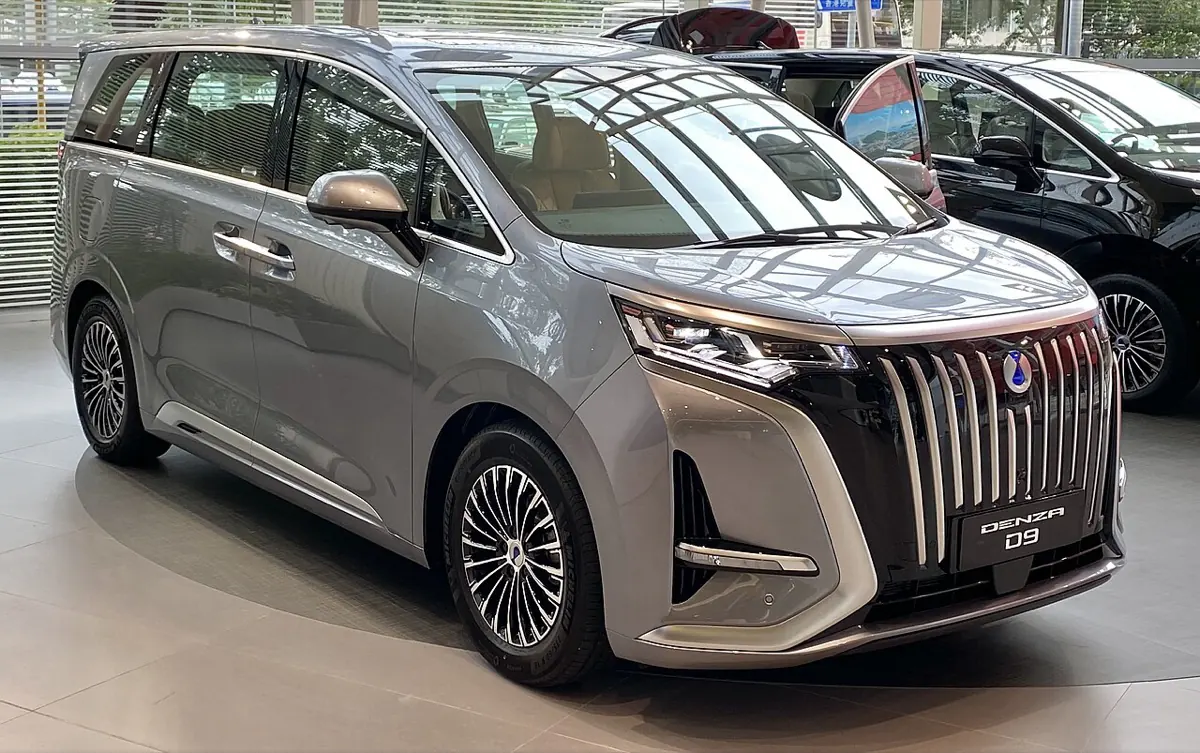
A Denza D9, the BYD-backed premium brand's people carrier, photographed in Kowloon, Hong Kong, in June 2024. Photo: User 3204 / Wikimedia Commons, CC BY-SA 4.0.
Why the push is happening now
The main reason is weakness at home. Exports made up 35 per cent of Chinese carmakers' passenger car sales in October, up from 19 per cent a year earlier, CarNewsChina reported. Domestic demand fell after China halved its purchase-tax break for new energy vehicles at the start of 2026. New energy vehicles are battery-electric and plug-in hybrid cars.
Margins are the second reason. BYD management has said its overseas business earns an average net profit of about RMB 20,000 per vehicle, China EV Home reported. This is a company claim and has not been independently audited at segment level.
The window may narrow. The CPCA also warned that some overseas orders were being shipped early, which could weaken exports in early 2027.
Four markets, four policy responses
Each government has set different terms for Chinese carmakers:
India: imports allowed, investment blocked. Companies from countries that share a land border with India, including China, need government approval to invest. An easing excluded Chinese firms, officials told Business Standard. Imported models without Indian type approval are limited to 2,500 units a year. BYD has now cleared that hurdle for the Atto 3, eMax 7 and Sealion 7, but not yet for the Seal or the two Denza models.
Japan: open market, uneven subsidies. From April 2026, the government purchase subsidy for BYD's electric cars was cut to ¥150,000. Toyota's bZ4X kept ¥1.3m, Automotive World reported. The scoring system rewards companies for their contribution in Japan, including charging networks. Yoshiaki Kawano of S&P Global Mobility said the change came after the US–Japan tariff talks. BYD Japan's president, Atsuki Tofukuji, has questioned whether nationality played a part.
Canada: a quota now, conditions on factories. From 1 March 2026, Canada replaced its 100 per cent surtax with a 6.1 per cent tariff on up to 49,000 Chinese-built electric cars a year. Government data published on 13 November showed 16,211 of those places used. The industry minister, Mélanie Joly, has said any factory must use Canadian parts and workers, with Canadian partners controlling joint ventures. Ontario's premier, Doug Ford, opposes assembling Chinese kits at local plants.
Hungary: an open door into the EU. BYD's Szeged plant and CATL's €7.3bn battery plant in Debrecen give Chinese firms production inside the EU. Cars built there avoid the EU's extra duties on Chinese-built electric cars, which add 20.7 per cent for Xpeng.
Hungary is the model Chinese carmakers have in mind for Canada, according to Wang Zichen of the Center for China and Globalization, a Beijing-based think tank that advises the government. "A Chinese car built in Hungary is not a Chinese car. It is a European car," he told the Globe and Mail.
Xpeng's route: contract plants and range extenders
Xpeng is much smaller than BYD but is now leaning harder on overseas sales. Its third-quarter results, published on 16 November, showed a record 118,390 deliveries and revenue of RMB 24.28bn, though the company remained loss-making. Overseas sales were more than 20 per cent of deliveries in the quarter, China EV Home reported.
Xpeng sold 45,008 cars abroad in 2025 in 60 countries and regions. It now expects more than 100,000 in 2026, including more than 40,000 in the fourth quarter. It forecasts that overseas sales will more than double again in 2027. Europe is expected to account for more than half of its international sales.
Xpeng's strategy relies on factories it does not own. Local production began in Indonesia in July 2025 and at Magna's Graz plant in September 2025. On 7 October 2026 the G9L SUV became the fourth model to complete trial production in Graz. Xpeng is also adapting its range market by market. In Australia, the L03 PowerX goes on sale in December at A$41,900. It is an extended-range electric vehicle, in which a petrol engine only generates electricity and never drives the wheels.
What it means for the UK
Britain is already one of the most open markets in Europe for Chinese brands. In October 2026, SMMT figures showed BYD registering 6,065 new cars, a 4.0 per cent share, up 73.3 per cent on a year earlier. Its 74,470 registrations so far in 2026 are up 90.5 per cent.
Chery's three brands, Jaecoo, Chery and Omoda, together registered 12,933 cars in October, more than MG's 7,837. Geely registered 2,269 and Leapmotor 1,773. Xpeng registered 330. It has said it will put more resources into its own subsidiary operations in the UK and Australia. In total, Chinese brands took more than a fifth of UK registrations in October, according to China EV Home's analysis of SMMT data.
Denza entered Europe in April 2026. Its UK pricing and availability have not been confirmed.
What is unclear, and what to watch
Two points are unresolved. Reports disagree on whether BYD's Szeged plant has begun series assembly. Canada's quota is also filling slowly. About a third of its places had been used by mid-November, so imports alone have not shown strong Chinese demand for the Canadian market.
27 November–6 December: the Guangzhou Auto Show, where BYD is expected to unveil its next-generation Han saloon.
December: BYD's year-end overseas total against its 1.8m target, and Xpeng's fourth-quarter overseas deliveries against its target of 40,000.
Before year-end: confirmation of series assembly at Szeged.
Canada–US talks: their outcome will decide whether Ottawa offers Chinese carmakers more than an import quota.
2027: Geely and Chery launch in Canada. India decides whether to certify Denza models after their first few quarters of sales.
Featured image: (SGP-Singapore) BYD Atto 3 SMHxxxxG 2024-04-14 by S5A-0043, via Wikimedia Commons, CC BY 4.0.


