

Spain votes on Sunday 29 November 2026 in a general election that the Socialist prime minister, Pedro Sánchez, called eight months early. On the headline figures his economy is one of Europe's strongest. The European Commission expects growth of 2.6 per cent this year, and unemployment stood at 10.18 per cent in the third quarter, below the 11.60 per cent recorded just before the last election in July 2023. Yet the final published polls put the conservative People's Party (PP) first, and most project that the PP and the hard-right Vox will win a majority of seats between them.
The gap between growth and mood is mostly about prices. Since the 2023 vote, annual house-price inflation measured by Spain's statistics office, INE, has risen from 3.6 per cent to 12.2 per cent. Over the same period growth in average wage costs slowed from 5.0 per cent to 4.0 per cent. Consumer prices were rising at 4.9 per cent a year in October 2026, against 2.3 per cent in July 2023. Economists quoted during the campaign say growth has come from more people working, not from each worker earning more.
The two big parties have not moved much since 2023. The change has come on the flanks. Vox has risen from 12.4 per cent of the vote to about 18 per cent. The parties to the Socialists' left have fallen from the 12.3 per cent won by Sumar in 2023 to about 8 per cent. In El País's polling average the right-wing bloc now leads the left by 12.5 points. In 2023 the two blocs were 1.6 points apart.
How the snap election came about
The immediate trigger was housing. In September an 87-year-old Madrid tenant was evicted. Her case set off protests, including an encampment at Madrid's Puerta del Sol, and a general strike that Bloomberg described as the first since 2012.
The government responded with changes to housing law. According to The Guardian, those proposals were voted down by right-wing parties and Catalan nationalists. Ara reports that Junts, the Catalan pro-independence party whose seven MPs had kept Sánchez in office, overturned the housing decree. Sánchez then called the election. El País dates the call to 6 October.
The campaign has not stayed on housing. Two rail disasters this year, at Adamuz and at Urda, have left 115 people dead, according to the BBC. The Urda crash on 28 October killed 69. And several court cases have touched Sánchez's circle, according to the BBC:
- José Luis Ábalos, a former transport minister, is serving a 24-year sentence for corruption-related crimes, the BBC reports.
- Santos Cerdán, a former senior Socialist official, is due to stand trial on similar charges, which he denies.
- Sánchez's wife, Begoña Gómez, faces trial over allegations of influence peddling. She denies wrongdoing.
- His brother, David Sánchez, has been barred from public office for nine years over irregularities in his appointment to a regional arts post. He denies wrongdoing.
Sánchez has acknowledged errors in trusting Ábalos and Cerdán. He has called the cases involving his wife, his brother and his former attorney general "nasty politics, not corruption", according to the BBC.
The polls set against the 2023 result
The table below sets the July 2023 result beside El País's weighted polling average and RTVE's seat projection, both published before the legal blackout on polls began on 24 November.
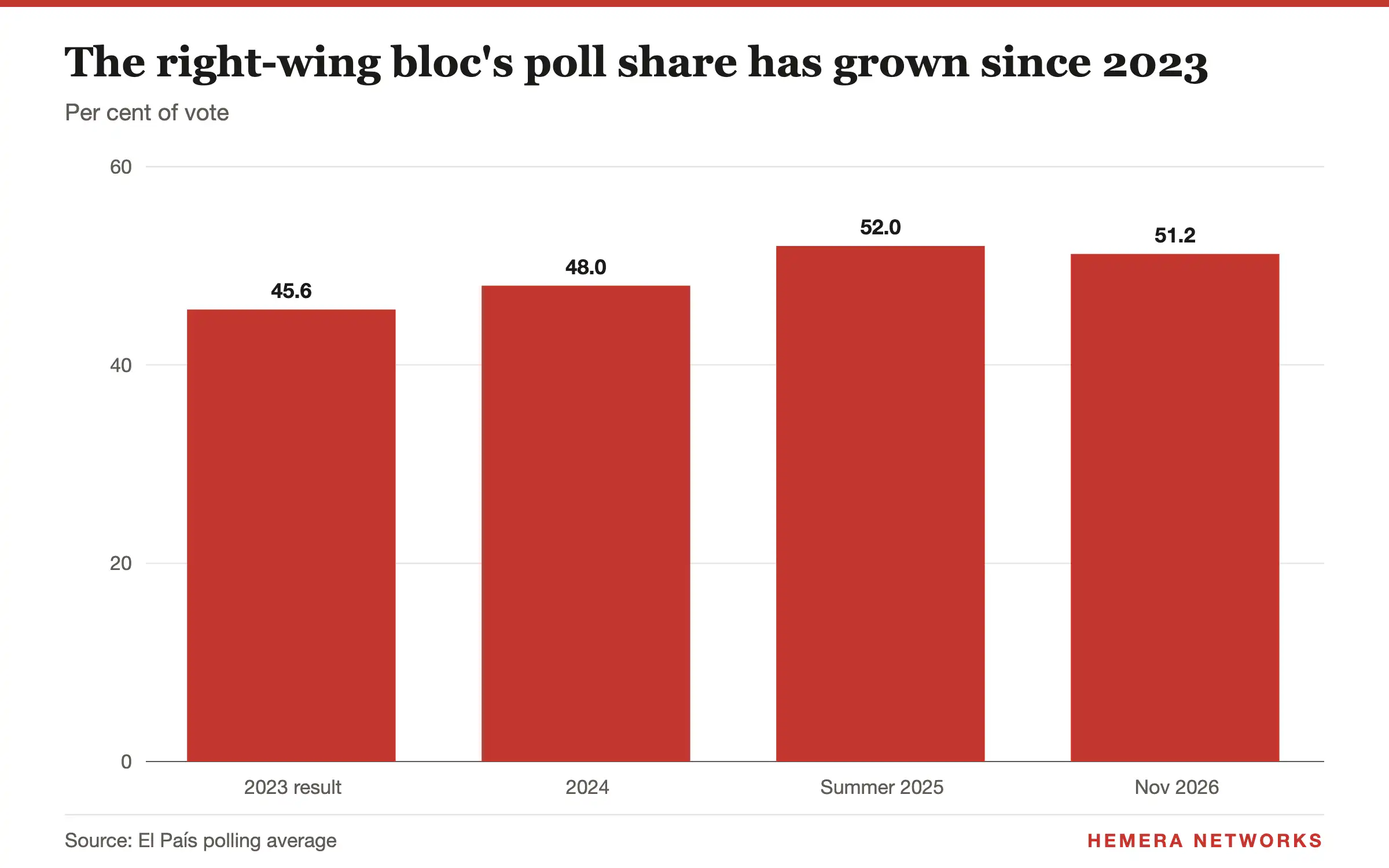
2023 is the actual result; later figures are El País's polling average. Chart: Hemera Networks. Source: El País polling average.
Party | 2023 vote (%) | 2023 seats | Poll average, Nov 2026 (%) | RTVE projected seats |
|---|---|---|---|---|
PP | 33.1 | 137 | 31.5 | 128 |
PSOE (Socialists) | 31.7 | 121 | 29 | 116 |
Vox | 12.4 | 33 | about 18 | 61 |
Sumar (2023) / left alliances and Podemos (2026) | 12.3 | 31 | 7.9 | not disclosed |
Sources: Congress of Deputies results via Wikipedia, El País polling average, RTVE average via Spain in English.
The 2026 figure on the left combines El País's 6.8 per cent for the new "Fronts" alliances and 1.1 per cent for Podemos where it runs alone. RTVE's PP figure includes its alliance with the Navarrese party UPN.
Individual polls point the same way, with different margins. A POLITICO poll by PF Global, with fieldwork from 15 to 17 November, had the PP on 29.5 per cent, the Socialists on 27.2 per cent and Vox on 19.6 per cent. A 40dB poll for El País and Cadena SER, with 7,500 interviews from 10 to 21 November, had the PP on 31.8 per cent and the Socialists on 30.9 per cent. That 0.9-point gap is inside its stated 1.1-point margin of error.
The bloc numbers matter more than the party race. By El País's count the right (PP, Vox and the smaller Se Acabó La Fiesta) stands at 51.2 per cent, against 38.7 per cent for the left. The right's share had risen from 48 per cent in 2024 to 52 per cent by summer 2025, before the left recovered about three points during the campaign. In 2023 the right won 45.6 per cent and the left 44 per cent.
The economy on paper: 2023 against 2026
The table compares the main indicators around the July 2023 election with the latest official figures.
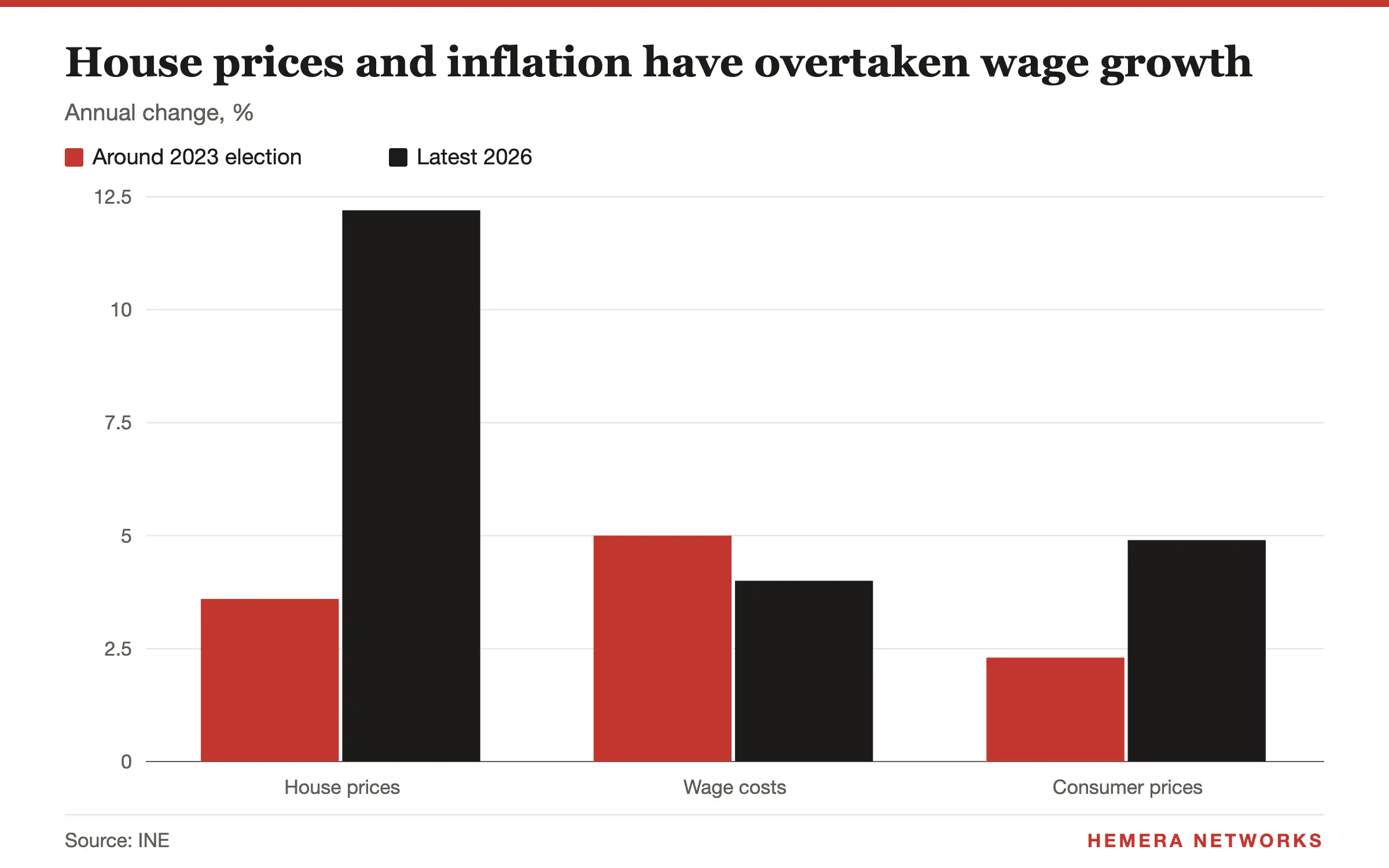
House prices and wage costs are second-quarter figures; consumer prices are July 2023 and October 2026. Chart: Hemera Networks. Source: INE.
Indicator | Around the 2023 election | Latest |
|---|---|---|
GDP growth, annual | 2.5% (2023) | 2.6% (2026, EC forecast) |
Unemployment rate | 11.60% (Q2 2023) | 10.18% (Q3 2026) |
Consumer price inflation | 2.3% (Jul 2023) | 4.9% (Oct 2026) |
House prices, annual change | 3.6% (Q2 2023) | 12.2% (Q2 2026) |
Rents on all contracts, annual change | 2.6% (2023) | 3.5% (2024, latest published) |
Wage cost per worker, per month | €2,262.63 (Q2 2023) | €2,512.68 (Q2 2026) |
Wage cost, annual change | 5.0% (Q2 2023) | 4.0% (Q2 2026) |
Sources: INE, European Commission.
Read across, the table shows two things. Activity and jobs are in better shape than in 2023. Average monthly wage costs are about 11 per cent higher than three years ago. But the prices households notice most are now rising faster than pay. In the second quarter of 2026, house prices rose three times as fast as wage costs. By October, headline inflation of 4.9 per cent was above the 4.0 per cent wage growth INE recorded for the second quarter.
The inflation rebound is recent. The Commission attributes it to "the surge in energy prices" and forecasts that harmonised inflation will average 3.9 per cent in 2026. Spain's growth still outpaces the eurozone: the EU projects 2.6 per cent for Spain against 1.2 per cent for the euro area, according to the Associated Press.
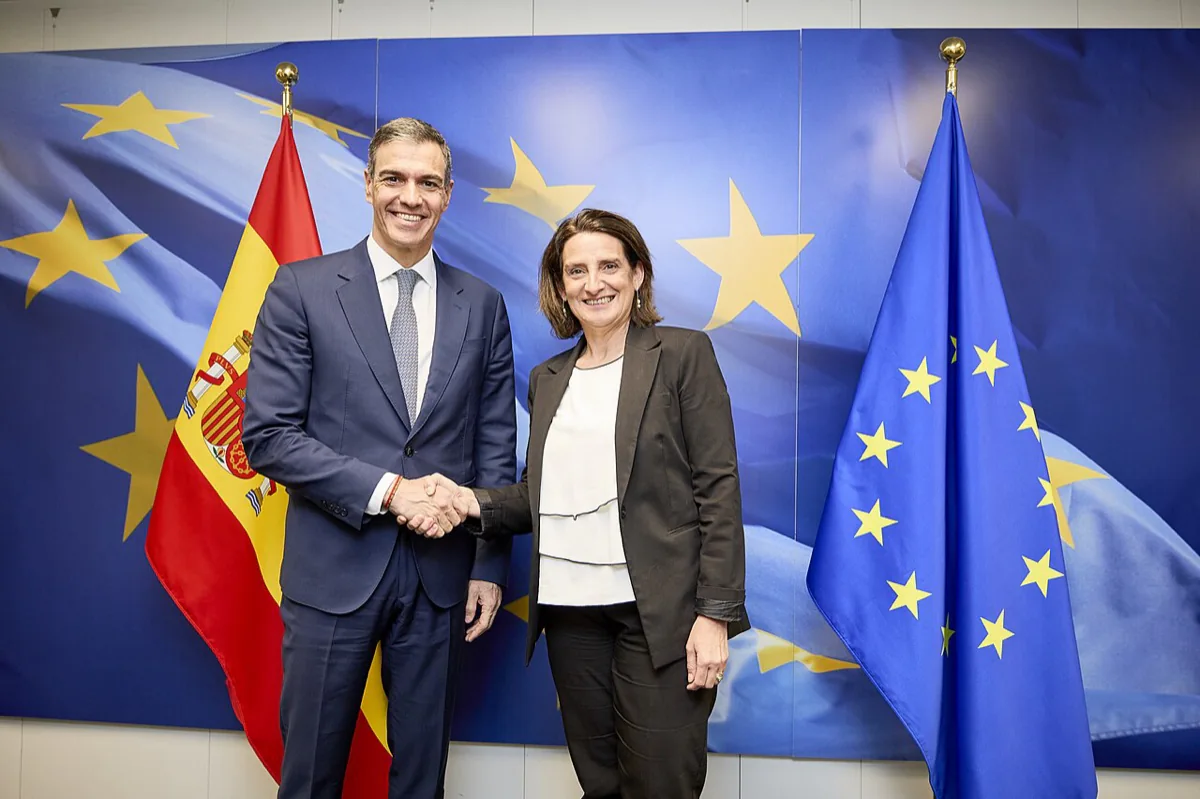
Spanish Prime Minister Pedro Sánchez shaking hands with Teresa Ribera at the European Commission, 28 May 2025. Photo: Europäische Kommission - Audiovisueller Dienst, Nicolas Landemard, Yügen, CE - Service audiovisuel, EC - Audiovisual Service / Wikimedia Commons, CC BY 4.0.
Why growth has not reached voters' pockets
Economists give three main reasons.
- Growth by volume. More workers raise total output without necessarily raising output per person. Pedro Aznar of Esade Business School told the AP: "We have a larger working population contributing to GDP, but our growth is driven more by volume rather than by generating more output per worker." Bloomberg reports that Spanish households are only about 11 per cent better off in real terms per head than two decades ago, half the EU average gain.
- Housing. Eurostat data cited by the AP show inflation-adjusted house prices rose 43 per cent between 2015 and 2025, against 25 per cent across the EU. The Bank of Spain estimates a shortage of 750,000 homes. Bloomberg reports that two-thirds of adults under 34 still live with their parents.
- Uneven pay gains. The minimum wage has risen sharply: by 54 per cent between 2018 and 2024, according to Bloomberg, and by 66 per cent since 2018, according to the AP, which measures to the present. Median wages have risen far less.
The rent figures help explain why the anger is concentrated among people who move. INE's index of all rental contracts rose only 3.5 per cent in 2024. But rents on new contracts rose 8.8 per cent that year, against 2.8 per cent on existing ones. Asking rents on the property portal Idealista were up 5.6 per cent in the year to October 2026, at €15.1 per square metre a month, and €23.4 in Madrid. The think tank Fedea estimates that almost 2 million extra households fall below the poverty line once rent is paid.
Ángel Talavera of Oxford Economics put it bluntly to the AP: "Housing has gone, well, bananas."
Some political scientists doubt the economy is deciding the race at all. Cristina Monge of the Complutense University told the BBC the campaign is "not so much about voters rewarding or punishing a government's performance or the proposals being made, but about belonging to one or other ideological bloc".
What each side is offering
The Socialists argue that the record is strong and the alternative riskier. In the only head-to-head debate, on 19 November, Sánchez cited growth and job creation. His government has extended a bank tax through 2027, with expected revenue of €1.4bn earmarked for housing, Anadolu reports.
The PP argues that growth has not translated into living standards. Feijóo replied that GDP could not be eaten, according to Politico. He promises to build 1 million homes. Polls by Sigma Dos and 40dB found viewers judged him the debate's winner, by 51 to 29 per cent and 43 to 33 per cent respectively.
Vox links immigration to housing, wages and public services. Its leader, Santiago Abascal, campaigns for a "national priority" giving Spaniards first access to services, a policy Vox negotiated in the four regions where the PP governs with Vox. "Spain doesn’t work anymore," Vox MP José María Figaredo said in a televised debate, as reported by Bloomberg.
Frente Amplio (Broad Front), led by former Barcelona mayor Ada Colau, is standing to the Socialists' left.
How the next government will be formed
Spain's 350 MPs are elected in 52 constituencies: the 50 provinces plus Ceuta and Melilla. Seats are allocated within each province by the D'Hondt method, which tends to reward larger parties, especially in small provinces. That is why a combined PP-Vox vote short of 50 per cent can still yield a majority of seats.
After the vote the King consults party leaders and nominates a candidate. Under Article 99 of the constitution, the candidate needs 176 votes at a first ballot, or more yes than no votes at a second ballot 48 hours later. If no one is invested within two months of the first vote, parliament is dissolved and a new election is held.
The 2023 precedent shows why seats, not first place, decide. Feijóo won most seats but lost his investiture on 27 September 2023 by 172 votes to 178. Sánchez was invested on 16 November 2023 by 179 votes to 171, with the backing of Sumar and Catalan, Basque, Galician and Canarian parties. Junts' support came in exchange for an amnesty for those prosecuted over the 2017 Catalan independence bid.
Grouping | 2023 (seats) | 40dB, 19 Nov | 40dB, 23 Nov | RTVE average |
|---|---|---|---|---|
Right (PP, Vox, UPN) | 171 | 192 | 187 | 189 |
Sánchez's 2023 investiture partners | 179 | 155 | 158 | 157 |
Majority needed | 176 | 176 | 176 | 176 |
Sources: Congress of Deputies results via Wikipedia, 40dB for El País and Cadena SER via Anadolu and Spain in English, RTVE.
The 2023 right-bloc figure adds PP, Vox and UPN seats. The RTVE figure adds its PP and Vox projections. RTVE's 20,000 simulations gave the PP and Vox an absolute majority in about 90 per cent of runs, and Sánchez's 2023 partners a 4.1 per cent chance.
Feijóo says his preferred outcome is a PP government with Vox support in parliament. He has not ruled out a coalition "under strict conditions and red lines", the BBC reports. A coalition would bring the far right into national government for the first time since the end of the Franco dictatorship.
What is disputed and what to watch
The polls disagree on the margin. El País notes that PP leads range from under one point (40dB and Ipsos) to nearly seven (Hamalgama). The state-run CIS, whose fieldwork ran from 7 to 30 October, put the Socialists ahead on 33.3 per cent to the PP's 25.5 per cent. El País says the CIS has overestimated the left since 2018.
Polling history cuts both ways. In 2023 the actual gap between the blocs was 1.6 points. Turnout is a further unknown: Politico found 55 per cent of the electorate not yet certain to vote.
The next decision points are fixed:
- Thursday 26 November: a four-way debate adding Abascal and Colau, according to Anadolu.
- Sunday 29 November: polling day. The blackout on publishing polls ends.
- Within 30 days of 24 November: the outgoing parliament's standing committee must endorse emergency decrees approved at the last cabinet before the vote, including longer parental and bereavement leave.
- After the new Congress meets: the King's consultations and the first investiture vote, where 176 is the number that counts.
Featured image: Congreso de los Diputados - Madrid 02 by Javier Perez Montes, via Wikimedia Commons, CC BY-SA 4.0.


