
In the clip Gordon Ramsay posted to announce his new job, he is not the one driving. The Stig is. Ramsay sits in the passenger seat as the car is flung down a track, and shouts "Top Gear is back" over the engine.
On 25 November 2026 the BBC named the 60-year-old chef as lead presenter of a revived Top Gear. Filming starts in 2027 with co-presenters yet to be named. The series is due on BBC One in 2028. It will be the first new Top Gear since 2022, when Andrew "Freddie" Flintoff was seriously injured at the show's Dunsfold test track in Surrey.
The record explains why the BBC keeps coming back to the show, and why it keeps having to. Top Gear has been taken off air twice, in 2001 and 2022. Its lead line-up has changed four times since 2015. Each era ended differently: a sagging audience, a presenter's admitted attack on a producer, a line-up viewers rejected, and a crash. The figures show the BBC has rebuilt the audience once before without a household name. Ramsay is a different kind of bet: a star whose fame reaches well beyond cars.
What the BBC announced
The announcement confirmed what Ed Havard, the BBC's director of entertainment, had trailed at the Edinburgh TV Festival in August 2026. "There has been a lot of speculation about this and we can confirm that Top Gear is coming back," he said then. Three months on, the corporation had its lead.
The essentials of the format survive. The Stig, the show's anonymous racing driver, returns. According to The Race, the programme will again be based at Dunsfold Aerodrome. The BBC promised filming in "locations across the globe", as reported by CBC. Co-presenters will be named later.
Ramsay is not new to the show. He appeared as a guest in 2002, 2006 and 2017, according to the BBC. He holds a racing licence. The BBC lists a collection that includes several Aston Martins and Ferraris, a Porsche, a Land Rover and a McLaren Senna. He runs Ramsay's Garage, a hospitality concept that has operated at Formula 1 races, and took part in a celebrity Lego car race at the Las Vegas Grand Prix weekend in November 2026.
"My love affair with cars began as a child, growing up a field away from Silverstone, where I would climb over the fences and sneak in for a glimpse of the racing," Ramsay said. Havard called his "fierce and fearless approach" a natural fit. Suzy Lamb, managing director of BBC Studios Entertainment, said the show "won't be a nostalgic reboot".
How each era measured up
The table below sets each line-up against the best comparable audience figure published at the time, and records how it ended.
Era | Lead presenters | Audience benchmark | How it ended |
|---|---|---|---|
Original, 1977–2001 | Rippon and Coyne; later Woollard, Clarkson, Willson | About 5m average after 1988 | Rested in 2001 after audience decline |
Relaunch, 2002–2015 | Clarkson, Hammond, May | 7.9m average, 8.6m peak (January 2007, overnight) | Clarkson's contract not renewed, March 2015 |
Evans/LeBlanc, 2016 | Evans, LeBlanc | 4.4m launch; under 2m finale (overnight) | Evans quit, July 2016 |
LeBlanc-led, 2017–2019 | LeBlanc, Harris, Reid | 2.5m for final series opener (February 2019) | LeBlanc left after 2019 series |
Flintoff era, 2019–2022 | Flintoff, McGuinness, Harris | 4.1m launch (June 2019, consolidated) | Rested after December 2022 crash |
Ramsay era, from 2028 | Ramsay; co-hosts not named | n/a | Filming from 2027 |
Sources: BBC News, STV News, PA Media, RTÉ, Time, Wikipedia (original-era average).
Two cautions apply. First, the measures differ. "Overnight" figures count live viewing on the night. "Consolidated" figures from Barb, the industry ratings body, add people who recorded the show and watched within seven days. The Flintoff launch drew 2.5 million overnight, according to RTÉ, but 4.1 million consolidated, according to PA Media. The 2016 Evans launch rose from 4.4 million overnight to 6.4 million consolidated.
Second, the global numbers are soft. The claim of 350 million weekly viewers worldwide was widely repeated during the Clarkson years. The show's own publicist later called it unreliable. Time magazine, in 2008, put the global audience at "somewhere near 500 million".
Read with those cautions, the pattern is clear. The first post-Clarkson line-up lost more than half its launch audience within six weeks. The Flintoff line-up recovered much of the ground.
1977 to 2001: the regional magazine
Top Gear began on 22 April 1977 as a monthly programme for BBC1 in the Midlands, made at Pebble Mill Studios in Birmingham. Angela Rippon and Tom Coyne presented it. Its producer, Derek Smith, said there was "a lot of interest in motoring" in the region. It moved to the national BBC2 network the following year.
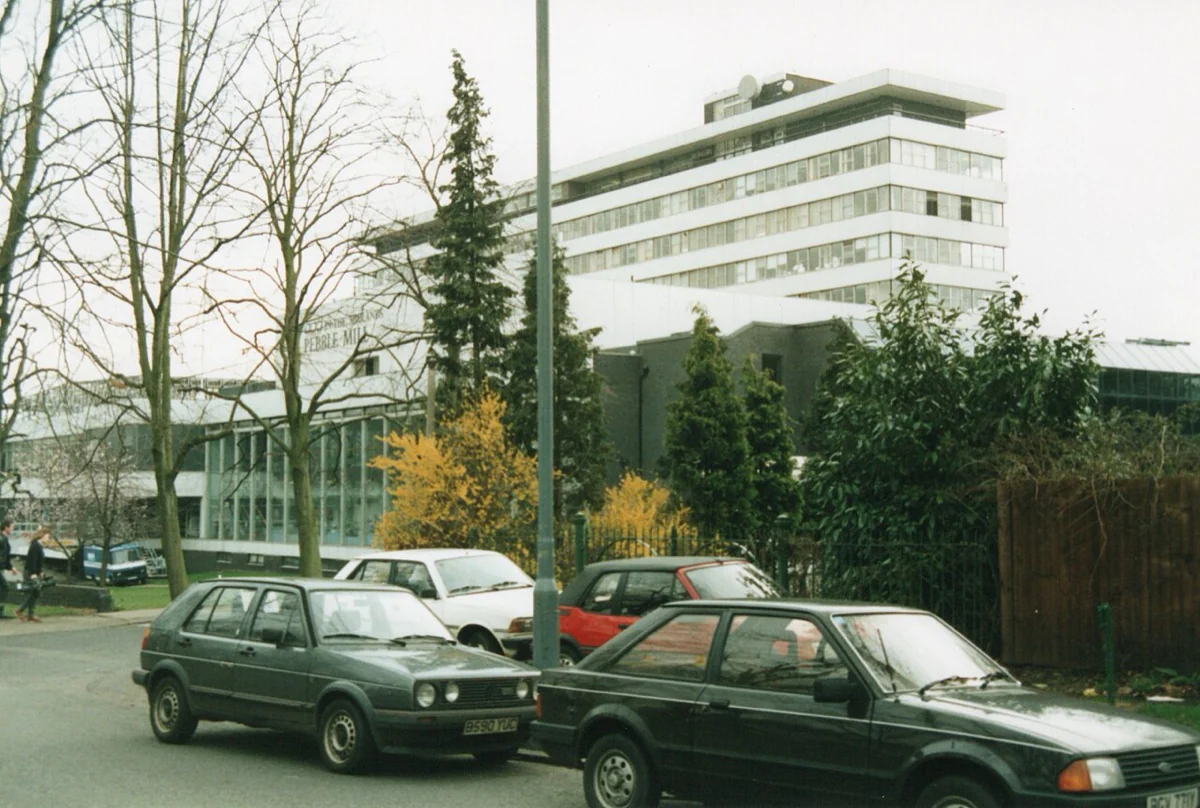
BBC Pebble Mill Studios in Birmingham, photographed in March 1992. Photo: PColeman75 / Wikimedia Commons, CC0.
For most of its first life it was a consumer show: road tests, prices and running costs. Noel Edmonds and then William Woollard fronted it. In 1987 the producer Jon Bentley brought in the racing driver Tiff Needell and a young motoring writer, Jeremy Clarkson, who made his debut on 27 October 1988.
From then on it regularly became BBC2's most-watched programme, with an average of about five million viewers, according to later accounts. Clarkson left in 1999. Other presenters followed him out. The BBC decided the show had run its course and rested it; the last episode aired on 17 December 2001. Most of the production team moved to Channel 5, which launched Fifth Gear in April 2002. The BBC kept the name.
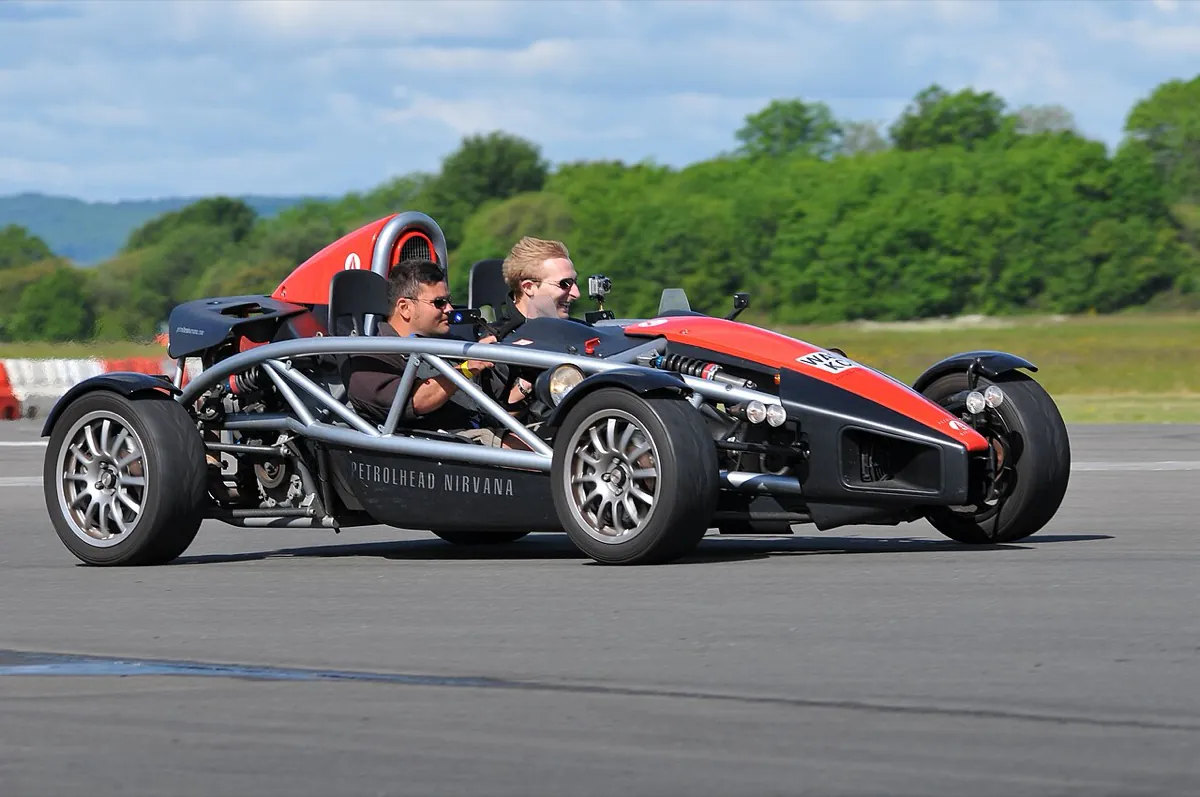
An Ariel Atom on the Top Gear test track during a 2011 visitor event. Photo: Tony Harrison from Farnborough, UK / Wikimedia Commons, CC BY-SA 2.0.
2002 to 2015: the relaunch that became a business
The new Top Gear launched on 20 October 2002. It was an hour long, studio-based and built for entertainment rather than consumer advice. Clarkson returned alongside Richard Hammond and the journalist Jason Dawe. James May replaced Dawe in 2003.
The audience grew steadily, then jumped. In September 2006 Hammond suffered a brain injury when a jet-powered dragster crashed during filming. When he returned on screen in January 2007, the BBC reported an average audience of 7.9 million and a peak of 8.6 million. That beat the 7.3 million who watched the Celebrity Big Brother final on Channel 4 the same night. The previous series had peaked at 5.3 million.
By 2008, Time reported, the show regularly drew more than 7 million viewers on BBC2, about a quarter of those watching television in its Sunday slot. It was also becoming the BBC's most valuable export. The commercial rights sat in Bedder 6, a company part-owned by Clarkson and the executive producer Andy Wilman.
The money that flowed around the show, and after it, is set out below. Several of the figures were reported rather than confirmed by the parties.
Item | Amount | Date | Status |
|---|---|---|---|
BBC Worldwide buyout of Bedder 6 | £16.2m | 2012 deal | Published accounts |
Clarkson's 30% stake in Bedder 6 | more than £8m | 2012 deal | Published accounts |
Amazon's Grand Tour deal, 36 episodes | £160m | 2015 | Reported by The Telegraph |
Clarkson's Amazon pay | £9.6m | 2015 | Reported by The Telegraph |
Oisin Tymon's discrimination and injury claim | £100,000 | Settled after 2015 | Reported |
Flintoff's settlement with BBC Studios | £9m | October 2023 | Reported by The Sun; not confirmed |
Sources: BBC Worldwide accounts via PA (New Zealand Herald), Fortune citing The Telegraph, The Mirror, Sky News.
The era ended at a hotel in North Yorkshire. On 4 March 2015 Clarkson attacked the producer Oisin Tymon, an attack he later admitted. The BBC's investigation found the physical attack lasted about 30 seconds and was stopped by a witness; Tymon's lip was left swollen and bleeding. Clarkson reported the incident himself. The BBC announced on 25 March 2015 that his contract would not be renewed.
Clarkson admitted what the BBC described as an "unprovoked physical and verbal attack". He later told BBC Radio: "It was my own silly fault so I can hardly complain." Hammond, May and Wilman left with him. Amazon reportedly committed £160m to their new programme, The Grand Tour, with a per-episode budget about ten times what they had at the BBC, according to The Telegraph as cited by Fortune.
After Clarkson: three line-ups in six years
The BBC's first answer was Chris Evans, the radio presenter, with the Friends actor Matt LeBlanc. Their first episode, on 29 May 2016, drew 4.4 million overnight. The second fell to 2.8 million. By the finale in early July, against Euro 2016 football on ITV, fewer than two million watched, an 8.7 per cent share. Evans announced his departure on 4 July 2016, after one series.
LeBlanc then led the show with the journalist Chris Harris and the presenter Rory Reid. The racing driver Sabine Schmitz and the former Formula 1 team owner Eddie Jordan also appeared. The audience did not return. The opener of LeBlanc's final series, in February 2019, drew 2.5 million, according to PA Media.
The third attempt worked better. Flintoff, the former England cricket captain, and the comedian Paddy McGuinness joined Harris in June 2019. The launch was BBC Two's most-watched programme of the day and, once consolidated, its most-watched title of the year to that point. From October 2020 the show moved to BBC One. The Race describes it as the most settled line-up since 2015.
The crash and the four-year pause
On 13 December 2022, while filming at Dunsfold, Flintoff was driving an open-topped Morgan Super 3, a three-wheeled sports car. It overturned. He was dragged face-down underneath it for about 50 metres and suffered facial and rib injuries. "I thought I was dead," he told a Disney+ documentary.
BBC Studios apologised. In March 2023 it said: "Under the circumstances, we feel it would be inappropriate to resume making series 34 of Top Gear at this time." It ordered a health and safety review. In October 2023 it reached a settlement with Flintoff, reported by The Sun to be worth £9m; the BBC did not disclose the amount. In November 2023 it said the UK show would be rested.
Danger was not new to the format. Hammond's 2006 crash had delayed a series by several months. But the Flintoff crash ended a line-up that had only just recovered the audience, and left a production record any revival must answer. Hammond, asked about the new series on BBC Radio 4, said it "doesn't have to be" a dangerous show.
What a chef host signals
Every previous lead presenter came from motoring, broadcasting or sport. Ramsay is the first whose main fame lies in an unrelated field. The BBC's own language is about scale. Havard called the pairing "the coming together of two iconic global powerhouses". Lamb said Ramsay "brings passion, mischief, genuine motoring credibility, and the kind of infectious competitive streak that defines the show at its best."
Three readings of the choice stand out in the coverage:
- Star power. The i Paper compared it to Nigella Lawson joining Bake Off: a star who needs the show less than the show needs them.
- Younger audiences. The same paper noted Ramsay's 40.8m TikTok followers and 22m YouTube subscribers, arguing he is "pretty much the only presenter who can both get the old Top Gear heads interested again and also make any sense at all to anyone under 30."
- A break with the past. Hammond said the BBC approached him to lead the new show. "I don't want to drag it back to what it was. That's why I didn't do it," he told Radio 4.
The rival's choices point the same way. Amazon's Grand Tour ended its Clarkson, Hammond and May run with a Zimbabwe special on 13 September 2024. It returned on 4 September 2026 with Francis Bourgeois, known for train-spotting videos, and James Engelsman and Thomas Holland, creators of the YouTube channel Throttle House. Amazon has said it will return to Prime Video for a second series. Both brands have moved away from the old trio's style, but from opposite ends: Amazon to internet-native talent, the BBC to one of television's biggest names.
There is a risk in that, which the figures make plain. The Evans experiment showed that a well-known presenter does not guarantee an audience, and that viewers can leave quickly. The Flintoff era suggested chemistry between presenters mattered more than any single name.
What is still unknown
Much of what will decide the show's fortunes has not been announced:
- The co-presenters. The BBC says they will be named "in due course". The comedian Jimmy Carr was widely linked to the show but, according to a report cited by the BBC, pulled out.
- The format. Lamb's promise of a "bold and unmissable new chapter" hints at change. No details have been given.
- Safety. The BBC has not set out publicly how its post-crash review will shape stunts and challenges.
- Ramsay's schedule. He has also been confirmed for a revival of Hell's Kitchen on ITV, announced on 20 November 2026.
Filming begins in 2027. Whatever the new series draws in 2028, the measure will be the same one that judged every line-up since 2002: whether viewers stay after the first episode. Hammond, who has seen more of the show's history than most, described it as "a grand old BBC stalwart". Its record suggests it survives its presenters. Whether it can thrive again depends on what the BBC builds around Ramsay, not on Ramsay alone.
Featured image: Top Gear Live Italia, 2014 Richard Hammond, James May, Jeremy Clarkson by Fringio, via Wikimedia Commons, CC BY-SA 4.0.


