

On 21 November 2026, at the Circuit de Barcelona-Catalunya, Ferrari parked two versions of its 296 side by side. The occasion was the Finali Mondiali, the season finale of its one-make racing series. One car was the 296 Challenge Evo, a track-only racer for 2027. The other wore number plates. Even reporters who had seen both up close struggled to separate them. evo called the road car "essentially a Challenge Evo with number plates".
That road car is the 296 Challenge Stradale, or CS, and it reverses five years of Ferrari engineering. It removes the plug-in hybrid system from the 296 entirely. The 3.0-litre twin-turbo V6 now works alone. It makes 661bhp, or 670cv in Ferrari's metric figure, against 819bhp for the hybrid 296 GTB. In return the car sheds 140kg, according to Ferrari. Ferrari also says it laps its Fiorano test track half a second faster than the 868bhp 296 Speciale.
The question is what Ferrari gains by giving up power, and whether the result is the rival to Porsche's 911 GT3 RS that its product team describes. The figures point to a clear trade. Ferrari has accepted less peak power for less weight, more downforce and a simpler car. At about £260,000, according to Autocar and evo, the CS costs roughly what a GTB does and about £100,000 less than the Speciale. Unlike most of Ferrari's track-focused road cars since 2003, it is not a limited edition. It is still a much dearer car than the Porsche it targets.
What Ferrari has built
The CS and the Challenge Evo were developed together and share the same hybrid-free V6. In the race car it produces 690bhp, according to Autocar. Both cars have a dry weight of 1,330kg. Dry weight is the mass of the car without fuel, oil and other fluids. Ferrari says the road car is "entirely geared towards providing the driver with a direct and physical driving experience", as Auto Express reported.
The bodywork is taken almost directly from the racer. A fixed rear wing, a large front splitter, dive planes ahead of the front wheels and a fully enclosed underbody together generate 617kg of downforce at 250km/h (155mph). Downforce is the aerodynamic load that presses a car onto the road and adds grip in fast corners. Ferrari puts the CS figure 72 per cent above the GTB's. evo reports that the wing alone produces 270kg.
The chassis changes are just as thorough. According to evo, the semi-active dampers now work with springs of double the stiffness, a lower ride height and an added helper spring. Ferrari claims, as reported by Autocar, that the changes bring:
- a 7 per cent gain in lateral performance, meaning cornering grip;
- a 34 per cent gain in stability;
- a 68 per cent reduction in roll gradient, a measure of how far the body leans in corners.
The cabin keeps air conditioning and a wireless phone charger. The door panels, however, are single-piece carbon fibre with no armrests or pockets. Buyers can also strip the trim from beneath the seats, leaving the bare chassis visible.
Less power, a quicker lap: the 296 family compared
The table below sets the CS against the two hybrid 296 coupés already on sale, using Ferrari's own power, weight and lap-time claims.
Car | Power (bhp) | Dry weight (kg) | Fiorano lap | UK price |
|---|---|---|---|---|
296 GTB (hybrid) | 819 | 1,470 | 1min 21.0sec | c£260,000 |
296 Speciale (hybrid) | 868 | 1,410 | 1min 19.0sec | Not confirmed |
296 Challenge Stradale | 661 | 1,330 | 1min 18.5sec | c£260,000 |
Sources: Ferrari, Autocar, evo, What Car?, Auto Express.
The CS is the least powerful 296 by a wide margin. It has 158bhp less than the GTB and 207bhp less than the Speciale. It even trails the Speciale's combustion engine on its own, which evo puts at 690bhp. By evo's calculation, the CS manages 497bhp per tonne, more than 100bhp per tonne below the Speciale.
Yet it matches the Speciale's 0-62mph time of 2.8sec and beats the GTB's 2.9sec. Around Fiorano it is 2.5sec quicker than the GTB, according to Autocar. Lower weight and higher cornering speeds make up for the missing straight-line punch. Ferrari is candid that the advantage depends on the circuit. Road & Track reports Ferrari's claim that the CS is marginally slower than the Speciale at Monza, where long full-throttle straights favour the more powerful car.
Why take the hybrid out
In the GTB and Speciale, a battery pack and an electric motor mounted between engine and gearbox add power and fill a familiar gap. A turbocharged engine responds slowly at low revs while its turbochargers spool up, an effect called turbo lag. The electric motor delivers torque instantly and hides it. Remove the motor, and the lag returns.
Ferrari's answer, according to evo and Autocar, was to retune the V6 with changes to boost pressure and valve timing. That improves low-rev response at the cost of some peak power. This is why the CS makes less than the 700cv Challenge Evo, which spends most of its time near the top of the rev range. Torque is 740Nm, Auto Express reports, and the engine revs to 8,500rpm.
Taking the hybrid out also created new engineering problems. The electric motor had been doing jobs beyond adding power. Reports from evo, Car and Driver and Autocar describe the fixes:
- a new belt-driven starter generator, because the high-voltage motor no longer starts the engine;
- a separate mechanical compressor for the air conditioning;
- larger rear carbon-ceramic brake discs and better cooling, because there is no regenerative braking (the motor slowing the car while recharging the battery);
Gianmaria Fulgenzi, Ferrari's chief product development officer, told Motor Sport that the team "worked on eliminating everything hybrid". Raffaele de Simone, Ferrari's chief development driver, put the goal plainly: "We want the purest and the most direct relationship with the car." Ferrari also told Motor Sport that it is not abandoning hybrid power, which it considers necessary for maximum performance in other models.
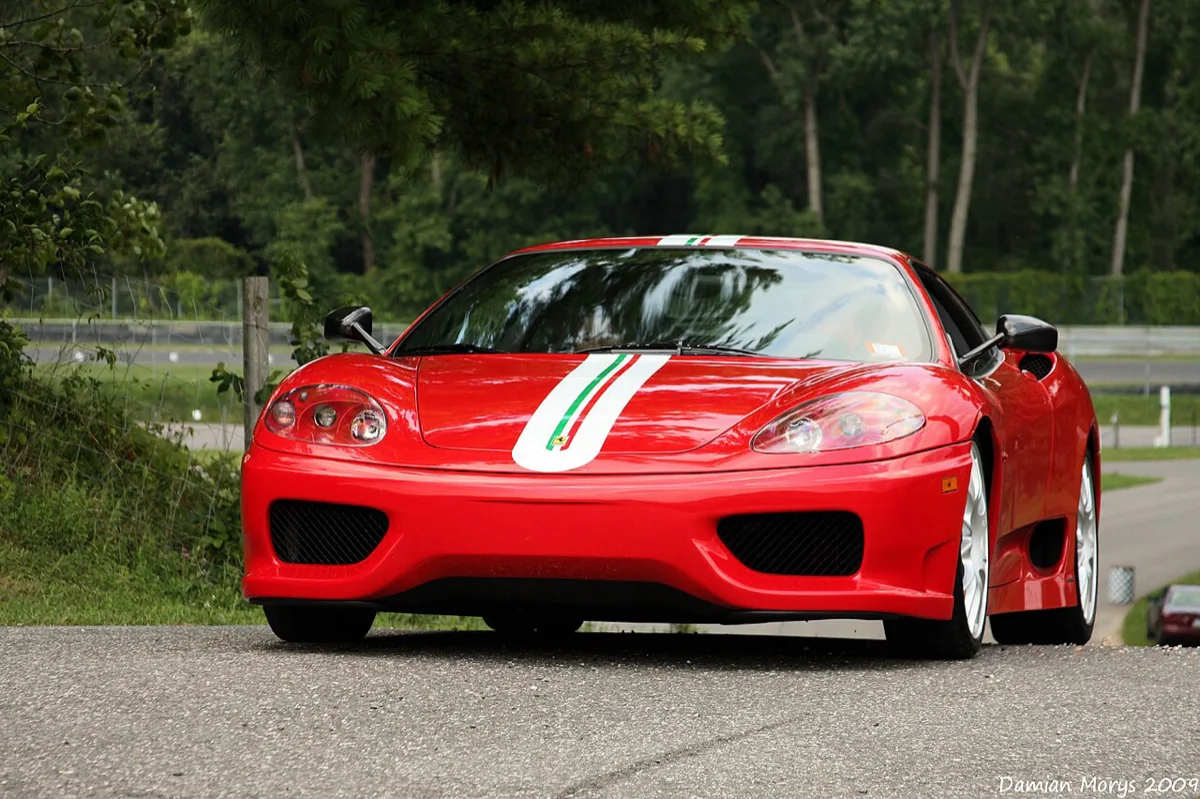
A Ferrari 360 Challenge Stradale, the 2003 car whose name the new 296 model revives, photographed in 2009. Photo: Damian Morys from New York City, United States / Wikimedia Commons, CC BY 2.0.
The Challenge Stradale line and the Porsche benchmark
The name dates from 2003. The 360 Challenge Stradale made its debut at that year's Geneva motor show as a road version of the 360 Challenge race car. evo records that 1,288 were built in 2003 and 2004 and calls it the original rival to Porsche's 911 GT3 RS. The badge has not been used since, according to Car and Driver.
Its successors took other names: the F430-based 430 Scuderia, then the 458 Speciale and the 488 Pista. There was never a 430 Challenge Stradale. The 430 Scuderia filled that role. The table below sets one Ferrari predecessor and two Porsche benchmarks against the new car.
Car (year) | Engine and power | Weight (kg) | 0-62mph (sec) | UK price new |
|---|---|---|---|---|
Ferrari 360 Challenge Stradale (2003) | 3.6 V8, 420bhp | 1,280 (claimed) | 4.1 | £133,025 |
Porsche 911 GT2 RS, 991 (2017) | 3.8 twin-turbo flat-six, 690bhp | 1,470 (kerb) | 2.8 | Not confirmed |
Porsche 911 GT3 RS, 992 (2022) | 4.0 flat-six, 518bhp | 1,450 (DIN kerb) | 3.2 | £192,600 |
Ferrari 296 Challenge Stradale (2026) | 3.0 twin-turbo V6, 661bhp | 1,330 (dry) | 2.8 | c£260,000 |
Sources: evo, Car Enthusiast, Porsche, PistonHeads, Autocar, Ferrari.
Over 23 years the Challenge Stradale has gained 241bhp and cut its 0-62mph time from 4.1sec to 2.8sec. It has also lost two cylinders and gained two turbochargers. Its list price has nearly doubled in cash terms. The 2003 figure is not adjusted for inflation.
Against the current GT3 RS, the CS has 143bhp more and is 0.4sec quicker to 62mph. At about £260,000 it costs roughly £67,000 more than the Porsche's £192,600 list price. The weights are not like for like. Ferrari quotes dry weight. Porsche quotes kerb weight, which includes fluids. The paper gap of 120kg therefore overstates the real difference.
Downforce is closer than the power figures suggest. Porsche quotes 409kg for the GT3 RS at 200km/h and 860kg at 285km/h. evo calculates that, scaled to the same 155mph, the CS falls in line with the GT3 RS. Only the 991-generation GT2 RS, which went out of production in 2019, matches the Ferrari's 2.8sec sprint. Porsche has not confirmed a successor.
A cheaper Ferrari, on purpose
The price is the most surprising number. Stefano Frigieri, the product manager for the car, explained the thinking to evo. He said that few Speciale owners use their cars hard on road or track, because of their exclusivity and value. The CS is meant to be less precious, so that owners will use it more. For the same reason, Ferrari will offer a track-only exhaust, fitted by dealers, that keeps the factory warranty intact.
Access is the other difference. The Speciale is part of Ferrari's special series. The CS is a standard range model with no production cap.
The timing fits Ferrari's sales mix. Its interim report for the third quarter of 2026, filed on 3 November, shows hybrids made up 32.5 per cent of shipments in the quarter, across eight hybrid models. Over the first nine months the share was 31.1 per cent. The same results show the 296 GTS convertible was phased out during the quarter. Auto Express describes the 296 as "slow-selling", although Ferrari does not publish sales by model.
The CS therefore gives Ferrari a combustion-only 296 for buyers who prefer one. Its wider product plans stay unchanged, and the car arrives alongside eight hybrids that continue on sale.
What is not yet settled
Several figures differ between outlets or rest on Ferrari's word alone:
- Price. evo and Autocar give about £260,000; Motor Sport gives £250,000. Car and Driver reports €291,000 in Italy. A UK list price from Ferrari was not available.
- Weight saving. Ferrari, evo and Autocar give 140kg against the GTB; DailySportsCar reports 150kg.
- Power. Ferrari's 670cv appears as 670hp in American coverage and as 661bhp in British coverage. These are different units, not different engines.
- Performance. All lap times and acceleration figures are Ferrari's claims. No outlet had published a drive of the car at the time of writing.
Deliveries are due in spring 2027, according to Motor Sport. Car and Driver expects American deliveries in the third quarter of that year. The Challenge Evo race car makes its debut in Ferrari Challenge Europe and North America in 2027, according to DailySportsCar. The UK, Japan, Australia and Middle East series follow in 2028.
What the trade-off says about Ferrari
Since the 296 arrived in 2021, Ferrari's argument has been that electrification makes its fastest cars faster. The Speciale, with its 868bhp, is the strongest form of that case. It was named Britain's Best Driver's Car for 2026 by Autocar.
The CS makes a different argument with the same car. It accepts the numbers a brochure rewards least, peak power and power-to-weight, and gains lap time, simplicity and price. If the independent drives match Ferrari's claims, the company will have shown that a hybrid and a combustion-only 296 can both be the quickest car in the range, depending on the circuit. For buyers, the more lasting change may be the simplest. For the first time since 2004, Ferrari's most racing-derived road car is a standard range model rather than a limited edition.
Related coverage: 2026 F1 regulations: FIA confirms new hybrid era with 100% sustainable fuel, smaller cars and active aero · Rimac Ends Nevera Production at 71 Cars, Well Short of 190 Target
Featured image: 2022 Ferrari 296 (cropped) by Max Baillie, via Wikimedia Commons, CC BY-SA 4.0.


