

The United States is no longer considered to have eliminated measles, according to several US media reports. It had held the status since 2000. An independent commission of experts, convened by the Pan American Health Organization (PAHO), is reported to have reached the decision. PAHO is the World Health Organization's regional office for the Americas. The commission is said to have concluded that the virus spread continuously inside the country for more than a year.
The Wall Street Journal first reported the decision on Friday 13 November, citing people familiar with the matter. CNN said a source close to the process had confirmed it. PAHO had not published a statement by Saturday morning. It did not immediately respond to Reuters. The finding comes as the US records its largest measles outbreaks in more than three decades. There have been 5,412 confirmed cases this year as of 12 November, according to the Centers for Disease Control and Prevention (CDC).
What elimination means and how it was lost
Elimination does not mean zero cases. It means no single chain of measles transmission persists in a country for a year or more. Imported cases and short outbreaks are compatible with the status.
PAHO defines endemic transmission as the "uninterrupted circulation of the same virus genotype and lineage for 12 months or more" in a given area. Genotype and lineage are genetic labels. They let scientists tell whether separate outbreaks belong to one continuous chain of spread. In a statement in March, PAHO said it would assess the US over a one-year window. The window began on 20 January 2025, when the country's outbreak began.
The review was first expected in April. It was moved to the commission's regular annual meeting in November. The body is formally the Regional Verification Commission for the Elimination of Measles, Rubella and Congenital Rubella Syndrome. It advises PAHO's director. Under PAHO's process, the director then formally communicates the classification to national authorities.
According to Reuters, Noel Brewer chairs an independent US advisory panel on measles. He is a public health professor at the University of North Carolina. He presented the CDC's status report and his group's assessment to the commission on 10 November. That report has not been released. Reuters cited a source as saying the CDC had itself found 12 months of continuous transmission.
Published evidence pointed the same way. In August, scientists at Utah's public health laboratory released a preprint, a study not yet peer-reviewed. It was based on genetic sequencing of patient samples. It found that one measles strain had circulated in the state for more than a year, CNN reported. That strain caused over 95 per cent of more than 600 Utah cases between June 2025 and June 2026. Sustained outbreaks were also recorded in South Carolina, Pennsylvania, Wisconsin and New York.
Record cases and a disputed death toll
CDC data show 5,412 confirmed cases in 2026 across 47 jurisdictions. That is more than double the 2,289 cases recorded in 2025. It is also the highest annual total since 1991, according to CNN. The CDC counts 43 new outbreaks this year, and 96 per cent of cases are linked to outbreaks. Reuters put the total since the start of 2025 at about 7,500 infections.
Measles is among the most contagious human diseases. One infected person typically passes it to 12 to 18 others who lack immunity. About one in nine reported cases this year has needed hospital treatment, according to CDC figures cited by CNN. Nearly all cases have been in people who were unvaccinated or whose vaccination status was unknown.
The number of deaths is contested. State health departments have reported at least 10 measles-associated deaths this year, according to Al Jazeera. There were seven in Pennsylvania, two in Wisconsin and one in New York. Pennsylvania and Wisconsin each reported a further death on 13 November. The Wisconsin case was an infant. The CDC's website lists six deaths.
The gap reflects a row over how deaths are counted. Pennsylvania classes a death as measles-associated if a person with confirmed measles dies within 30 days of symptoms starting, unless an unrelated cause is clear. In August, the state's governor, Josh Shapiro, announced its first measles deaths since 1992. The Health and Human Services Secretary, Robert F Kennedy Jr, called the announcement "premature". In September a CDC spokesperson said the agency would "report measles deaths if and when the National Center for Health Statistics reports measles as the underlying cause of death", according to the health research organisation KFF. Death certificate data of that kind can lag by months or years. The CDC says it is working with state epidemiologists on a standard definition.
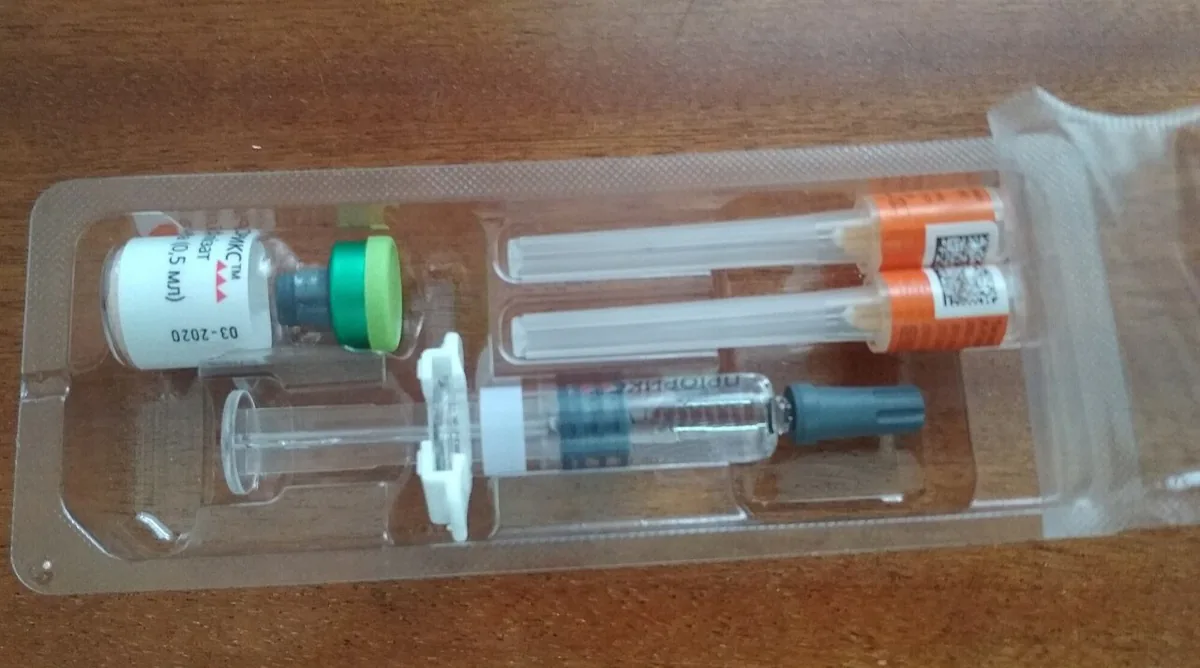
A Priorix vaccine kit, which protects against measles, mumps and rubella, in a 2019 file photo. Photo: Dctrzl / Wikimedia Commons, CC BY-SA 4.0.
Falling vaccination rates
Two doses of the measles, mumps and rubella (MMR) vaccine give about 97 per cent protection against the disease. Preventing sustained spread requires roughly 95 per cent vaccination coverage, Reuters noted. Coverage among US kindergarten children fell from 95.2 per cent in the 2019–20 school year to 92.4 per cent in 2025–26, according to figures cited by Al Jazeera.
Reuters linked the resurgence to declining immunisation and rising vaccine hesitancy during Mr Kennedy's tenure. He has long cast doubt on the safety of the measles vaccine without scientific evidence. The CDC director, Erica Schwartz, spoke before the decision. She told Reuters that losing the status would mean the agency doing "the same exact thing": working with states to encourage vaccination.
Independent specialists were blunter. "It is a fully preventable disease. It is unconscionable that we have this amount of measles," Dr Brewer told Reuters. Demetre Daskalakis, a former director of the CDC's National Center for Immunization and Respiratory Diseases, told CNN: "Measles elimination is a vital sign for our public health system. It shows cracks in our foundation." Peter Hotez, co-director of the Center for Vaccine Development at Texas Children's Hospital, said: "Basically, measles is back."
The loss carries no financial or legal penalty. Jennifer Nuzzo is director of Brown University's Pandemic Center. She told the University of Minnesota's CIDRAP news service before the meeting: "It's a symbolic loss." She added that it "shows to both our allies and our enemies that the United States is no longer able or willing to protect itself." Experts quoted by CIDRAP also warned that other countries rely on US technical help for their own elimination efforts.
What happens next
A formal announcement from PAHO is still awaited. The commission was also due to review Mexico, which faces the same risk. To regain elimination, the US must interrupt transmission. It must then go at least 12 months without the strain circulating, according to Reuters. William Moss, an epidemiologist at the Johns Hopkins Bloomberg School of Public Health, told CNN: "So it's not going to be a trivial task for the United States to regain its measles elimination status." Brazil lost its status in 2019 and regained it in 2024, CIDRAP noted.
The US has left the World Health Organization but remains a member of PAHO. It joins a growing list of countries that have lost elimination. Canada lost its status in November 2025, which also cost the Americas their region-wide measles-free status. In January 2026, WHO Europe confirmed that the UK had lost its status too, based on 2024 data. The UK Health Security Agency reported 2,911 laboratory-confirmed cases in England in 2024. It also reported two-dose MMR coverage among five-year-olds of 83.7 per cent.
PAHO says high and even vaccination coverage, strong surveillance and rapid outbreak response are essential to stopping transmission. In the UK, the NHS has since January offered the second dose of a combined measles, mumps, rubella and chickenpox vaccine. It is given at a new appointment at 18 months, according to UKHSA.
Featured image: Pan American Health Organization (PAHO) (53844803888) by ajay_suresh, via Wikimedia Commons, CC BY 2.0.


