

The UN climate summit in Antalya, COP31, ended on Sunday 22 November 2026 without the overarching political agreement its hosts had built it around. The European Union, the UK, Panama, the Marshall Islands, Norway and others rejected a final draft that did not mention fossil fuels. Saudi Arabia and Russia had made clear they would accept no wording on them at all. The summit ran about two days past its scheduled Friday close. It became the longest UN climate conference on record.
Summits that fail to agree their main political text are rare. The Hague in 2000 was suspended over how to count forests towards Kyoto Protocol targets. Copenhagen in 2009 could only "take note" of an accord struck by a small group of leaders. Antalya is different in kind. The fight was not over a new obligation. It was over whether to restate one already agreed, at COP28 in Dubai in 2023.
That matters because UN climate talks run on consensus. A determined minority on either side can therefore stop a deal. Earlier breakdowns were repaired within a year or two. Whether this one is depends on COP32 in Addis Ababa, Ethiopia, in November 2027. The unresolved business now goes there.
What happened in Antalya
The talks opened on 9 November. More than 190 countries were represented. More than 92,000 people registered, provisionally a record, according to Reuters. The United States sent no delegation, as Hemera reported on 15 November.
The leadership was unusual. Turkey hosted, and its environment minister, Murat Kurum, was COP president. Australia's climate and energy minister, Chris Bowen, chaired the formal negotiations as "president of negotiations". The arrangement was a compromise after the two countries could not settle who would host.
The centrepiece was meant to be an "Antalya Pact", a cover decision. This is the overarching political text that frames a summit's outcome rather than settling any single agenda item. The first draft, published on Monday 16 November, mentioned "fossil fuel" or "fossil fuels" six times, according to the BBC. Hemera reported that day on its call for an immediate shift. Oil producers objected, and later drafts dropped the words.
The final text appeared after 3am on 22 November. That left negotiators about three hours to lodge objections. It "recalled" the Dubai decision "in its entirety" without naming coal, oil or gas. It also contained:
- a goal to raise electricity's share of final energy use to 35 per cent by 2035;
- a target to capture, reuse and store one billion tonnes of carbon dioxide, which critics said would prolong fossil fuel use;
- a call to triple adaptation finance by 2035, with no dollar figure and no baseline;
- a first COP acknowledgement that warming will overshoot 1.5C above pre-industrial levels.
The summit did not produce nothing. Separate decisions were adopted on a just transition mechanism for workers, the Adaptation Fund, carbon markets and transparency. Only the presidency-led texts fell.
How Antalya compares with earlier failures
The table sets COP31 against the summits most often cited as failures or turning points. It also includes Dubai, whose language Antalya could not repeat.
Summit | Ended | Sticking point | Main outcome | What followed |
|---|---|---|---|---|
COP6, The Hague | 25 Nov 2000, suspended | Counting forest "sinks" towards Kyoto targets | No deal; session suspended | Resumed in Bonn, July 2001 |
COP15, Copenhagen | 19 Dec 2009 | Binding cuts, finance, process | COP only "took note" of Copenhagen Accord | Cancún 2010 imported the Accord's core elements |
COP25, Madrid | 15 Dec 2019, nearly 44 hrs late | Article 6 carbon-market rules | Thin text; market rules deferred | Rules agreed in Glasgow, 13 Nov 2021 |
COP28, Dubai | 13 Dec 2023, about a day late | Fossil fuel phase-out wording | Call to "transition away" from fossil fuels | Not restated explicitly since, per E3G |
COP31, Antalya | 22 Nov 2026, about 44 hrs late | Naming fossil fuels; adaptation finance | No cover decision; other items adopted | Open items to COP32, Nov 2027 |
Sources: European Commission (CORDIS), UK Parliament (Hansard), Earth Negotiations Bulletin, Circle of Blue, C2ES, Carbon Brief, CLS Blue Sky Blog, Euronews, Associated Press, Health Policy Watch.
At The Hague, talks on making the Kyoto Protocol work collapsed on 25 November 2000. The dispute was over whether forests and soils that absorb carbon could count against rich countries' targets. Europe and the United States blamed each other. John Prescott, then UK deputy prime minister, told Parliament that the US had first sought sinks credits worth 300 million tonnes. He said he had cut that to 75 million in a late deal that EU ministers did not endorse. The session was suspended and resumed in Bonn in July 2001.
Copenhagen's main document was written by a small group of leaders. Seven countries refused it, led by Tuvalu and including Sudan, Venezuela and Cuba. The conference therefore only "took note". The Accord's goals included holding warming below 2C and mobilising $100bn a year by 2020. They were brought into the UN process at Cancún a year later.
Madrid set the previous duration record. It closed at 1.55pm on 15 December 2019, nearly 44 hours late. It failed on carbon-market rules under Article 6 of the Paris Agreement. These were deferred and finally agreed at Glasgow on 13 November 2021, ending six years of negotiation.
The pattern is that earlier failures were about building something new: Kyoto's accounting, a successor treaty, market rules. Each was repaired within one to two years. Antalya failed on restating a commitment governments had already made.
Why the Dubai language became the breaking point
Dubai was itself hard-won. On 6 December 2023 OPEC's secretary general wrote to members. He urged them to reject any text that targeted fossil fuels rather than emissions. Al Jazeera described Saudi Arabia as the most vocal holdout. An early presidency draft angered many countries by avoiding firm calls on fossil fuels. The final text, adopted on 13 December, called for "transitioning away from fossil fuels in energy systems, in a just, orderly and equitable manner".
Alden Meyer of the think tank E3G said fossil fuels went unmentioned in COP final decisions for more than 25 years before Dubai. He said there has been no explicit mention since. COP30 in Belém in 2025 produced a deal but no commitment to phase them out.
In Antalya the producers' position hardened. Saudi Arabia's delegate, Mohammad Ayoub, told the plenary that Arab states had engaged in good faith. He said they accounted for a small share of historical emissions, according to the BBC. The Saudi delegation argued that "climate change requires all solutions on the table", including carbon capture. Russia's Sergei Kononuchenko warned that shrinking oil and gas supply would cause energy poverty. "For that reason, we cannot agree to any formulation on fossil fuel," he said.
Bowen described the bind plainly: some parties said fossil fuels must be mentioned. Other parties insisted that if it was mentioned, they would veto it. The EU's position, given by Ireland's climate minister Darragh O'Brien, was the mirror image: "It is unconscionable that we would have a climate pact that makes no mention of fossil fuels."
The setting made compromise harder. The war in Iran has disrupted oil and gas through the Strait of Hormuz.
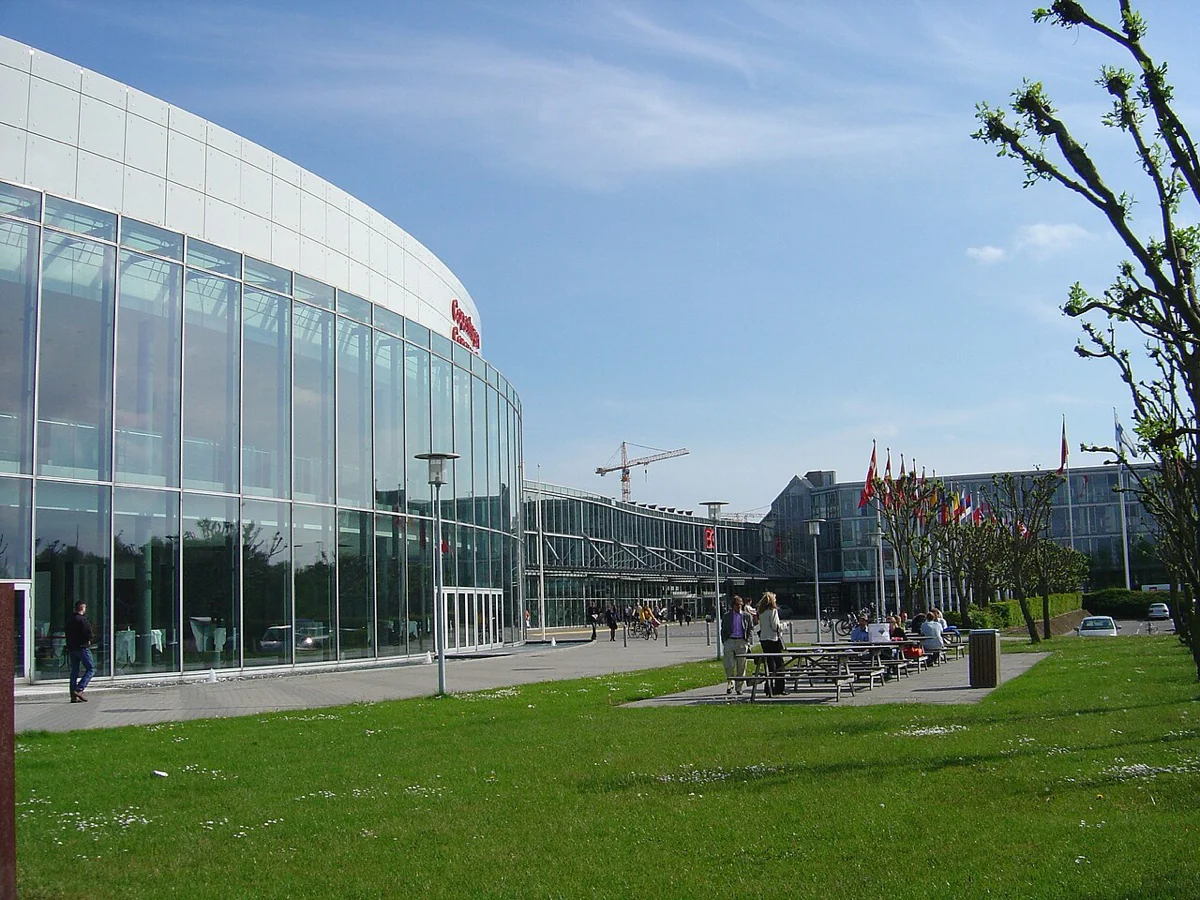
The Bella Center in Copenhagen, venue of the 2009 COP15 climate summit, photographed in 2007. Photo: Froztbyte / Wikimedia Commons, CC BY-SA 3.0.
Who stood where on the final draft
Positions in the final plenary did not split neatly into rich and poor countries, as the table shows.
Party | Position on final draft | Stated reason |
|---|---|---|
European Union | Rejected | No mention of fossil fuels |
UK | Rejected | Moved backwards on the science |
Panama | Rejected | Weak on 1.5C; too reliant on carbon capture |
Marshall Islands | Rejected | Silent on fossil fuels |
Norway | Rejected | Went backwards from earlier agreements |
Saudi Arabia | Opposed any fossil fuel wording | All solutions, including carbon capture |
Russia | Opposed any fossil fuel wording | Risk of energy poverty |
India (for LMDC group) | Willing to accept | Concerns on equity and historical responsibility |
China | Accepted framing; regretted failure | Developing countries' priorities lost |
African Group, Kenya | Critical | Finance; Africa's needs not reflected |
Sources: BBC, Al Jazeera, The Hindu, Health Policy Watch, Reuters via The Straits Times, Associated Press, London Evening Standard.
The Like Minded Developing Countries (LMDC) is a bloc including India, China and Saudi Arabia. It said it was willing to move forward despite discomfort.
How many countries stood with the EU is unclear. The Hindu reported that about 130 countries supported the EU's stance. The Associated Press reported that a considerably larger number of nations accepted the decision, often reluctantly. Neither published a list.
The money that was missing
Finance was the second fault line. At COP30, governments agreed to triple adaptation finance, money to help countries cope with heat, drought and floods. The BBC reports the commitment was to triple it by 2035 from $40bn, though the baseline remains contested. Three times $40bn is $120bn. A $120bn target that appeared in an earlier Antalya draft was dropped from the final text.
That left a pledge with no number. Developing countries said this gave richer nations too much room. "Rich nations and polluting governments cannot keep arriving empty-handed," said Mohamed Adow of Power Shift Africa. Russia used the dispute to attack the EU, saying its climate finance came mainly as loans.
Frank Jotzo, an economist at the Australian National University, summed up the double bind: "fossil fuel powers will not agree to have their resource wealth devalued", while rich countries will not provide enough finance.
The consensus problem
COP decisions need the agreement of every party. In practice that means near-unanimity among almost 200 delegations. No country has a formal veto, but any can object. A presiding officer cannot declare consensus over a bloc's open opposition.
Calls for reform followed quickly. Former US vice-president Al Gore said it was "outrageous that a handful of petro-states have veto power over any mention of fossil fuels". Bowen noted the obstacle: "you also need consensus to change consensus". Dialogues on the consensus process are scheduled for November 2027 and November 2028.
Countries are also turning to other routes:
- the Santa Marta initiative, a group of states committed to phasing out fossil fuels that grew out of COP30;
- the International Court of Justice advisory opinion confirming states' legal obligations on climate change;
- voluntary pledges, such as the electrification goal, which was presented separately from the cover text.
What is still disputed
- How long it ran. Health Policy Watch counted a record 44 hours of overtime. The Hindu said 48 hours. Both agree it passed Madrid's record.
- Which precedent applies. The BBC and Reuters call it the first summit without a final agreement since Copenhagen. Health Policy Watch says it is the first without a high-level decision since The Hague, because Copenhagen still adopted a decision taking note of its accord.
- Support for electrification. Estimates of how many countries backed the electrification goal varied between sources.
- Blame. Rachel Cleetus of the Union of Concerned Scientists blamed richer nations, petrostates and the two presidencies. Fiji's climate minister, Lynda Tabuya, praised Bowen's efforts. In Australia, opposition leader Angus Taylor called for Bowen to go. Other opposition members questioned the A$150m cost.
What happens next
Under rule 16 of the UN climate rules of procedure, unfinished items carry over automatically to the next session. They include the details of transitioning away from fossil fuels, adaptation finance and the work programme on cutting emissions. Bowen stressed that the Dubai decision remains in force.
The first test is the mid-year negotiating session in Bonn in June 2027. The decisive one is COP32 in Addis Ababa in November 2027. There, conclusions of a road map on adaptation finance are due. Work also begins on the second global stocktake, the five-yearly review of progress under the Paris Agreement. Stiell told delegates the process has "suffered setbacks before and come back stronger." Bonn in 2001 and Cancún in 2010 show it has happened. Neither involved governments retreating from a promise already made.
Related coverage: COP31 Draft Calls for 'Immediate' Shift Away From Fossil Fuels · US Democrats Arrive at COP31 as Trump Administration Stays Away · 2026 Extreme Weather Toll Reaches Tens of Thousands as El Niño Builds
Featured image: COP31 - Protests 06 by Xuthoria, via Wikimedia Commons, CC BY-SA 4.0.


