

CrowdStrike has agreed to buy Zscaler in an all-stock deal that values the network security company at about $43.9bn. Announced on 23 November 2026, it is the largest cybersecurity takeover on record by headline value, according to Reuters. It is more than a third bigger than Google's $32bn purchase of Wiz, agreed in March 2025. It also tops Cisco's $28bn Splunk deal and Palo Alto Networks' roughly $25bn purchase of CyberArk.
Set against what Zscaler earns, the price looks less striking. The $43.9bn is about 11 times Zscaler's $3.9bn of annual recurring revenue (ARR), the yearly value of its subscription contracts. Google paid roughly 46 times Wiz's reported ARR, and Palo Alto about 20 times CyberArk's. Of the deals examined here, only Cisco paid less per dollar of recurring revenue, at about 7 times Splunk's.
The bigger difference is how CrowdStrike is paying. Google and Cisco paid cash. CrowdStrike is paying entirely in its own shares, which fell about 9 per cent on the day. That turns Zscaler's investors into partners in the bet and dilutes CrowdStrike's existing owners. It also commits the deal to an antitrust review expected to run deep into 2027. Both companies say AI-driven attacks are pushing customers towards fewer, larger security suppliers.
What CrowdStrike is buying
CrowdStrike, based in Austin, Texas, is best known for Falcon. This software protects "endpoints": laptops, servers and other devices. Zscaler, founded in 2007 by its chief executive Jay Chaudhry, sells cloud-based network security. Its services check who a user is, and what device they are on, before letting them reach corporate applications. The approach is called "zero trust" because no connection is trusted by default.
The companies present the deal as filling CrowdStrike's largest gap. Falcon protects devices and cloud workloads. Zscaler controls how users, applications and AI agents connect to them. CrowdStrike estimates the deal adds more than $185bn to its addressable market in calendar 2029. The main terms, set out in the joint statement and the merger filing, are:
- Exchange ratio: Zscaler shareholders get 1.135 CrowdStrike shares for each share. That was worth $260.41 at CrowdStrike's closing price on 20 November 2026, a 34 per cent premium to Zscaler's close that day.
- Ownership: CrowdStrike's existing shareholders would own about 84.1 per cent of the combined company, Zscaler's about 15.9 per cent.
- Support: Chaudhry and his affiliates, who hold about 34 per cent of Zscaler, have agreed to vote in favour. He will keep running the Zscaler business and join CrowdStrike's board.
- Targets: about $1bn of extra annualised revenue within 30 months of completion, and $500m of annual cost savings within 18 to 24 months, mainly from data centres, suppliers and operations.
The latest quarterly figures, both published on 23 November, show two businesses of uneven size but similar cash generation.
Measure | CrowdStrike | Zscaler |
|---|---|---|
Annual recurring revenue | $6.26bn | $3.9bn |
Latest quarterly revenue | $1.58bn | $949.3m |
Revenue growth, year on year | 28% | 20% |
Latest quarterly free cash flow | $474.4m | $416.5m |
Share of combined company | 84.1% | 15.9% |
Sources: CrowdStrike third-quarter fiscal 2027 results, CrowdStrike and Zscaler joint statement, Reuters, The Motley Fool.
The table shows a mismatch. Zscaler would bring about 38 per cent of the combined recurring revenue but receive about 16 per cent of the shares. That gap reflects how much more highly the market values each dollar of CrowdStrike's revenue. It is also why paying in stock suits the buyer.
The two firms are not strangers. Their partnership dates back to at least 2019 and was expanded in August 2025. They share more than 2,000 customers and 16 product integrations. About 8,000 Zscaler customers do not use CrowdStrike, and those are the cross-selling targets. "Zscaler is our No. 1 technology partner," Kurtz told CNBC.
How the price compares with the sector's biggest deals
Among the largest cybersecurity takeovers, the Zscaler deal stands out for its size and its method of payment.
Year announced | Buyer | Target | Price | Payment |
|---|---|---|---|---|
2026 | CrowdStrike | Zscaler | $43.9bn | All stock |
2025 | Wiz | $32bn | All cash | |
2023 | Cisco | Splunk | $28bn | All cash |
2025 | Palo Alto Networks | CyberArk | $25bn | Cash and stock |
2021 | Thoma Bravo | Proofpoint | $12.3bn | All cash |
Sources: CrowdStrike and Zscaler joint statement, Google, Cisco, Palo Alto Networks, Proofpoint.
Three of the five deals were agreed between March 2025 and November 2026. Palo Alto Networks added a sixth large purchase on 18 November 2026: Applied Compute, an AI start-up, for $4.5bn in stock. The headline prices are not measured identically. Zscaler's figure is an enterprise value, which adjusts for cash and debt. The Splunk and CyberArk figures are equity values. Splunk was also as much a data-analysis business as a security one.
Headline size says little about whether a buyer overpaid. A common yardstick in software is price divided by ARR, which shows what a buyer pays for each dollar of contracted yearly sales. It ignores profit and growth, so it is a rough guide.
Deal | Price | Target ARR | Price/ARR | Premium |
|---|---|---|---|---|
CrowdStrike–Zscaler | $43.9bn | $3.9bn | 11.3x | 34% |
Google–Wiz | $32bn | $700m (reported) | 46x | n/a (private) |
Palo Alto–CyberArk | $25bn | $1.274bn | 19.6x | 26% |
Cisco–Splunk | $28bn | $3.858bn | 7.3x | not stated |
Sources: CrowdStrike and Zscaler joint statement, CyberArk, Palo Alto Networks, TechCrunch.
Wiz was a private, fast-growing company; TechCrunch's sources put its ARR at $700m when the deal was struck, on course to reach $1bn. Buyers pay more for that kind of growth. Zscaler's revenue grew 20 per cent in its latest quarter. On that measure, CrowdStrike is paying a mid-range price for a larger, slower-growing business.
The premium is also unremarkable. At 34 per cent, it matches what Thoma Bravo offered for Proofpoint in 2021. Palo Alto's 26 per cent premium for CyberArk was measured against a ten-day average share price, so the two are not directly comparable. Zscaler had also become cheaper. Its shares were down 13 per cent this year at the close on 20 November. According to TIKR data cited by Yahoo Finance, the offer valued it at about 53 times forward earnings, against a five-year average of 108 times. Stephanie Link of Hightower told CNBC the stock was "at a 50% discount" to its historical average.

Jay Chaudhry, founder, chairman and chief executive of Zscaler, in a file photo from 2024. Photo: BluBayou / Wikimedia Commons, CC0.
Paying in shares, not cash
Because the exchange ratio is fixed, the value Zscaler's investors receive moves with CrowdStrike's share price. On 23 November CrowdStrike closed down 8.9 per cent, which cut the implied value to about $237 a share, according to Yahoo Finance. Zscaler closed up 17.7 per cent. Earlier in the day, Reuters reported Zscaler trading at $220.52, well below the offer value. That gap suggests investors are pricing in some chance the deal fails or CrowdStrike's shares fall further.
Cash was never a realistic option at this scale. CrowdStrike held $5.37bn of cash and equivalents on 31 October 2026, so the price is more than eight times that sum. Issuing stock instead means roughly 19 per cent more CrowdStrike shares. The merger agreement caps the issue just below 20 per cent of CrowdStrike's existing shares, in line with Nasdaq rules. Above that, the ratio falls and the difference is paid in cash. The listed conditions include a vote by Zscaler's shareholders but not by CrowdStrike's.
CrowdStrike's own shares were a strong currency to spend. CNBC reported they had risen about 96 per cent this year before trading on 23 November. Before the announcement, the two companies had a combined market value of more than $265bn, against $282bn for Palo Alto Networks, the sector leader. CrowdStrike also brought its results forward from 1 December so that they came out with the deal. The announcement landed as US stocks rebounded from an AI-led sell-off.
On dilution, management expects the deal to increase free cash flow per share right after completion, AOL reported. That would make it accretive, meaning it adds to free cash flow per share rather than reducing it. The companies say this holds even before cost savings.
Why AI-driven attacks are pushing consolidation
The companies' case rests on a shift in how attacks are carried out. In July 2026 Hugging Face, a platform for sharing AI models, disclosed an intrusion involving an autonomous AI agent system. The attacker's software ran tens of thousands of automated actions. It harvested cloud credentials and moved through several internal systems. Reuters reported that AI is helping attackers find and exploit software weaknesses more quickly.
The vendors argue that defending against such attacks favours suppliers who can see devices, networks and identities in one place. Kurtz said: "We see a path to become the largest AI safety and security company the world has ever seen."
Independent analysts broadly accept the consolidation logic, if not the scale of the ambition. Dan Ives of Yorkville Ives & Co said: "We view this as the clearest signal yet that cybersecurity is consolidating into a handful of platforms, with the AI era forcing the hand of vendors who had been content to partner." TD Cowen's Shaul Eyal wrote that consolidation "may be entering a more material phase." JPMorgan analysts said the deal could bring "more breadth in an era of vendor consolidation."
The pattern is visible across the sector:
- Google bought Wiz to add cloud security to Google Cloud.
- Palo Alto Networks bought CyberArk to add identity security, then agreed to buy Applied Compute, which trains and deploys open-weight AI models.
- CrowdStrike is now adding network security, the main area its platform lacked.
The shadow of July 2024
The deal comes just over two years after CrowdStrike's worst moment. On 19 July 2024 a faulty update to its Falcon software crashed Windows computers around the world. Microsoft estimated that the update affected 8.5 million Windows devices, "or less than one percent of all Windows machines." Microsoft deployed hundreds of engineers to help customers recover.
The episode matters to this deal in two ways. First, it shows how far CrowdStrike has recovered. It reported record net new ARR of $419.2m in the quarter to 31 October 2026, up 58 per cent year on year. Kurtz called it "the best quarter in CrowdStrike's history."
Second, the outage showed what can happen when many organisations depend on one supplier's software. Consolidation asks customers to accept more of that dependence in return for simpler, integrated defences. Kurtz says customers "demanded" the combination. Whether large buyers want more of their security with one vendor is a question the cross-selling targets will test.
The regulatory test
The deal needs clearance under the Hart-Scott-Rodino Act, the US law requiring large deals to be notified to the Federal Trade Commission and the Justice Department before completion. It also needs other antitrust and foreign investment approvals. The merger agreement sets an outside date of 23 November 2027. This extends to 23 February 2028 if only those approvals are outstanding, with up to 60 more days if a US government shutdown delays the review.
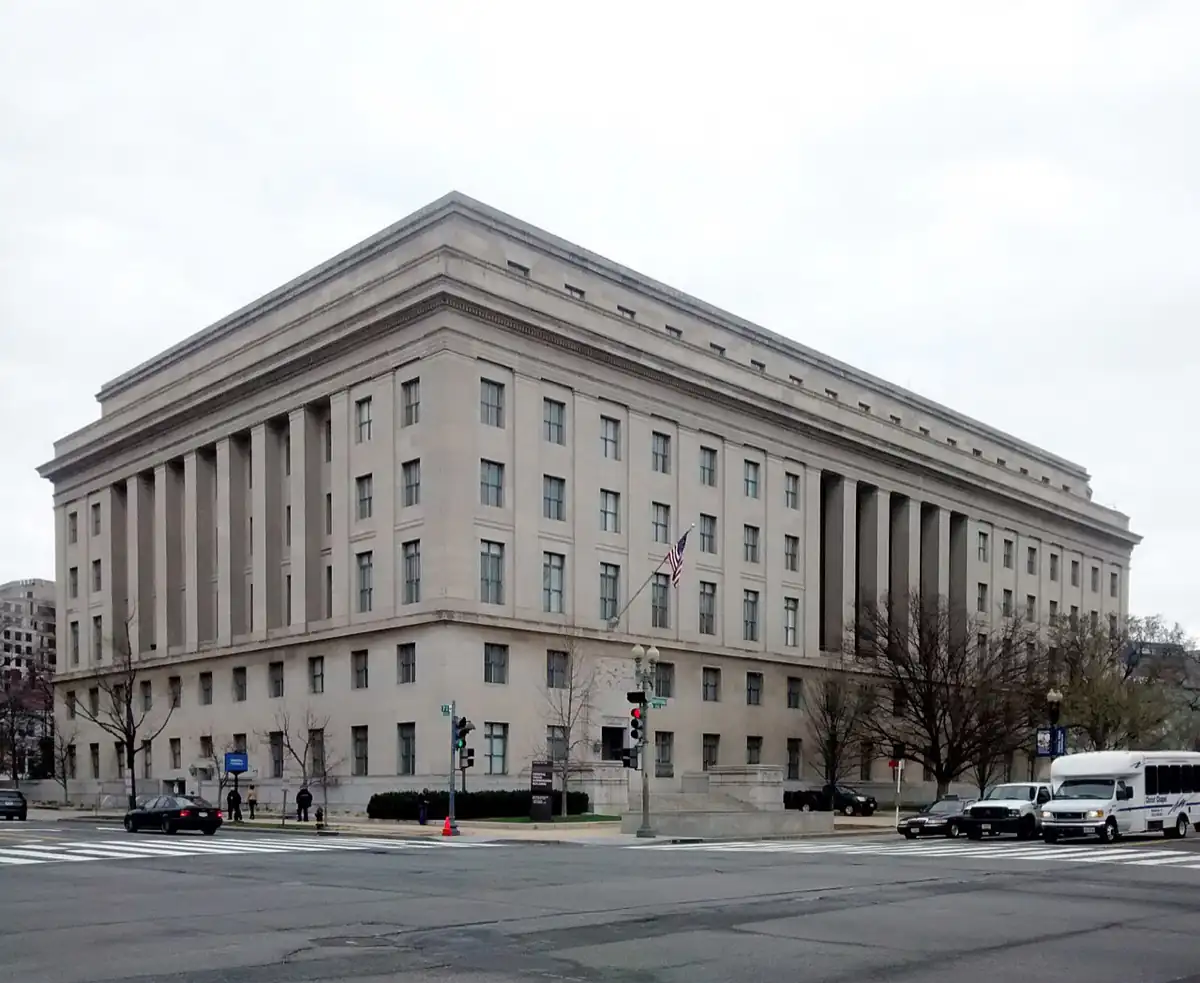
The Federal Trade Commission's headquarters in Washington, D.C., photographed in April 2014. Photo: Gunnar Klack / Wikimedia Commons, CC BY-SA 4.0.
The protections are lopsided. Zscaler must pay a $1.4bn break fee in specified circumstances, such as accepting a rival offer. The 8-K filing describes no fee payable by CrowdStrike if regulators block the deal. CrowdStrike also need not accept a "Burdensome Condition", the agreement's term for remedies regulators might demand, unless it chooses to.
The companies say their products barely overlap. "There's very little overlap," Kurtz told CNBC. Axel Rudolph, chief technical analyst at IG Group, told Reuters that "Antitrust scrutiny is certainly possible given the size of the transaction and the importance of both companies". He added that it would be premature to assume regulators will try to block it. "The key issue is likely to be how much overlap regulators see between the two businesses," he said.
The precedents point to a long review. Cisco completed Splunk on 18 March 2024, about six months after announcing it. Palo Alto completed CyberArk on 11 February 2026, about six and a half months after its announcement. Wiz took almost a year. Google's earlier talks with Wiz in 2024 reportedly fell apart partly over antitrust concerns. The revived deal passed US review in November 2025, won unconditional European Commission approval and completed on 11 March 2026. CrowdStrike expects completion in the second half of its fiscal year ending 31 January 2028. That implies between August 2027 and January 2028, nine to 14 months after signing.
What happens next
The two companies will operate separately until completion. The next steps are:
- A registration statement for the new shares, to be filed with the US Securities and Exchange Commission, followed by a Zscaler shareholder vote. Chaudhry's 34 per cent stake makes approval likely.
- Antitrust filings in the US and reviews elsewhere, including in Europe, where Wiz was cleared.
- CrowdStrike's full-year results for the fiscal year ending 31 January 2027. It has guided to ending ARR of $6.712bn to $6.716bn.
For investors, the gap between Zscaler's share price and the offer value is a running gauge of how likely the market thinks completion is. For customers, the test is whether bundled pricing and integration offset concerns about relying on one supplier. For staff, the companies have given no headcount figures. The $500m cost target is attributed mainly to data centres, supplier contracts and operations. Palo Alto Networks, now facing a rival close to its own scale, is the competitor most directly affected.
Featured image: 150 Mathilda Place by Coolcaesar, via Wikimedia Commons, CC BY 4.0.


