

On 25 November 2026 the US Federal Communications Commission (FCC) gave SpaceX authority to operate up to 1,000,000 satellites in a constellation called Starmind. Each satellite is meant to work as a small data centre. It would carry solar-powered AI processors, do its computing in orbit and send the results to Earth through laser links to SpaceX's Starlink network. The FCC called it "the first authorization in U.S. history for a constellation of data centers in space".
The licence is narrower than the headline number suggests. It governs radio use and how satellites behave in orbit. It does not cover rockets, which the Federal Aviation Administration (FAA) licenses separately. The only radio spectrum it grants is a backup control channel. SpaceX also cannot yet use four of the six orbital shells it was granted, all above 600 km, until the FCC accepts a debris plan for them.
The scale is still without precedent. A million satellites is about 58 times the 17,247 working satellites now in orbit. It is about 89 times the size of Starlink as it stands today. The first big milestone, 100,000 satellites by November 2035, is nearly 25 times the number of payloads launched worldwide in all of 2025. The licence leaves open the central question: whether SpaceX can build and fly anything close to that number.
What the FCC approved on 25 November
SpaceX applied in January 2026. The order, issued by the FCC's Space Bureau, grants part of the request and defers the rest. It covers satellites in orbital shells each 50 km deep, at altitudes from 500 to 1,002 km and at 30-degree and sun-synchronous inclinations. A sun-synchronous orbit passes over each part of the Earth at the same local time every day, so a satellite can stay in near-constant sunlight. SpaceX had described altitudes of up to 2,000 km, which is the range the BBC reported.
The deadlines follow a new schedule the FCC adopted in its space modernisation rule-making. If SpaceX misses any of them, the authorisation lapses. The licence runs for 15 years from the date SpaceX certifies that its first satellite is operating. The FCC also waived its surety bond rule. That rule normally requires operators to post a bond they forfeit if they miss milestones.
The Space Bureau denied petitions from Amazon's satellite unit Kuiper Systems (Amazon Leo), the satellite operator Viasat and the American Astronomical Society (AAS). FCC chairman Brendan Carr said the decision "opens a bold new frontier for the computing infrastructure needed to power America's leadership and growth". Elon Musk replied on X: "Much appreciated. This will be a great asset to America and the world."
A spectrum licence, not a launch licence
The FCC regulates how satellites licensed in the US use radio spectrum. As part of that, it sets conditions on debris. Rockets fall under a different agency. The order itself says "the FAA is the agency responsible for conducting review of the environmental effects of rocket launches". Each Starmind launch will therefore need its own FAA approval.
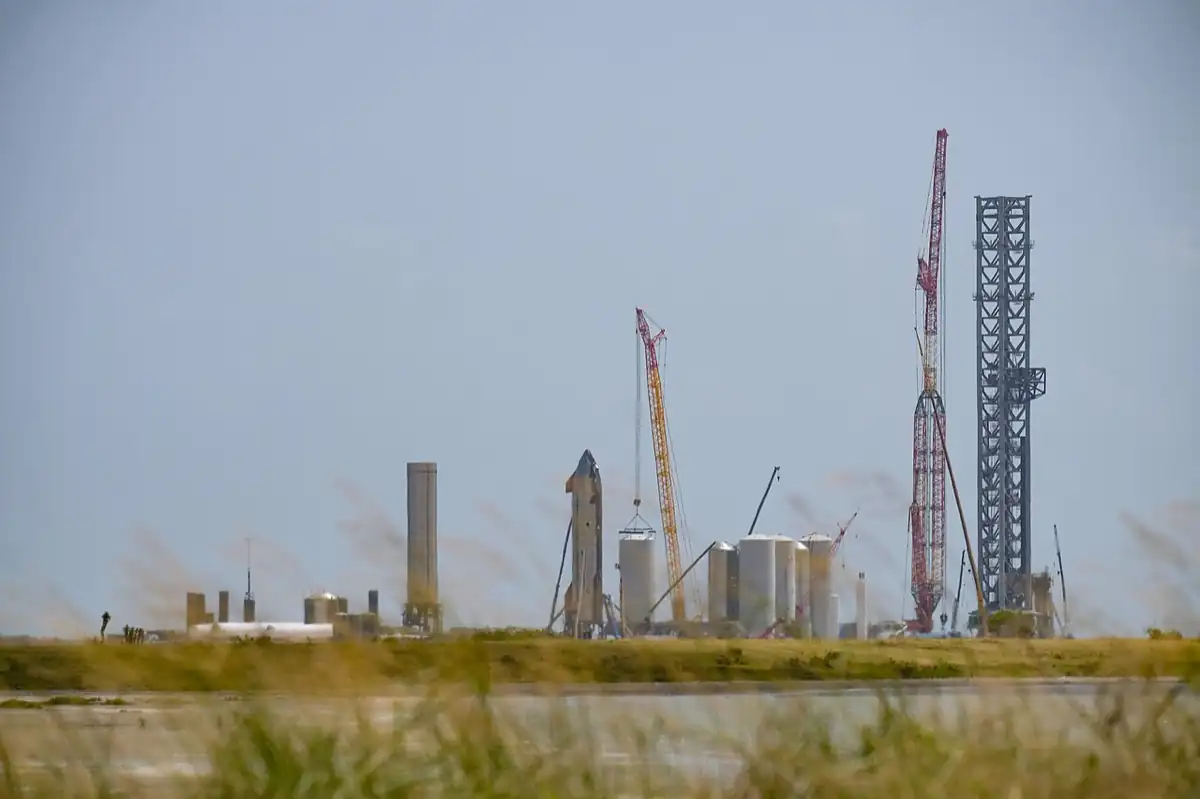
SpaceX's Starbase launch site in Texas, seen across the bay in September 2021, with a Starship prototype, cryogenic tank farm and launch tower. Photo: Lars Plougmann from United States / Wikimedia Commons, CC BY-SA 2.0.
In practice, the order does the following:
- It permits up to 1,000,000 satellites in the six specified shells, subject to the milestone schedule.
- It grants radio spectrum only for backup: two Ka-band segments, 18.8–19.3 GHz down to Earth and 28.6–29.1 GHz up, for emergency telemetry, tracking and command. This use is unprotected and must not interfere with other users. Normal traffic is meant to travel over lasers.
- It accepts the debris plan only for satellites below 600 km.
- It defers SpaceX's request to dispose of higher satellites in long-lived orbits instead of bringing them down through the atmosphere.
- It requires reports twice a year on close approaches, removals, re-entries and deployed satellites.
The FCC said it dismissed comments on topics outside its authority, including environmental concerns and effects on optical astronomy.
How a million compares with what is in orbit
Counts of satellites differ because catalogues and definitions differ. On 18 November 2026 the astrophysicist Jonathan McDowell's catalogue listed 17,247 active satellites. It also listed 35,102 tracked objects in total. Reuters, whose report was carried by several outlets, used a round figure of 17,000 satellites. In July, Space.com cited about 15,000 active satellites and 46,000 tracked objects.
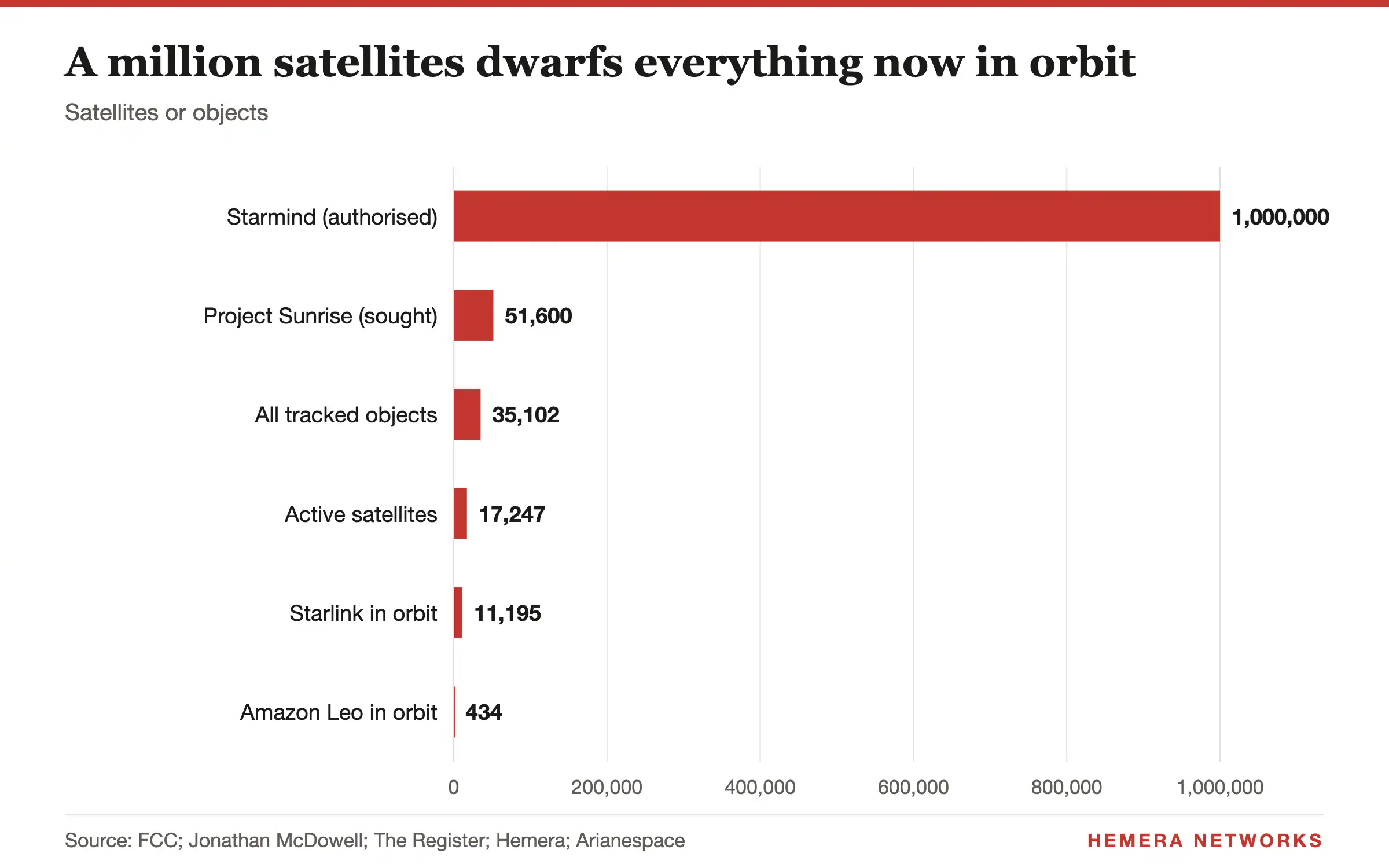
Starmind and Project Sunrise are licence figures; the rest are counts in orbit in November 2026. Chart: Hemera Networks. Source: FCC; Jonathan McDowell; The Register; Hemera; Arianespace.
The table below sets Starmind against the constellations already licensed or proposed. On every measure it is an order of magnitude or more larger.
System (operator) | Satellites authorised or sought | In orbit | Purpose | Altitude |
|---|---|---|---|---|
Starmind (SpaceX) | 1,000,000 authorised | 0 | Computing in orbit | 500–1,002 km |
Starlink broadband (SpaceX) | 19,408 authorised (4,408 first generation, 15,000 Gen2) | 11,195 | Internet access | Low Earth orbit |
Starlink Mobile (SpaceX) | 15,000 authorised | unconfirmed | Direct-to-phone service | Very low Earth orbit |
Amazon Leo, first generation | 3,232 authorised (3,236 in 2020) | about 434 | Internet access | not confirmed |
Project Sunrise (Blue Origin) | 51,600 sought | 0 | Computing in orbit | 500–1,800 km |
Sources: FCC, Jonathan McDowell (planet4589.org), Satellite Today, Reuters, Arianespace, The Register.
SpaceX's entire licensed Starlink estate across both systems comes to 34,408 satellites, so Starmind is about 29 times larger. Amazon Leo has reached about 13 per cent of its licensed first-generation total. Other companies want to compute in orbit too. Starcloud has applied for 88,000 satellites. Google launched its first chips into space in October 2026 for its Project Suncatcher. The FCC is still reviewing these other proposals.
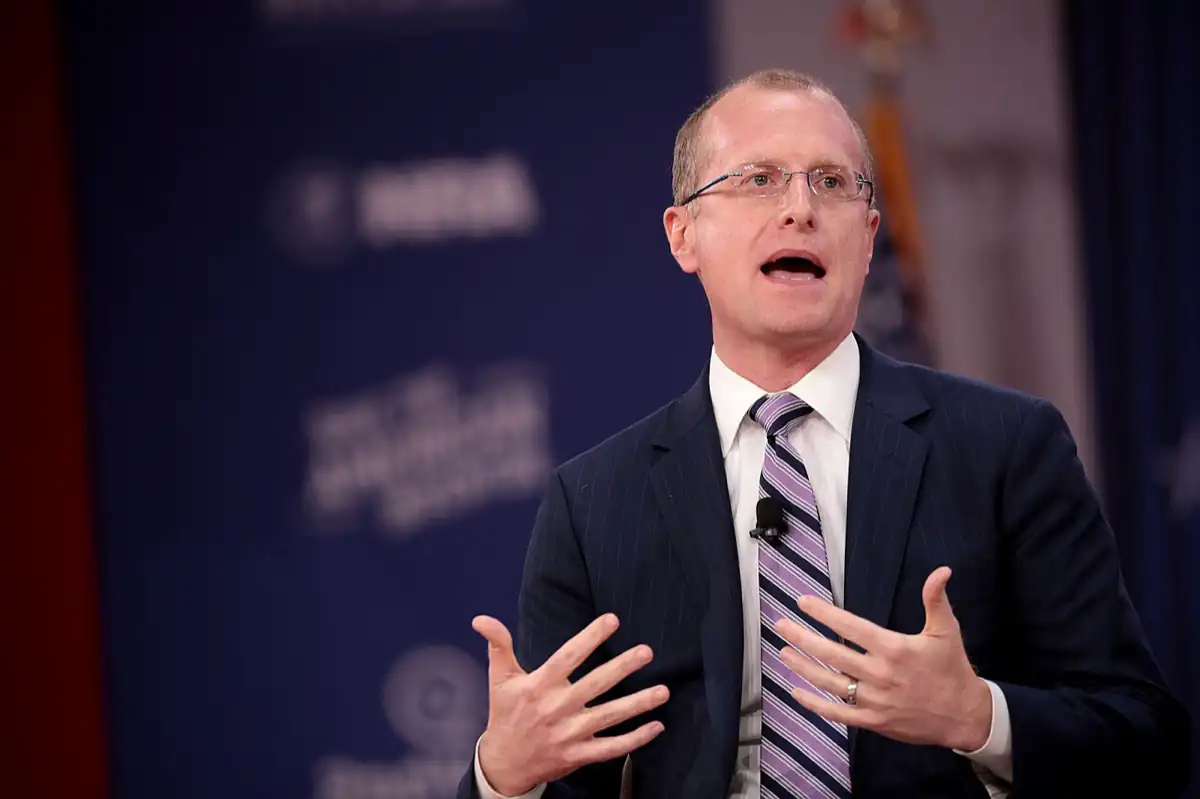
Brendan Carr, now FCC chairman, speaking as an FCC commissioner at the Conservative Political Action Conference in Maryland in 2018. Photo: Gage Skidmore from Peoria, AZ, United States of America / Wikimedia Commons, CC BY-SA 2.0.
How SpaceX's earlier licences went
SpaceX has a pattern of asking for more than it is first given. It sought approval for 42,000 Starlink satellites before deployment began. In 2020 it asked for 29,988 second-generation (Gen2) satellites. The FCC granted 7,500 in December 2022 and a further 7,500 on 9 January 2026, citing debris concerns along the way. It deferred the other 14,988, "including satellites proposed for operations above 600 km". It noted the upgraded satellites "remain untested on orbit".
Starmind breaks that pattern in one way and repeats it in another. The full million was granted at once, not in tranches. But the same 600 km line now decides which shells SpaceX can actually use. The deadlines also differ in structure, as the table shows.
Licence | Granted | Interim milestone | Halfway deadline | Full deadline |
|---|---|---|---|---|
Starmind | 25 Nov 2026 | 1 satellite by 25 Nov 2033; 100,000 by 25 Nov 2035 | 500,000 by 25 Nov 2038 | 1,000,000 by 25 Nov 2040 |
Starlink Gen2 (15,000) | Dec 2022 and 9 Jan 2026 | n/a | 50% by 1 Dec 2028 | Dec 2031 |
Amazon Leo (3,232) | 30 Jul 2020 | n/a | 1,616 by 30 Jul 2026 (waived June 2026) | 30 Jul 2029 |
Sources: FCC, BNN Bloomberg, Hemera, WESH.
Amazon's experience shows what a milestone means in practice. Its 2020 licence required half the constellation in orbit by 30 July 2026. In June 2026 the FCC waived the halfway deadline. In return, satellites Amazon launches after that date temporarily lose priority over some radio frequencies. As Hemera reported on 16 November, Amazon had 398 satellites in orbit before a United Launch Alliance Vulcan rocket failed on 15 November and destroyed 40 more. An Ariane 6 added 36 on 24 November.
The launch bottleneck
Launch capacity is the hardest limit on the licence. The European Space Agency (ESA) counted more than 300 launches in 2025, carrying more than 4,000 new payloads into orbit, or about ten a day. SpaceX's rockets have flown hundreds of missions. Even so, Starmind's 2035 milestone alone is nearly 25 times that whole year's global output.
Reuters reported that the application bets heavily on cutting costs with Starship, SpaceX's fully reusable rocket, which is still in development. Hemera reported on 15 November that SpaceX had caught a Starship upper stage returning from orbit but lost the booster on the same flight.
Amazon argued in March that SpaceX would need "centuries" to deploy the constellation and called the plan a "lofty ambition rather than a real plan". Carr replied that "Amazon should focus on getting Amazon's house in order with their own launches and their own satellite constellation". Musk has promised a first launch in the fourth quarter of 2027. SpaceX's May 2026 IPO filing (an initial public offering of its shares) gave 2028 as the earliest date for deploying compute satellites.
Satellite operators often ask for more satellites than they intend to fly, to keep their designs flexible. The figures suggest the million is best read as a ceiling, not a plan. Engineering questions also remain open:
- whether processors can survive radiation in orbit;
- how to shed heat in a vacuum, where the only way to cool is to radiate it away;
- how to protect hardware from debris and micrometeoroids.
Debris and the 600 km line
The 600 km line splits the six shells. Two sit between 550 and 585 km. Four sit between 686 and 1,002 km. Below 600 km, the FCC found SpaceX's debris plan complied with its rules. For the higher shells, SpaceX must file a modification with a final debris plan before it launches any satellites there.
Under FCC rules, satellites that finish their missions below 2,000 km must re-enter the atmosphere within five years. SpaceX asked for permission to send some of its higher satellites into disposal orbits around Earth, or around the Sun, instead. The FCC deferred that request for lack of information. SpaceX has committed to designing the satellites to burn up completely on re-entry and to aiming re-entries over the ocean.
ESA's 2026 space environment report warned that collisions could set off further collisions, a cascade known as Kessler syndrome. That could make some orbits unusable. ESA said more than three intact satellites or rocket bodies already re-enter the atmosphere each day. The astrophysicist and author Adam Becker told CNBC: "Any serious attempt at this is going to further pollute the night sky and runs a serious risk of a cascading chain reaction of space junk collisions, which would be a disaster for all of humanity."
Astronomers and environmental groups lost at the FCC
The AAS petitioned in March 2026 for the application to be denied. After the decision it said it was "disheartened and dismayed". It argued that the satellites would be larger and therefore brighter than existing ones, and "visible as extremely bright objects for longer periods in the night sky". The FCC found the astronomy concerns "sufficiently addressed in SpaceX's application", through SpaceX's commitment to coordinate with the National Science Foundation. It said the AAS's concerns about infrared heat from the satellites fell outside a radio-frequency review.
The FCC also declined any further environmental review. In July 2026 a coalition represented by the law firm Earthjustice petitioned the FCC to pause all orbital data-centre licences until it had carried out a full environmental review. Jan Hasselman, a senior attorney at Earthjustice, said then: "If we have to sue so that they comply, we will."
Behind the push into orbit is a backlash on the ground. In the November 2026 midterm elections, US voters approved dozens of measures to restrict data centres. SpaceX told the FCC that its satellites would cut "the environmental impact associated with terrestrial data centers". That claim has not been independently tested.
What happens next
- Acceptance: according to reports of the order, SpaceX has about 30 days to decline the conditional grant. If it does nothing, it is treated as accepting.
- Higher shells: SpaceX must file a modification with a debris plan before using any shell above 600 km.
- First launch: Musk has promised one in late 2027. The licence requires a working satellite by 25 November 2033.
- Rivals: Blue Origin's application for 51,600 satellites is still before the FCC.
- Possible litigation: environmental groups have said they are ready to sue. It is not known whether they will challenge this order.
Related coverage: ULA's Vulcan Rocket Fails, Losing 40 Amazon Leo Satellites · SpaceX Catches Starship Upper Stage From Orbit but Loses Booster
Featured image: Starlink Satellites over Carson National Forest, New Mexico (noirlab2206b) by M. Lewinsky/Creative Commons Attribution, via Wikimedia Commons, CC BY 4.0.


