

Nvidia's shares rose 31.5 per cent on Monday 23 November 2026 after its board reinstated Jensen Huang as chief executive, 11 days after he resigned. The chipmaker added about $950bn in market value in one session. It was the stock's biggest one-day percentage gain since 2003.
The S&P 500 rose 4.7 per cent, its best day since April 2025. That came one session after its worst week since the same month. In the five trading days to 20 November the index fell 8.6 per cent and the Nasdaq Composite 10 per cent. The fall left the S&P 500 in a correction, meaning at least 10 per cent below its record.
Against earlier shocks, the fall was severe but not extreme. It was far smaller than the Nasdaq's 25 per cent week in April 2000 and close to the tariff week of April 2025. What sets it apart is that a single company drove both the rout and the rebound. That points to how much of the US market now rests on Nvidia, and to why one day's recovery settles less than it seems to.
The trading days that moved the market
The sell-off came in two waves, with a partial recovery between them. The sequence matters because the causes overlapped:
- 5 November: the S&P 500 fell 4.4 per cent and the Nasdaq 5.5 per cent. That left the Nasdaq 11.9 per cent below its October high, inside correction territory. The Associated Press linked the fall to worries that high borrowing costs and the midterm election results could slow data-centre construction.
- 12 November: Nvidia announced that Huang had resigned "effective immediately". Colette Kress, the finance chief, became interim chief executive. He had reportedly admitted an extramarital affair days earlier. CNBC reported that the reports behind his exit included an affair with a woman alleged to be a Chinese spy.
- 19 November: Anthropic, the AI developer, made its stock market debut. NBC News reported that broad selling of tech stocks began in earnest that day.
- 20 November: Nvidia fell about 14 per cent after a report that the US Securities and Exchange Commission was examining possible accounting issues. Nvidia did not respond to NBC News's request for comment, and the SEC declined to comment.
- 23 November: Nvidia's board said it had voted unanimously to reinstate Huang after receiving "input from senior levels of the United States government".
The table below sets the final week against Monday's reversal.
Measure | Week to 20 Nov | Fri 20 Nov | Mon 23 Nov | Close 23 Nov |
|---|---|---|---|---|
S&P 500 | −8.6% | −3.7% | +4.7% | 7,237.47 |
Nasdaq Composite | −10.0% | −5.3% | +6.5% | 24,089.56 |
Dow Jones | −8.0% | −1.9% | +3.0% | 49,597.72 |
Nvidia | almost −23% | about −14% | +31.5% | $165 |
VIX volatility index | n/a | +26.2% to 35.89 | −25.8% | 26.63 |
Sources: Associated Press, CNBC, NBC News, Anadolu Agency, City AM.
Monday recovered most of one week, not the whole slide. Nvidia closed at about $165, around 5 per cent below its level on 11 November, the day before Huang resigned. It remained about 31 per cent below its record close of $239.24 on 6 October. The Nasdaq-100, an index of the largest non-financial Nasdaq stocks, stayed about 15 per cent below its peak, NBC News reported. The S&P 500 climbed back out of correction territory.
How the swing compares with 2000, 2024 and 2025
The four comparisons each tell a different story about speed, cause and recovery. The table sets them alongside both legs of the November 2026 sell-off.
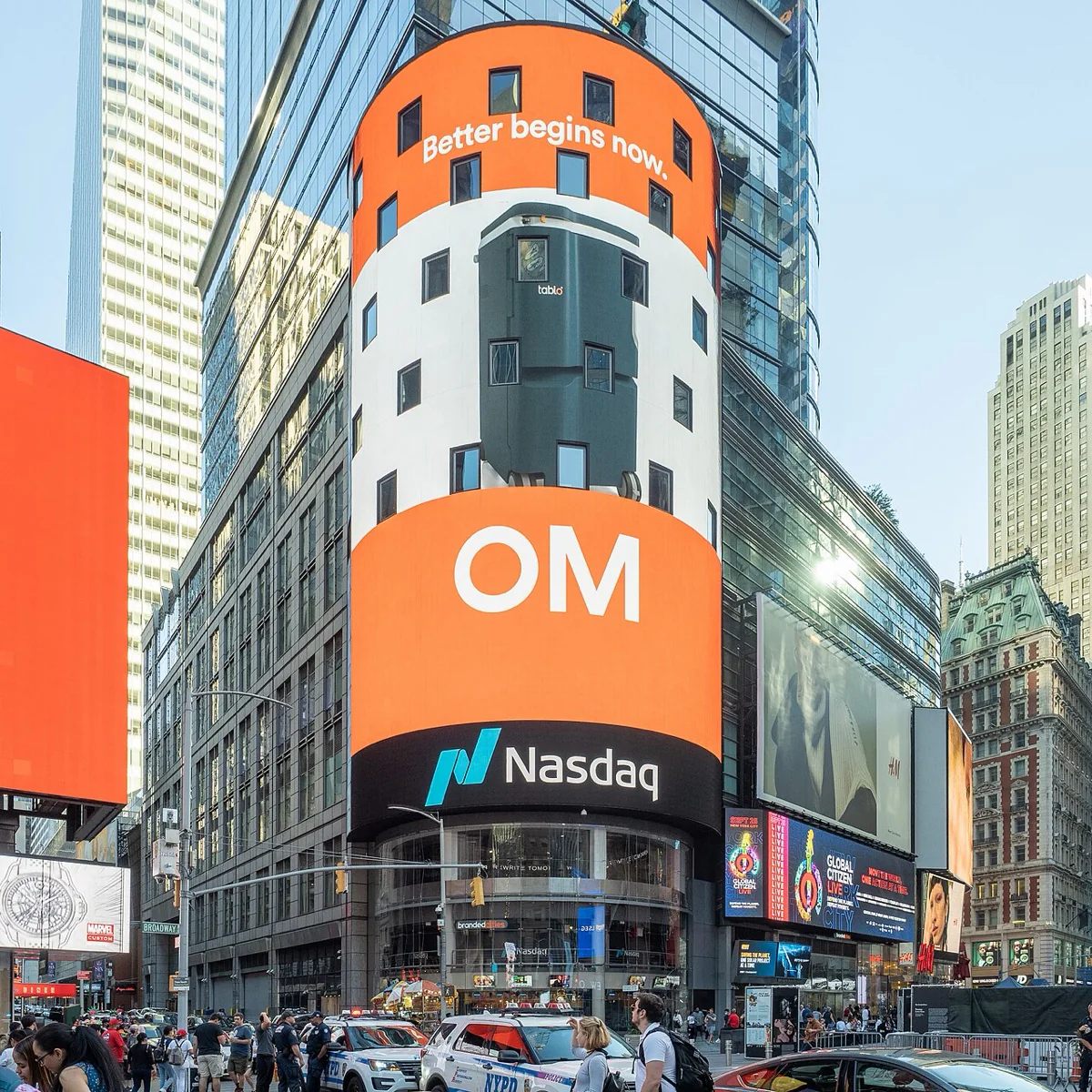
The Nasdaq MarketSite in Times Square, New York. File photo from September 2021. Photo: ajay_suresh / Wikimedia Commons, CC BY 2.0.
Episode | Trigger | S&P 500 | Nasdaq Composite | Recovery |
|---|---|---|---|---|
Week to 14 Apr 2000 | Inflation data, margin calls | −10% (week) | about −25% (week) | Nasdaq regained 2000 peak 23 Apr 2015 |
5 Aug 2024 | Weak US jobs data, yen trades unwound | −3.0% (day) | −3.4% (day) | S&P 500 record 19 Sep 2024 |
27 Jan 2025 | DeepSeek's low-cost AI model | −1.5% (day) | −3.1% (day) | Nasdaq +2% next day |
Week to 4 Apr 2025 | "Liberation Day" tariffs | −9% (week) | about −10% (week) | S&P 500 record 27 Jun 2025 |
5 Nov 2026 | Data-centre and AI valuation fears | −4.4% (day) | −5.5% (day) | |
Week to 20 Nov 2026 | Huang exit, Anthropic debut, SEC report | −8.6% (week) | −10.0% (week) | S&P 500 out of correction 23 Nov |
Sources: Honolulu Star-Bulletin (AP), Associated Press, 24/7 Wall St (SPDR S&P 500 ETF data), Bloomberg via The Spokesman-Review, Reuters via Dawn, The Motley Fool, NPR, PBS, Reuters via Kitco.
Dotcom, 2000–02. The comparison most often raised is also the least close. On 14 April 2000 the Nasdaq fell 9.7 per cent, ending a week in which it lost about a quarter of its value. It was already 34 per cent below its 10 March peak of 5,048.62. It went on to bottom at 1,114.11 in October 2002, about 78 per cent below that peak. It took 15 years to regain it. At the 2000 peak the Nasdaq traded at about 190 times earnings, according to AP. LSEG data show US company earnings up 40.2 per cent year on year in the latest quarter, with tech up 65 per cent.
"The fundamentals are so diametrically different from where we were in 2000," said Matt Orton, chief market strategist at Raymond James Investment Management. Not every measure is reassuring, though. The cyclically adjusted price-to-earnings ratio, which compares prices with ten years of average earnings, is near its highest level since the dotcom peak, The Motley Fool noted.
August 2024. That sell-off was driven by macroeconomics, not by one company. Weak US jobs data and the unwinding of trades funded with cheap yen loans hit every market. Japan's Nikkei fell 12.4 per cent. The S&P 500 set a fresh record six weeks later, on 19 September 2024.
DeepSeek, January 2025. This is the closest analogue. A Chinese start-up's cheaper AI model raised doubts about demand for Nvidia's chips. Nvidia fell just under 17 per cent and lost $592.7bn of market value, a record one-day loss for a Wall Street stock according to LSEG data. Monday's gain of about $950bn was larger than that loss. The two days were mirror images: both ran through Nvidia rather than through the economy.
April 2025. The tariff shock produced the largest index-level snap-back. On 9 April 2025 a 90-day tariff pause lifted the S&P 500 by 9.5 per cent and the Nasdaq by 12.2 per cent. Before that rally the S&P 500 had been nearly 19 per cent below its record. That rebound followed a government decision touching every listed company. The November 2026 rebound followed a decision by one company's board.
History counsels caution about reading a bottom into one session. An analysis by 24/7 Wall St found eight weeks since 2000 in which the S&P 500 tracker fell further than it did in the week to 20 November. In six cases the following week was higher. Only twice, in March 2020 and April 2025, did the bad week mark the low.
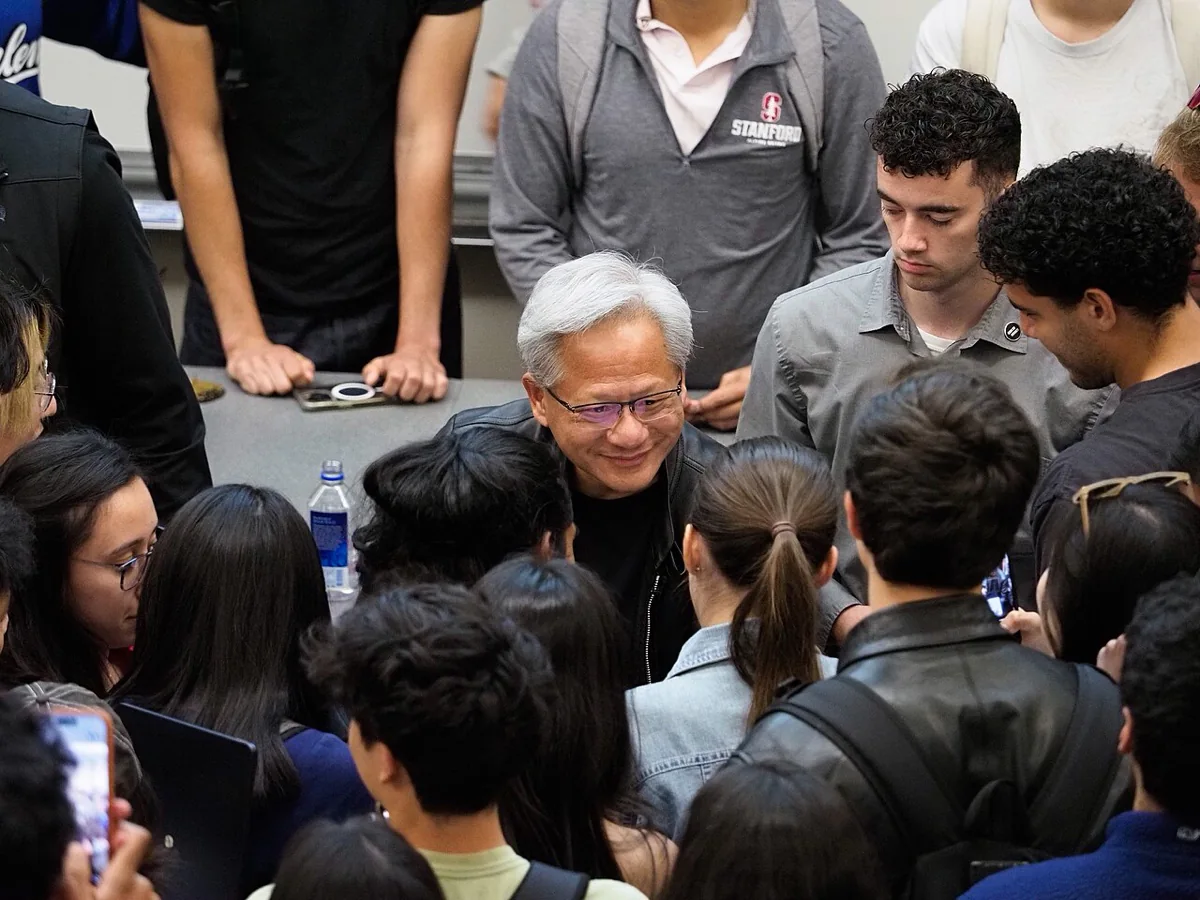
Nvidia co-founder and chief executive Jensen Huang with students after a talk at Stanford University on 30 April 2026. Photo: Anders Eidesvik / Wikimedia Commons, CC BY 4.0.
Why one company can move an entire market
Nvidia made up 5.7 per cent of the SPDR S&P 500 ETF, the largest fund tracking the index, on 19 November, according to State Street holdings data cited by 24/7 Wall St. The same analysis estimated its weight at about 8.6 per cent on 6 October. The seven largest technology holdings made up 32.5 per cent of the fund.
Nvidia's role goes beyond its weight. It has invested in customers such as CoreWeave, a data-centre operator. Investors call the pattern "circular financing". Nvidia funds AI companies, which buy computing capacity from cloud providers, which in turn buy Nvidia chips. A threat to Nvidia's leadership therefore became a threat to the financing of the wider build-out. CoreWeave rose 22 per cent on Monday.
"He is not just Nvidia's CEO; he is arguably the biggest salesman for the entire AI ecosystem." (Charu Chanana, Saxo Markets)
Index funds deepen the effect. They buy shares in proportion to company size, so the biggest firms draw the most new money. Nine of the ten largest holdings in the MSCI All Country World Index are US technology companies, and the tenth is TSMC, Nvidia's main chip manufacturer. Together they make up nearly a quarter of the index, DW reported. That index underpins many global tracker funds held by UK savers.
Volatility and money flows
The VIX, which measures the volatility investors expect from S&P 500 options over the next 30 days, closed at 35.89 on 20 November. It was the gauge's first close above 30 since late March. That is well short of August 2024. On 5 August 2024 the VIX briefly touched 65.70, which the Bank for International Settlements called its biggest one-day spike on record. In March 2020 it peaked above 85.
The rebound, by contrast, was historically violent. Nasdaq-100 futures hit CME Group's 7 per cent overnight limit before Monday's open, Yahoo Finance reported. Since 2007 the contract has hit its overnight limit upward only three times: twice in March 2020 and on 23 November 2026. Overnight futures did not reach 7 per cent on the DeepSeek day, in August 2024 or in April 2025, all of which were falls.
Flows show that ordinary investors were still buying before the worst of the sell-off. US equity funds took in $45.71bn in the week to 18 November, LSEG Lipper data showed, including $10.3bn into technology funds. Professional investors had moved earlier. Goldman Sachs prime brokerage data showed hedge funds sold about $20bn of tech shares in the two weeks to early November. Their sales of existing holdings outpaced new bets against stocks by 3.5 times, Hedgeweek reported.
That positioning helps explain Monday's speed. "This 'Mechanical Bounce' guarantees us nothing," wrote Nomura's Charlie McElligott.
What the rebound did not settle
The issues that shook Nvidia remain open. The company said a committee of independent directors is still investigating reports that Huang was the target of a foreign intelligence effort. It is also searching for a new chief compliance officer. The SEC has declined to comment on the reported inquiry, and the California attorney general's office said the reinstatement did not reduce the need for its own probe. On 23 November the US added Megaspeed, a Singapore-based company reportedly linked to the affair, to a trade blacklist.
Huang said earlier in November: "I own my mistakes completely, and I am committed to cooperating with the Board's independent investigation." Board chair Harvey Jones said on 23 November: "The Board believes Jensen is the right person to lead NVIDIA."
Analysts largely read Monday as relief rather than resolution:
- "The CEO question has been resolved, but the governance and geopolitical questions have not," said Yang Wang of Counterpoint Research in London.
- "Similar volatility shocks have typically taken 6-8 weeks to subside," wrote Jim Reid of Deutsche Bank.
- "I don't think it's a fundamental bottom for what it's worth," said Drew Pettit of Round Hill Investments.
Other pressures predate the Huang episode. Markets are pricing a US interest rate rise. Fed funds futures, which track bets on the central bank's rate, implied a December increase as a certainty on 24 November, CNA reported, up from 89 per cent odds on 20 November. The 10-year Treasury yield stood at 4.94 per cent. The Bank of England raised its main rate on 5 November for the first time in three years.
What happens next
The calendar is crowded, and each date tests whether the rebound holds:
- 25 November: US PCE inflation data, the Federal Reserve's preferred price gauge.
- 1 December: Huang is due to give a transcribed interview to three House committees, including Intelligence and the China Select Committee. Nvidia's general counsel, Tim Teter, is to appear on 2 December.
- 3 December: Huang is scheduled to testify before the Senate Banking Committee.
- 8–9 December: the Federal Reserve's final policy meeting of 2026.
For investors, the episode shows that diversification through index funds now carries a large single-company risk. A UK saver in a global tracker held Nvidia, TSMC and the US technology giants whether or not they meant to. London's FTSE 100, light on technology stocks, rose 1.30 per cent on Monday against the S&P 500's 4.7 per cent.
The figures suggest the AI trade has become a bet on a small number of companies and, for a few days, on one executive. A rebound driven by a board decision can be undone by a hearing, an inflation print or a rate rise. The next three weeks will show which of those carries more weight.
Featured image: 2788-2888 San Tomas Expwy by Coolcaesar, via Wikimedia Commons, CC BY-SA 4.0.


