

Nvidia's board reinstated Jensen Huang as chief executive on Monday 23 November 2026. The decision came eleven days after he resigned amid reports linking him to a woman US intelligence reportedly suspects of working for China.
The reversal matters well beyond Silicon Valley. Nvidia makes the processors that power most advanced artificial intelligence (AI) systems. Washington restricts their sale to China. Federal agencies are now asking whether those restrictions were evaded through a Singapore customer linked to the woman, and whether Nvidia told investors enough. None of those inquiries ends with Mr Huang's return. Nvidia's shares rose by roughly a third in early trading.
Among past founder exits, the closest parallel is OpenAI's removal and rapid restoration of Sam Altman in November 2023. There are two big differences. At OpenAI the crisis was an internal boardroom dispute, and the board that fired Mr Altman was largely replaced. At Nvidia, the board that accepted Mr Huang's resignation stays in place. The pressure to reverse came partly from the US president, and the questions behind the crisis are in the hands of regulators, prosecutors and Congress.
From resignation to return in eleven days
The crisis became public on 8 November, when Mr Huang, 63, admitted in a message to staff that he had been unfaithful to his wife, without naming anyone. The board opened an independent investigation that day. On 10 November its independent directors hired the law firm Wachtell, Lipton, Rosen & Katz to run it.
On 12 November Nvidia told the US Securities and Exchange Commission (SEC) that Mr Huang had resigned as president, chief executive and director with immediate effect. He co-founded the company in 1993. Colette Kress, the chief financial officer, became interim chief executive, and Harvey C. Jones became the board's first chair. Hemera reported on 14 November on a Reuters account that Mr Huang had told colleagues his dealings with the woman were ordinary customer business. The New York Times also reported a relationship with a senior Nvidia employee.
On the company's results call on 17 November, Mr Jones ruled out a return. He said the board "does not intend to reinstate Jensen as CEO", according to Al Jazeera's account of the call. The board had hired the search firm Heidrick & Struggles to find a permanent successor.
The board's position then changed in under a week. President Donald Trump said publicly that Mr Huang deserved a second chance. A petition backing his return gathered close to 200,000 signatures. Nvidia's statement on 23 November said the board had voted unanimously after "a series of discussions and meetings" with him. It said it had received input from senior levels of the US government and was confident his return "poses no national security risk". Ms Kress returns to her finance role.
What is reported about Alice Huang and Megaspeed
The woman at the centre of the case is Alice Huang, a former executive of Megaspeed, a Singapore-based cloud computing company that runs data centres in South-east Asia. She is not related to Jensen Huang. Megaspeed was a large Nvidia customer. It bought more than $4.8bn of Nvidia chips from June 2024, according to The New York Times as cited by CNBC.
The New York Times reported on 22 November that Alice Huang kept in contact with an officer of China's Ministry of State Security, the country's main civilian intelligence agency, from spring 2025 until autumn 2026. The newspaper cited people with knowledge of US intelligence reports. That period overlaps with at least part of her reported relationship with Mr Huang. The Times also reported that her business partner, Kang Wei, worked with the same agency. Neither Alice Huang nor Mr Kang responded to the paper.
Several points remain unproven or disputed:
- Jay Clayton, the US Director of National Intelligence, told ABC on 22 November: "There is an investigation ongoing into her firm and into her."
- Singapore's Ministry of Home Affairs found insufficient evidence for offences over inaccurate declarations, but gave her a stern warning for knowingly giving inaccurate information. It said she was not investigated for espionage.
- Megaspeed says it is a "legitimate and lawful business" and that Alice Huang left on 30 August 2025.
- China denies the allegations. Mao Ning, a foreign ministry spokeswoman, on 12 November urged the US to stop "fabricating so-called spy narratives and using them as a pretext for imposing a technological blockade".
Mr Huang has not been accused of a crime. He told Bloomberg on 29 October that the US government had not told him of its suspicions. A spokesperson for him declined to comment on the latest Times report.
Chip sales, export controls and the accounting inquiry
US export controls require a licence to sell the most capable AI chips to Chinese buyers. The concern is that chips sold legally to firms elsewhere in Asia were then moved into China. The Commerce and Justice departments said they had been investigating Megaspeed since 2024 over possible export-control breaches. The Justice Department now leads the criminal inquiry, CNBC reported. Nvidia removed Megaspeed from its customer list in August 2025.
Treasury Secretary Scott Bessent has led the administration's public questions to Nvidia. On CBS's Face the Nation on 22 November, he said officials had contacted Nvidia's interim management, lead directors and lawyers and still needed answers. He wants to know whether any compliance failures were confined to junior staff or reached senior executives. "I think we have to see where the buck stops," he said.
Separate inquiries are running in parallel:
- SEC accounting inquiry: Reuters reported on 20 November, citing two people briefed on the matter, that SEC enforcement staff are examining Nvidia's accounting. Reuters could not establish which practices are involved. Nvidia changed its geographic revenue reporting in 2025, which removed Singapore from the breakdown. The Financial Times reported that Singapore sales had risen to almost half of global revenue. The SEC declined to comment.
- SEC disclosure questions: According to Fortune, the SEC is also examining whether Nvidia's disclosures adequately covered the risk of chips being diverted to China.
- California: The state attorney general has reportedly subpoenaed Nvidia over whether the company or Mr Huang enabled China to obtain advanced chips or confidential information, or misled investors.
- FBI: Mr Trump has said the FBI is examining Mr Huang's relationship with Alice Huang and any intelligence ties.
Investigations are not findings of wrongdoing, and many close without action. The business itself has not faltered. Nvidia reported revenue of $115.8bn for the quarter to 25 October, up 103% on a year earlier, and net profit of $64.9bn, Al Jazeera reported.
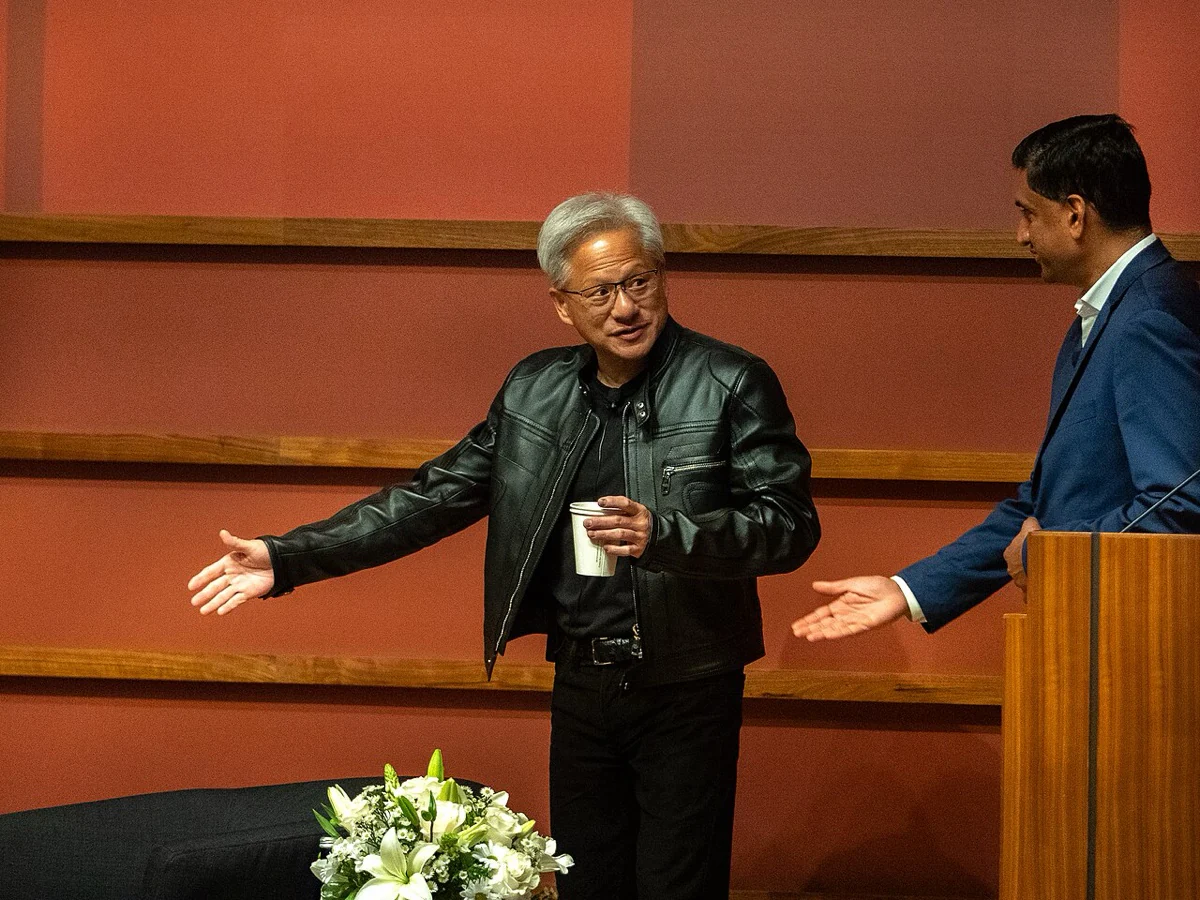
Nvidia chief executive Jensen Huang, left, with US Representative Ro Khanna at a Stanford event in April 2026. Photo: Anders Eidesvik / Wikimedia Commons, CC BY 4.0.
How the reversal compares with past founder exits
Departures of founders and long-serving chiefs under pressure have ended in different ways. The table sets Mr Huang's exit against four well-known cases. Intel's Brian Krzanich was not a founder, but his exit is included because it also followed a breach of rules on relationships at work.
Leader, company | Left | Trigger | Returned | Time out |
|---|---|---|---|---|
Steve Jobs, Apple | 16 Sep 1985 | Lost power struggle with CEO John Sculley | Interim CEO, 16 Sep 1997 | 12 years |
Travis Kalanick, Uber | June 2017 | Five major investors demanded he quit | No | n/a |
Brian Krzanich, Intel | 21 Jun 2018 | Past relationship with an employee | No | n/a |
Sam Altman, OpenAI | 17 Nov 2023 | Board said he was not candid with it | Deal announced 21 Nov 2023 | 4 days |
Jensen Huang, Nvidia | 12 Nov 2026 | Reported relationships; reported spy suspicions about Alice Huang | 23 Nov 2026 | 11 days |
Sources: Nvidia SEC filings, OpenAI, Poynter, Al Jazeera, CBS News, PBS NewsHour.
The OpenAI case resembles Nvidia's in speed and in how pressure built. OpenAI's board said on 17 November 2023 that Mr Altman had been "not consistently candid in his communications with the board". Nearly all of the company's roughly 770 staff then signed a letter calling for his return. Microsoft, OpenAI's largest backer, offered to hire him. A deal came within four days.
At Nvidia, the pressure came from a public petition, prominent technology figures and the US government. Mr Trump said he spoke to Mr Huang on 22 November and told CNBC that Mr Huang "did nothing wrong".
The outcomes for the boards differ. OpenAI's restoration came with a new board, chaired by Bret Taylor; only one director who voted to remove Mr Altman stayed. It also came with a review by the law firm WilmerHale. Nvidia's directors remain, and their own investigation continues. Uber and Intel show the more common path: once investors or the board had acted, the chief executive stayed out. In both cases a finance or senior executive filled in, as Ms Kress did at Nvidia.
The Jobs case is the reminder that return is possible, but it took twelve years and the near-collapse of Apple.
What the board has changed, and what it has not
Nvidia's statement on 23 November set out three governance steps alongside the reinstatement:
- A new National Security and Export Control Committee, made up only of independent directors, to oversee trade compliance and national security risk.
- A search for a chief compliance officer who will report to the board's nominating and corporate governance committee, not to management.
- The independent directors' investigation into reports that Mr Huang was the target of a foreign intelligence effort "will proceed to conclusion". Mr Huang has said he supports it.
Mr Jones remains chair. Before 12 November Nvidia had no board chair. Its founder ran the company with no separate board leader. That separation survives his return.
What has not changed is the source of the risk. The board has said there is no national security risk, citing government input. Yet the Director of National Intelligence says the Megaspeed investigation is live. The Treasury Secretary says the administration lacks answers on compliance. The board's investigation has not reported. Critics say the board decided before the facts were in. Senator Elizabeth Warren called the reinstatement "reckless", CNBC reported.
The White House's role is itself under scrutiny. The New York Times reported that advisers told Mr Trump on at least two occasions, before the scandal became public, about Alice Huang's alleged links. "We have to protect our brilliant people. Jensen is one of them," he said at a White House news conference on 20 November.
The market: a record swing
The share price shows how closely investors tied Nvidia's value to Mr Huang personally, and how the accounting report compounded the fall. The figures below are closing prices except where marked; Monday's trading was still under way at the time of writing.
Date (2026) | Share price ($) | Context |
|---|---|---|
6 Oct | 239.24 | Record close |
6 Nov | 186.64 | Before Huang's admission on 8 Nov |
11 Nov | 173.73 | Last close before resignation filing |
20 Nov | 125.53 | Day of Reuters SEC accounting report |
23 Nov | 159.48 | Pre-market, after reinstatement |
23 Nov, 9:57 ET | 166.35 | Early trading |
Sources: CNBC, Yahoo Finance, 24/7 Wall St.
From the October record to the close on 20 November, the shares lost 47.5%. The shares fell about 13% on 20 November alone, according to LSEG data cited by Reuters. By 9:57 on Monday they were up 32.5% on Friday's close. They were still about 30% below the record.
24/7 Wall St. put Monday's gain in market value at about $990bn at 9:57 ET. That would be about double the previous one-day record of just under $450bn, set by Microsoft on 30 July 2026.
What happens next
The next fortnight brings Mr Huang's first formal questioning by Congress:
- 1 December: Mr Huang gives a closed-door, transcribed interview to three House committees, including Foreign Affairs.
- 2 December: Tim Teter, Nvidia's general counsel, appears before the same panels.
- 3 December: Mr Huang is due to testify in public as the sole witness at a Senate Banking Committee hearing, CNBC reported.
Beyond those dates, the open questions are the ones no board vote can settle. Prosecutors must decide whether Nvidia chips were illegally diverted to China. The SEC must decide whether Nvidia's accounts and disclosures were adequate. And Nvidia's own investigators must report what they find about their chief executive. The reinstatement settles who runs Nvidia. It does not settle those questions.
Related coverage: US Chip Curbs Reach the Cloud: What the Remote-Access Rule Changes · Asian Stocks Slide as Chip Selloff Meets Weak Chinese Data
Featured image: 2788-2888 San Tomas Expwy by Coolcaesar, via Wikimedia Commons, CC BY-SA 4.0.


