

Ukraine struck the bridge linking Russia to occupied Crimea overnight into Monday 16 November, and Russian authorities halted road traffic across the Kerch Strait. The strike came during what Russia's defence ministry described as an attack by 1,336 Ukrainian drones on 15 Russian regions, Crimea, and the Black Sea and Sea of Azov.
Moscow's mayor, Sergei Sobyanin, said about 600 of those drones were heading for the capital region. Early reports suggest the bridge suffered limited damage. By Russia's own count, however, this was one of the largest drone attacks of the war. It came days after US-mediated talks in Abu Dhabi ended without a breakthrough, and three days before Xi Jinping, Donald Trump and Vladimir Putin are due to meet in Shenzhen.
Damage to the Kerch bridge unclear
Sergei Aksyonov, the Russian-installed head of Crimea, announced the strike on Telegram. "The enemy has hit the Crimea bridge," he wrote. "As a result, traffic will be restricted, likely until the afternoon." He set up an emergency headquarters in Kerch, the city at the Crimean end of the crossing. He did not describe any damage or say whether anyone had been hurt.
According to the state news agency TASS, Russia's Transport Ministry said repairs were under way and passenger trains were running normally. Engineers were assessing whether cars could cross in alternating directions on a single lane. TASS said preliminary information showed no injuries. Several trains bound for Crimea were running two to four and a half hours late.
Nobody has independently verified the extent of the damage. AFP reported that social media channels close to the Russian military showed no sign of serious damage. Crimean Wind, a pro-Ukrainian monitoring channel, said a drone hit one of the arches over the navigable span, the raised section that lets ships pass beneath. A separate claim that the arch had shifted has not been verified. The Russian Telegram channel Mash reported about 2,000 vehicles stuck in queues. According to the Kyiv Independent, Kyiv had not commented on the strike by Monday morning.
The 19km crossing is Europe's longest bridge. It opened to road traffic in 2018 and to trains in 2019, four years after Russia seized the peninsula from Ukraine. It is widely seen as one of Putin's signature infrastructure projects, and it carries supplies to Russian forces in southern Ukraine. Ukraine has hit it before. A truck bomb in October 2022 killed four people and limited traffic for months, and sea drones (uncrewed explosive boats) struck it in July 2023. Ukrainian forces have also reportedly hit at least six bridges along a Russian logistics corridor linking the Rostov region with occupied southern Ukraine since early October.
Scale of the overnight attack
Russia's defence ministry said its air defences destroyed 1,336 drones over regions including Moscow, Bryansk, Kursk, Rostov and Krasnodar, as well as Crimea. These figures cannot be independently verified. The ministry did not say how many drones reached their targets.
The ministry's total is higher than the 1,214 drones it reported downing on 29 October, which The Moscow Times described at the time as a record. Before that, the ministry reported more than 1,100 on 20 September. AFP, which keeps its own tally of official Russian statements, described Monday's figure as the second-highest daily total this year.
Sobyanin said about 600 drones headed for the Moscow region between 14:00 GMT on Sunday and 05:00 GMT on Monday. He said 191 were brought down as they approached the city and the rest were destroyed further out.
Russian officials reported casualties in several regions. In the Bryansk region, which borders Ukraine, a 59-year-old man was killed when a drone dropped an explosive device on his car. Six people, including children, were injured in the Seversky district of the Krasnodar region. In the Rostov region, Governor Yury Slyusar said three people were injured in the town of Azov, where four industrial sites caught fire. The exiled Russian outlet Astra reported that at least two of those sites were near oil depots.
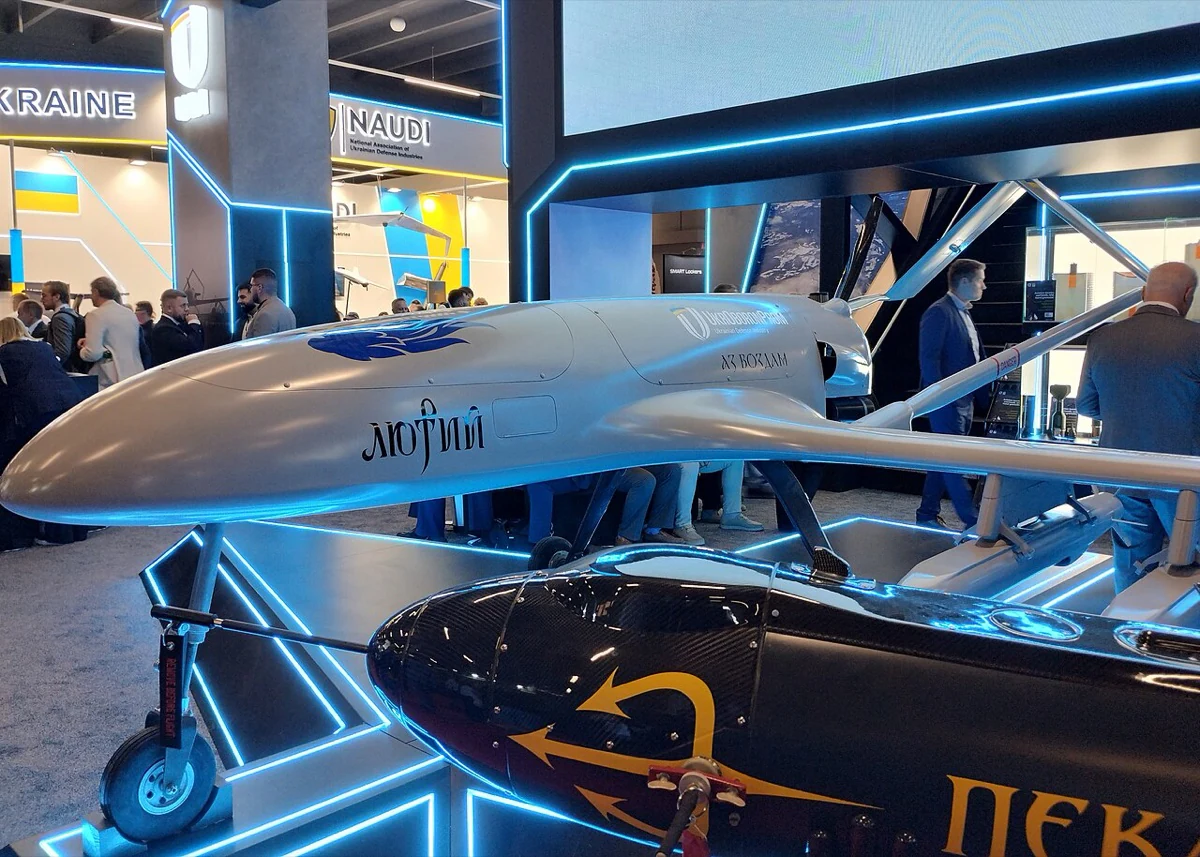
A Ukrainian Liutyi long-range attack drone on display at the International Defence Industry Exhibition in Kielce, Poland, in September 2026. Photo: Michał Derela / Wikimedia Commons, CC BY-SA 4.0.
Strikes in both directions
Kyiv describes its long-range strikes as retaliation for Russian missile and drone attacks on Ukrainian cities and the power grid. Those attacks have killed hundreds of civilians and regularly cut electricity and heating for millions of people. In a video address on Sunday evening, President Volodymyr Zelensky claimed that Ukraine had disabled more than 55 per cent of Russia's oil refining capacity. That figure has not been independently verified. "This is our justified response to Russia's refusal to de-escalate and its strikes on our energy infrastructure," he said.
Ukraine's General Staff said that overnight into 15 November its forces hit the Nizhnekamskneftekhim petrochemical complex and the TAIF-NK refinery in Tatarstan, about 1,200km from Ukraine. It also said it struck the Monolit plant in Trubchevsk, in the Bryansk region, which makes aircraft parts, including for helicopters.
Russia also attacked Ukraine overnight. Ukraine's air force said Russia launched 158 drones and that 131 were shot down. Oleksandr Hanzha, governor of the Dnipropetrovsk region, said one person was killed and three injured in Dnipro. Mykhailo Semikin, acting governor of Zaporizhzhia, reported one death and two injuries in his region. Russia's defence ministry said its strikes hit a dry-cargo ship at sea and a locomotive near Zaporizhzhia railway station. It claimed both were being used to support Ukraine's armed forces. Both governments deny deliberately targeting civilians.
Talks stall before Shenzhen
Last week's talks in Abu Dhabi were the first US-mediated negotiations between the two sides since February. They produced plans for a large prisoner exchange, but the details are still being worked out. After the talks, Putin repeated his territorial demands. He said Moscow would regard any deployment of foreign troops in Ukraine as a "continuation of war". As Hemera reported on 14 November, Zelensky said Washington had proposed that Kyiv cede territory in exchange for NATO membership. Moscow has repeatedly said it will not accept Ukraine joining the alliance.
On Monday, China confirmed that Xi will meet Trump and Putin in Shenzhen on 19 November, on the sidelines of the Asia-Pacific Economic Cooperation (APEC) summit. Beijing said the three leaders would discuss "world peace". Trump has said he plans to raise denuclearisation and the Iran war. US officials say the war in Ukraine is not expected to be a focus. Zelensky has warned that the meeting could become a modern version of the 1945 Yalta conference, where major powers carved up spheres of influence without smaller countries in the room.
What the strike signals
On the evidence so far, the attack on the bridge looks more symbolic and logistical than structural. Even a few hours' closure holds up Russian traffic into Crimea and shows that the crossing can still be reached. Russia's own figures also suggest that Ukraine's long-range campaign is growing: more than 1,100 drones on 20 September, 1,214 on 29 October and 1,336 on Monday. Each attack on that scale forces Moscow to keep air defences around the capital, where they cannot protect refineries, airfields or front-line troops.
Ukraine is also applying pressure while the diplomacy is unsettled. It wants to show that it can impose costs on Russia while Washington, Beijing and Moscow discuss the wider security picture without Kyiv in the room. Russia has stepped up its own attacks on Ukrainian bridges in recent months, including in Kyiv.
There are two things to watch next. The first is whether Russian engineers reopen the bridge to normal traffic. The second is whether the war comes up in Shenzhen on 19 November, despite US officials saying it will not be a focus.
Related coverage: US Floated Donbas-for-NATO Trade, Zelensky Says After Abu Dhabi Talks · Drones Hit Three Commercial Ships Off Romania's Sulina Canal
Featured image: Крымский мост 13 сентября 2019 года (1) by Росавтодор, via Wikimedia Commons, CC BY 4.0.


