

Iran's Islamic Revolutionary Guard Corps (IRGC) said on Sunday 15 November that a supertanker carrying more than two million barrels of crude oil had sunk after hitting a naval mine in the Strait of Hormuz. On Monday morning its naval arm went further. It said two more tankers had struck mines and caught fire, and declared that it had mined the shipping lane the United States has been using to move tankers past Iran.
None of the claims has been independently confirmed. Iran has not named any of the vessels, or given their owners, flags or crews. A British maritime security centre did report an attack on a tanker in the Gulf on Sunday, with the crew safe, but said it was unclear whether this was the ship Iran described. Confirmed or not, the claims raise the perceived risk for shipowners using a channel that normally carries about a fifth of the world's oil.
What Iran says happened
The first statement was carried by Iranian state television on Sunday. It said two tankers had been using an "unauthorised" route through the southern part of the strait.
"Over the past few hours, two oil tankers travelling along an unauthorised route in the southern part of the Strait of Hormuz struck naval mines, resulting in massive explosions and fire," the IRGC said. It added that one of them, a supertanker, "sank in the southern waters of the Persian Gulf". A cargo of two million barrels is typical of a very large crude carrier, the biggest class of oil tanker in common use.
According to Anadolu, the Turkish state news agency, the IRGC alleged that the tankers had switched off their navigation systems and tried to cross undetected with US military support. A naval mine is an explosive charge placed in the water that detonates on contact with a ship or when one passes close by.
Late on Sunday, Iran's regular navy, which is a separate force from the IRGC, said another tanker had hit a mine east of the strait and caught fire hours earlier. Reuters said it could not independently verify that report.
On Monday, the IRGC Navy's public relations office said two further tankers had been hit while trying to cross the southern strait. It alleged that they were operating under the direct guidance of US officers, with support from American fighter jets. It claimed that six tankers had caught fire and were sinking in the waterway since Sunday, and that pollution had spread across the strait's waters and shores. It again gave no vessel names and no casualty figures.
The IRGC presented the attacks as a response to the US naval blockade of Iranian ports, and warned shipowners against cooperating with the US military. "The southern American-created route in the Strait of Hormuz has been mined with walls of fire," the statement said.
What can be confirmed
The UK Maritime Trade Operations centre (UKMTO), run by the Royal Navy to collect security reports from merchant ships, said on Sunday it was aware of a report from Indian shipping authorities. That report described an attack on a tanker sailing east through the Gulf before entering the strait. "The crew are accounted for and safe," UKMTO said. It said the damage and environmental impact were not yet known.
Iran has made similar announcements repeatedly since the summer. The maritime news site gCaptain has logged IRGC mine claims on 18 July, 31 August, 2 September, and 10 and 12 October. None was independently confirmed. After the 31 August claim, US Central Command (CENTCOM), which directs American military operations in the region, said: "No ships have hit mines in the Strait of Hormuz."
In one October case, Iran said the Singapore-flagged containership GFS Pride had struck a mine. CENTCOM said an IRGC projectile had hit it instead. The ship sank while under tow, and all 21 crew were evacuated. The Joint Maritime Information Center, a multinational naval information hub, separately found "no substantiation" for IRGC claims that two supertankers struck mines on 17 October.
On 28 October, CENTCOM said that "All internationally recognized primary transit routes through the Strait of Hormuz have been cleared of sea mines". The IRGC spokesman, Hossein Mohebi, replied: "Prove your Hormuz mine-clearing claim with independent evidence, not statements!" CENTCOM had not publicly addressed the latest claims by early Monday UK time.
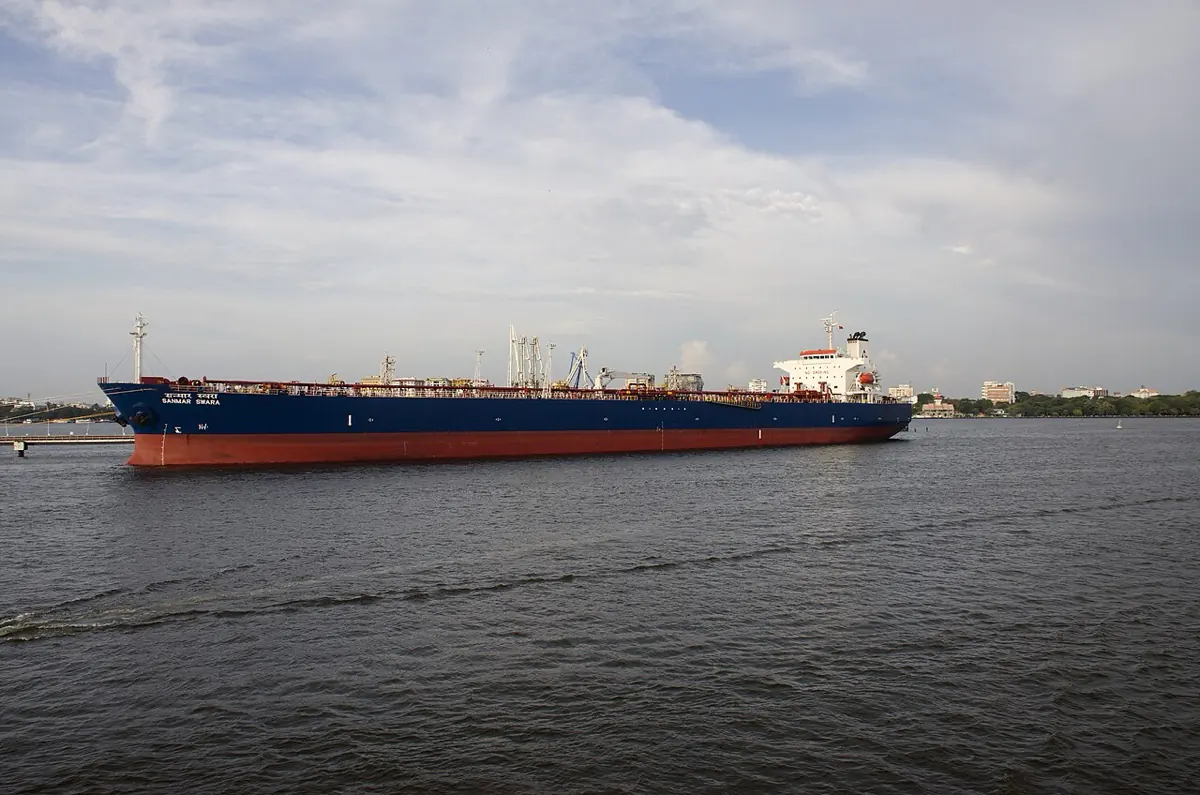
An oil tanker at Cochin Oil Terminal in India, shown as a file photo; it is not the vessel in the Iranian claim. Photo: Rangan Datta Wiki / Wikimedia Commons, CC BY-SA 4.0.
The contest over the southern route
Iran has heavily restricted traffic through the strait since the war began on 28 February, insisting that ships use routes it authorises. It declared the strait closed again on 12 July, after the US resumed strikes on Iran. Washington responded by blockading Iranian ports and helping tankers through the waterway. CENTCOM said in October that it had helped Gulf countries export 1.5 billion barrels of oil via Hormuz since the summer.
Many of those ships use a corridor near the Omani coast, on the southern side of the strait. Tehran regards that corridor as unauthorised, and its Monday statement described it as American-created. Reuters reported in March that Iran had laid about a dozen mines in the strait, and US forces later carried out clearance operations.
The Institute for the Study of War (ISW), a Washington think-tank, has questioned whether new mines exist. In an assessment cited by the Israeli news site Ynet, it said it had seen "no indications that Iran has successfully re-mined the strait". It judges that Iranian forces are instead attacking ships with drones and missiles. In its view, "Iran's repeated mine claims appear designed to undermine shipping operators' confidence in U.S. naval escorts."
If that reading is right, the claims serve a purpose whether or not any mine is in the water. Shipowners and insurers weigh risk on reports as well as confirmed damage. A declared minefield on the US-backed corridor directly challenges Washington's assurance that the lanes are clear, and its wider claim to be keeping the strait open.
The cost to crews and markets
The danger to seafarers is real whatever the weapon. The International Maritime Organization had recorded more than 130 incidents in the area by 11 November, with at least 25 seafarers killed. Hemera reported on 14 November that the UN had put the death toll at 25 since the war began.
Oil markets were calm on Monday morning. Brent crude fell about 1 per cent to $94.86 a barrel, according to the Indian brokerage HDFC Sky, which cited expectations of a global supply surplus. The modest move suggests traders were not treating Sunday's sinking claim as a confirmed loss of supply.
Iran's claim that pollution has spread along the strait is also unverified. A full supertanker cargo lost at sea would be a serious environmental event for Gulf coastal states, which rely heavily on desalinated seawater.
What comes next
The immediate test is evidence. A sunken supertanker would leave traces: an owner or insurer reporting a loss, a flag state seeking its crew, or a slick visible from space. If none appears in the coming days, the claim will join a growing list that has not been substantiated.
The political test is in Washington. Reuters reported on 14 November that President Donald Trump had privately told advisers he might hold off on further strikes on Iran unless Tehran or the Houthis provoked the United States. A confirmed sinking of a tanker escorted along the US-backed route would put that position to an early test. The open question is whether the White House treats Iran's declared "walls of fire" as that provocation.
Related coverage: UN Says 25 Seafarers Killed Since Iran War as Hormuz Attacks Mount · Trump Weighs Holding Off on Iran Strikes Unless Tehran Provokes US
Featured image: De Ruyter 29022020 EMASOH by Ministerie van Defensie, via Wikimedia Commons, CC0.


