

Drones struck three commercial ships in the Black Sea near Romania's Sulina canal on the night of Saturday 14 November. Romania's defence ministry said two of them were hit inside Romanian territorial waters. That is the belt of sea under the country's sovereignty. Prime Minister Luca Niculescu said on Sunday that the air force had scrambled fighter jets twice.
No one was hurt, and the crews put out fires on board, according to Defence Minister Ștefan-Radu Oprea. The strikes came a day after a drone hit a fourth vessel off the Romanian coast. They extend a run of attacks on merchant shipping off Romania and Bulgaria since October. They also bring the war at sea between Russia and Ukraine closer to a NATO member's shore.
What happened off Sulina
Oprea named the three ships. The Evia Petrol V is a Greek-flagged oil and chemical tanker. The bulk carrier Marsol and the oil products tanker Ali Najafov both fly the flag of Saint Kitts and Nevis, Reuters reported.
The defence ministry said the Evia Petrol V was hit at about 21:10 local time. It was roughly four nautical miles (7.4km) east-south-east of Sulina. About 35 minutes later a drone struck the Marsol, some five nautical miles south-east of the canal. Fires broke out on both ships. The Ali Najafov was hit later that night near the mouths of the Danube. Its crew also put out a fire, the ministry said. It did not give a precise position for the third vessel.
On the evening of Friday 13 November, a drone hit the Palau-flagged general cargo ship Larissa 1 about 12km off the coast near Sfântu Gheorghe, according to Romanian media cited by Anadolu. The strike damaged a cargo crane but caused no fire, and the captain reported no injuries. The ship was sailing towards Sulina, with Ukraine reportedly its final destination. Oprea said an investigation was under way.
Romanian radar also tracked aerial targets over the weekend. On Saturday afternoon the ministry detected an object about 20km north-east of Valkove, a Ukrainian town across the Danube. Two F-16s on air policing duty took off from the 86th Air Base at Fetești, the ministry said. Air policing is the routine guarding of national airspace. Residents in the north and east of Tulcea County were sent alerts. HotNews reported further radar contacts east of Snake Island and south-east of Sulina.
Who is behind the strikes
Romanian officials have not said where the drones came from. They described the attacks as a direct consequence of Russia's war in Ukraine. Writing on X, Niculescu said: "Once again, maritime security in the Black Sea has been threatened."
"These incidents are unacceptable and constitute a violation of international law," Niculescu said. "They reflect the deteriorating security situation caused by Russia’s ongoing war against Ukraine."
Russia has denied targeting Ukraine's neighbours with drones. It has not accepted responsibility for all the recent attacks on shipping. In some cases it has claimed that targeted ships were carrying military or dual-use cargo for Ukraine, the Associated Press reported. The origin of the drones used this weekend cannot be independently verified.
Romania's president, Nicușor Dan, was more direct after a cargo ship sank off Constanța in October. He called that attack "clearly part of the escalation that Russia is carrying out in the context of the war in Ukraine."
The location matters. The Sulina canal links the Danube to the Black Sea, and Ukraine uses it for exports. Many of the ships hit in October and November were anchored near the canal or sailing to or from it, Reuters reported. Maritime security analysts quoted by the AP said some vessels appeared to have been targeted because of links to Ukrainian grain exports.
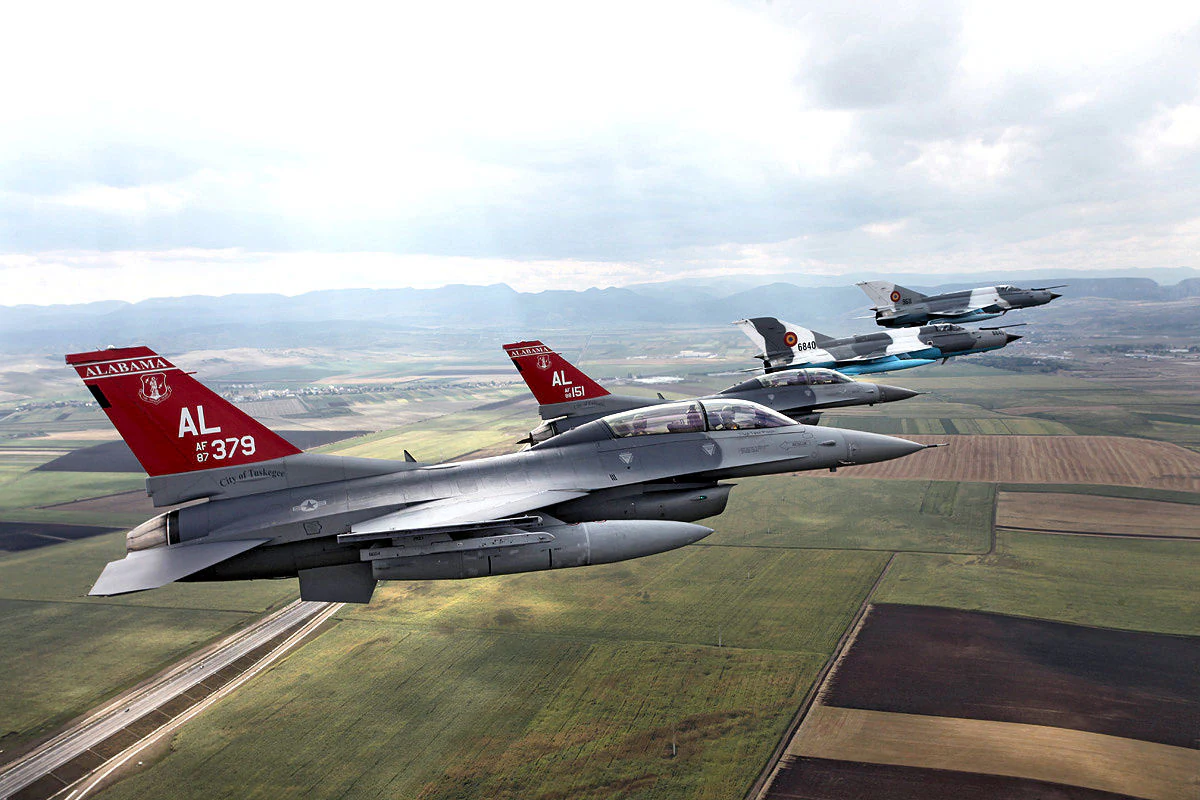
US Air National Guard F-16s flying with Romanian Air Force MiG-21s during an exercise in Romania, 2012. Photo: United States Air Force / Wikimedia Commons, Public domain.
A widening campaign at sea
The weekend's strikes follow a deadlier October. Romania's foreign minister said four merchant ships were targeted on 15 October. He said eight people died, according to the AP. On 23 October the Comoros-flagged cargo ship Khoryv sank about 13 nautical miles from Constanța after a drone strike. One sailor was left dead and three missing. On 28 October the Liberian-flagged container ship Contship Jet, bound from Haifa to Constanța, sank after naval drones hit it off Bulgaria.
By early November drones had hit at least a dozen merchant ships in the Black Sea in a matter of weeks. At least 30 sailors had been killed or reported missing, the AP reported. The maritime risk firm Ambrey has recorded more than 300 attacks on shipping in the Black Sea this year. It describes the sea as the world's deadliest shipping route, according to the Kyiv Post. Hemera reported on 14 November that the UN counts 25 seafarers killed in attacks linked to the Iran war, including around the Strait of Hormuz.
The costs are already showing in trade. Insurance premiums have risen. The London insurance market has widened its high-risk classification to cover much of the Black Sea, the AP reported. Traffic to Ukrainian ports has fallen.
Pressure on NATO's southern flank
Oprea has asked allies for practical help. "We need the solidarity of our allies, shown through patrols with surveillance aircraft and through equipment for counter-drone warfare," he said. France has temporarily moved an Atlantique 2 maritime patrol aircraft to Romania after Bucharest asked for reinforcement. According to HotNews, Oprea also wants faster delivery of "Gap Filler" radars from the French firm Thales. These are meant to cover blind spots in low-level radar coverage.
Bulgaria is under the same pressure. On 16 October its defence minister, Dimitar Stoyanov, said Sofia had formally asked NATO for combat aircraft and anti-drone systems. This came after a commercial vessel sank off its coast following a drone attack. Bulgaria also summoned Russia's ambassador. NATO has pledged to reinforce its eastern flank with additional maritime patrol aircraft, radar systems and drones, according to the AP.
In Hemera's analysis, the attacks fall into a grey zone that makes a collective response hard to frame. They damage foreign-flagged ships in Romanian waters. But they have not hit Romanian territory, forces or citizens. Their origin also remains formally unattributed. That leaves allies weighing surveillance and air defence rather than any wider military response. Each strike inside territorial waters, however, raises the cost of treating the campaign as someone else's war.
What comes next
Oprea will be in Brussels on Tuesday and Wednesday, 17 and 18 November, to meet fellow defence ministers. He has said he will put the Black Sea situation on the table. The test is whether allies send more patrol aircraft and counter-drone equipment, and how quickly. Shipowners face a decision of their own. They must decide whether the Sulina route to Ukraine is still worth the risk.
Related coverage: Ukraine Hits Crimea Bridge as Russia Reports 1,336-Drone Attack
Featured image: Rasarit soare by Danyzus, via Wikimedia Commons, CC BY-SA 3.0.


