

Six months after it was declared, the Ebola outbreak in the Democratic Republic of the Congo is still spreading faster than the effort to contain it. More than 11,000 people have been infected, according to government data, and close to half of them have died.
The outbreak is caused by Bundibugyo virus, a rarer member of the Ebola family. There is no approved vaccine or treatment for it. It is already the second-largest Ebola epidemic on record. On 12 November the medical charity Médecins Sans Frontières (MSF) said it remained out of control. The charity blamed unpaid and untrained staff, missing equipment and surveillance teams that are absent from the field.
Health Policy Watch, citing the latest official count, put the toll at 11,114 confirmed cases and 5,433 deaths, a fatality rate of 48 per cent. The World Health Organization's most recent weekly situation report, with data to 7 November, recorded 10,920 confirmed cases and 5,323 deaths. It added 388 cases in a single week and described transmission as high and sustained, with no sign of decline.
How the outbreak compares
The benchmark is the 2014–16 epidemic in West Africa, which recorded more than 28,600 cases and over 11,000 deaths. The Associated Press reports that Congo's outbreak is on track to surpass that death toll. It is already the deadliest of Congo's 17 Ebola outbreaks.
Closing the gap would take time. On the most recent week's increase of 197 deaths, it would take more than six months to match West Africa. But experts expect the outbreak to last that long. Neil Ferguson, an epidemiologist and director of public health at Imperial College London, told a briefing on 11 November that transmission was likely to continue a year from now.
Ferguson's team also believes the official figures understate the true scale. "Throughout the outbreak, we think we're probably only detecting about half of cases which are occurring," he said. His group estimated that between 2,000 and 3,000 people in Congo are currently infected. That is a model-based estimate, not a count.
The virus has reached eight of Congo's 26 provinces. Ituri, the epicentre, accounted for 7,485 cases and North Kivu for 2,593, according to WHO data to 3 November. Kenya has confirmed nine cases and two deaths, with no new cases since 19 October. Nigeria recorded one imported case in Abuja; the patient was evacuated to Switzerland. Uganda's outbreak has been controlled since August, the WHO said.
Cases 'coming out of nowhere'
One way to judge an Ebola response is to ask whether new patients were already known to health teams. Ideally, most new cases come from contact tracing. That means tracking down and monitoring the people an infected person has been near. In Congo, that link is largely missing.
MSF said only 9 per cent of the patients it treated in Ituri had previously been identified as contacts. The Africa Centres for Disease Control and Prevention (Africa CDC) has said 80 per cent of new cases are detected outside surveillance.
Anna Halford, an MSF emergency coordinator, told The National that most patients in treatment centres were "surprise cases". "They do not have a known epidemiological link to any other case," she said. "You should not have the majority of your cases coming out of nowhere."
Where people die also matters. The bodies of Ebola victims are highly infectious, and unsupervised burials can spread the virus. MSF said close to two-thirds of Ebola deaths in the past month happened in the community rather than in treatment centres. In the Beni health zone of North Kivu, nearly three-quarters of patients are thought to have been infected inside a health facility.
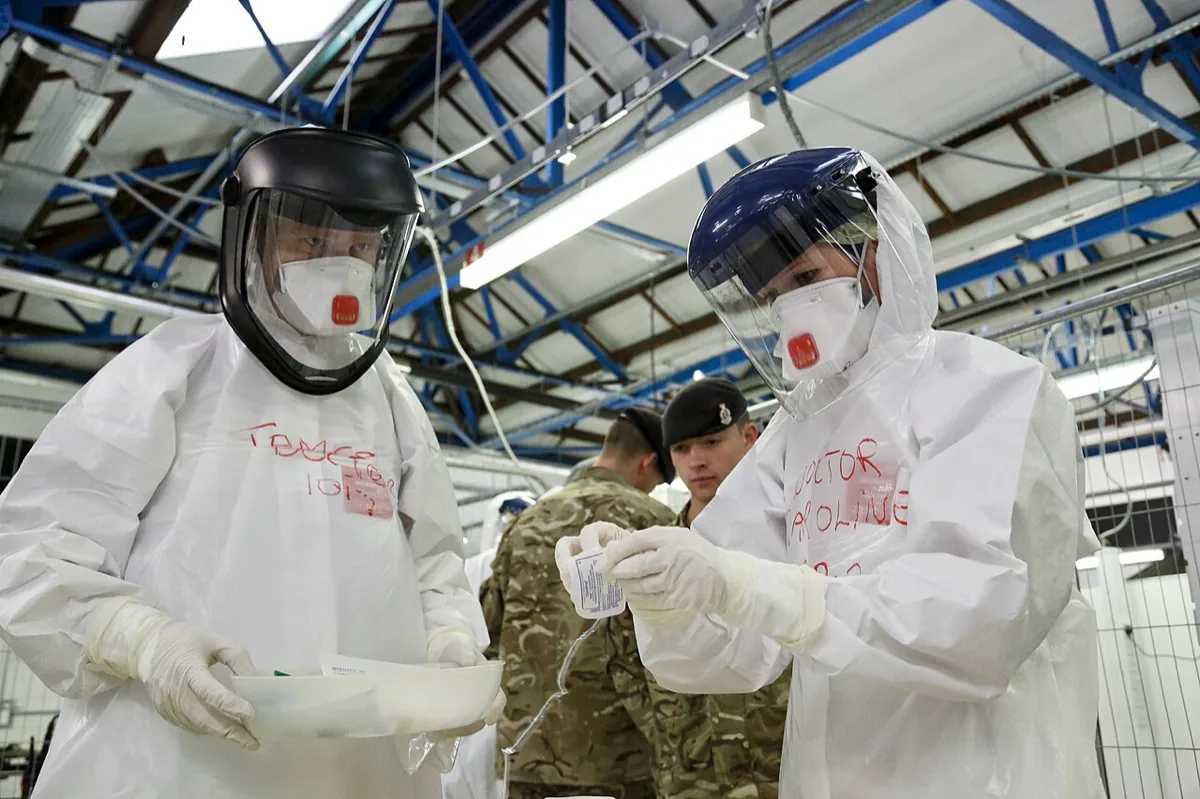
NHS doctors and nurses practise in full protective equipment at an Army Ebola training facility near York, UK, in 2014. Photo: DFID - UK Department for International Development / Wikimedia Commons, CC BY 2.0.
Money that is not reaching the front line
MSF's international president, Dr Javid Abdelmoneim, said the problem was not a shortage of funds. "Our teams are often left speechless by the dysfunction they witness in many areas," he said. The charity listed ambulances without fuel, community workers without phones and staff who had not been paid.
Halford described health workers at the edge of the outbreak lacking basic equipment. "They're in flip flops," she said. "It's not a lack of money." Health workers have repeatedly gone on strike over pay that is months overdue, the AP reported.
In October, Africa CDC said $962m had been disbursed directly to organisations running the response, but around $700m was unaccounted for. The agency did not allege theft. It described the gap as a failure of financial reporting and transparency. Congolese authorities have since cut the number of accredited organisations from nearly 100 to 25 and say they are investigating. The communications minister, Patrick Muyaya, said: "The funds granted were not paid into the general treasury".
MSF acknowledged real progress, including more isolation and treatment units and better diagnostic capacity. It has itself allocated €64.6m, almost entirely from private donations, and runs eight treatment centres.
Children and conflict
Children have been hit especially hard. According to UNICEF figures reported by the AP, children accounted for 35 per cent of deaths recorded up to 4 November. Children under five made up 21 per cent of all deaths. Nearly 72 per cent of infected under-fives have died, roughly seven in ten.
The outbreak is concentrated in eastern Congo, where armed groups including M23 and the Allied Democratic Forces are active. In early November, an attack on Cantine-Aloya in North Kivu killed 66 people, including three health workers. More than 1,000 contacts were lost to follow-up, and three confirmed patients could not be traced. The WHO director-general, Dr Tedros Adhanom Ghebreyesus, called it "a significant setback to the response".
What happens next
Vaccines are being tested, but none is proven against this virus. A multi-vaccine trial called Tumaini began in Bunia, Ituri's capital, on 23 October. It uses ring vaccination, which means immunising the contacts of confirmed patients. It is first testing Ervebo, a vaccine licensed against a different Ebola species, Zaire. Two Bundibugyo-specific candidates will join once national regulators approve them. They are ChAdOx1, from the University of Oxford and the Serum Institute of India, and Moderna's mRNA-1469.
A separate WHO-sponsored trial is testing whether the antibody treatment MBP134 or the antiviral remdesivir improves survival. Early treatment findings are expected in the coming months. Vaccine results are expected in early 2027. "Vaccines alone will not end this outbreak, but they could become a powerful new tool for bringing it under control," Tedros said.
Outside the region, the risk remains low. The WHO rates the global risk as low and advises against travel or trade restrictions. The UK Health Security Agency also assesses the risk to the UK public as low. It has advised clinicians to consider Ebola in feverish patients who have left Congo or Uganda within the previous 21 days.
For now, MSF is urging the Congolese government and UN agencies to train, pay and equip responders, and to send resources where cases are rising. "Otherwise, we risk spending years constantly playing catch-up with this outbreak," Abdelmoneim said.
Featured image: Bunia by HokieRNB, via Wikimedia Commons, Public domain.


