

In the early hours of Sunday 22 November 2026, sea drones struck the Russian corvette Merkury as it lay moored at the naval base in Benghazi, eastern Libya. Satellite images taken that day show the ship capsized and mostly underwater. On 23 November President Volodymyr Zelensky said Ukrainian forces had used seven Ukrainian-made naval drones to sink the corvette. He said they had also hit a second target, the sanctioned Russian cargo ship MV Angara.
The attack took place roughly 2,400 km from the front line in Ukraine. When Ukraine sank the Black Sea Fleet flagship Moskva in April 2022, the cruiser was at sea about 120 km south of Odesa, and the weapons were two coastal anti-ship missiles. The Merkury is a far smaller prize. But it was hit in a third country's port, by uncrewed boats, after a year in which Ukrainian strikes on Russian ships have spread from the Black Sea to the Mediterranean and the Baltic.
That reach brings new costs. Both of Libya's rival governments have protested. The UN mission in Libya has demanded an investigation, Italy has warned of the war spilling into the Mediterranean, and the Kremlin has warned of "painful consequences". The open question is no longer whether Ukraine can strike Russian ships far from home. It is who carries the risk when it does.
What happened in Benghazi
The Merkury is a Project 20380 (Steregushchiy-class) corvette, a small multi-role warship of about 1,800 tons with a crew of about 90, commissioned in 2023. It carries a Ka-27 naval helicopter. Libya's eastern administration said the ship was on its way back to Russia and had stopped at Benghazi to refuel and take on supplies under a cooperation agreement with Moscow.
Zelensky called it "an exemplary Ukrainian operation in response to Russia's war". He wrote: "Despite all the enemy's efforts to counter the attack, the Russian corvette Merkury was sunk." He said the Ka-27 helicopter was destroyed with the ship. Ukraine's Security Service (SBU), which ran the operation with the military, said the corvette regularly escorted Russian naval convoys, including the Angara.
Libyan officials linked to the eastern-based Libyan National Army (LNA) gave a different count to the Associated Press. Speaking anonymously, they said at least four drones were intercepted and two hit the corvette. One said at least 10 people, Libyan and Russian nationals among them, were wounded. Ambrey, a UK maritime security firm, said some of the explosions were likely caused by ammunition detonating on board.
The Angara is a Russian-flagged roll-on/roll-off cargo ship built in 1998. Ukraine's military intelligence sanctions register says the United States sanctioned it on 8 May 2022, followed by the EU, the UK and others. The register says it carried North Korean ammunition from the port of Rajin to Russian ports. Separately, the Libyan coast guard reported a sea-drone strike on a Maltese-flagged commercial ship off Benghazi. It is not clear whether that was the same vessel.
From the Moskva to the Merkury
The Moskva remains the benchmark for Ukraine's war at sea. The table sets the two sinkings side by side.
Measure | Moskva (2022) | Merkury (2026) |
|---|---|---|
Type | Cruiser, Black Sea Fleet flagship | Project 20380 corvette |
Displacement | 11,500 tons | 1,800 tons (standard) |
Crew | about 485–510 | about 90 |
Date hit | 13 April 2022 | 22 November 2026 |
Where | At sea, about 120 km south of Odesa | Moored at Benghazi naval base, Libya |
Distance from front line | n/a (off Ukraine's coast) | about 2,400 km |
Weapon (Ukrainian account) | Two Neptune anti-ship missiles | Seven naval drones |
Russia's first account | Fire and munition detonation | No Defence Ministry account by 23 November |
Casualties | Russia: 1 dead, 27 missing (April 2022) | At least 10 wounded (Libyan official) |
Sources: Kyiv Independent, NPR, Wikipedia (citing US and Russian officials), The War Zone, Associated Press via NPR and The Globe and Mail.
The Moskva displaced more than six times as much as the Merkury. As a military loss, Benghazi is far smaller. The Moskva was the first Russian flagship lost since the Second World War, according to the Kyiv Independent, and its sinking changed how Russia used its fleet near Ukraine's coast.
Two things are similar. In both cases ammunition on board appears to have made the damage worse. And in both cases Moscow was slow to say what had happened. In 2022 the Defence Ministry first spoke only of a fire. On 23 November 2026 the Kremlin spokesman, Dmitry Peskov, said only that Russia had "taken note" of Zelensky's statement and that the Defence Ministry would comment.
The difference is reach and method. The Moskva was hit by land-based missiles fired from Ukrainian territory at a ship in Ukraine's own sea. The Merkury was hit by small drone boats in a port on another continent, in a country that is not party to the war.
A campaign that left the Black Sea
Inside the Black Sea, Ukraine has used missiles and sea drones to push Russia's fleet back. In March 2024 Ukraine's navy spokesman, Dmytro Pletenchuk, told the AP that a third of the warships Russia had in the Black Sea before the war had been destroyed or disabled. That is a Ukrainian claim. He also acknowledged that only two of about a dozen missile-carrying warships had been sunk. The Kerch Bridge to Crimea has been attacked repeatedly: by a truck bomb in 2022, by naval drones in 2023 and, on 16 and 17 November 2026, by strikes that the SBU says destroyed one of its metal arches and the road span beneath. Russian authorities confirmed damage. Peskov said the bridge would be restored.
The Black Sea itself remains contested. Hemera reported on 16 November that drones had hit three commercial ships off Romania's Sulina Canal.
Since late 2025 the strikes have moved much further afield. The table lists Russian naval and Russia-linked merchant ships attacked beyond the Black Sea, with the Moskva for reference.
Vessel | Date | Location | Weapon | Responsibility |
|---|---|---|---|---|
Moskva (cruiser) | 13 Apr 2022 | Black Sea, off Odesa | 2 Neptune missiles | Ukraine claimed |
Qendil (oil tanker) | Dec 2025 | Mediterranean, over 2,000 km from Ukraine | Aerial drones | SBU official claimed |
Arctic Metagaz (LNG carrier) | 3 Mar 2026 | Mediterranean, about 240 km off Sirte | Sea drone (Russian claim) | Unclaimed; Russia blamed Ukraine |
Boikiy (corvette) | 3 Jun 2026 | Kronstadt, Baltic | Aerial drones | Ukraine claimed |
Naro-Fominsk (corvette) | 11 Nov 2026 | Gulf of Finland | At least 4 drones | SBU claimed |
Sparta II (cargo) | 21 Nov 2026 | Gulf of Finland, west of Gogland | Drones | Unclaimed; Finland says likely Ukraine |
Merkury (corvette) | 22 Nov 2026 | Benghazi naval base | 7 naval drones (Ukraine) | Zelensky and SBU claimed |
Angara (cargo) | 22 Nov 2026 | Off Benghazi | Naval drones | Zelensky and SBU claimed |
Sources: Kyiv Independent, NBC News/Reuters, The Moscow Times, Associated Press, Naval News, Maritime Executive, The Hill, SBU and Zelensky statements as reported by AP and ABC News.
The broad pattern is visible in the table. The earliest strikes far from home were on merchant ships, some of them unclaimed. Openly claimed attacks on Russian warships came later. Benghazi is the first of those in the Mediterranean.
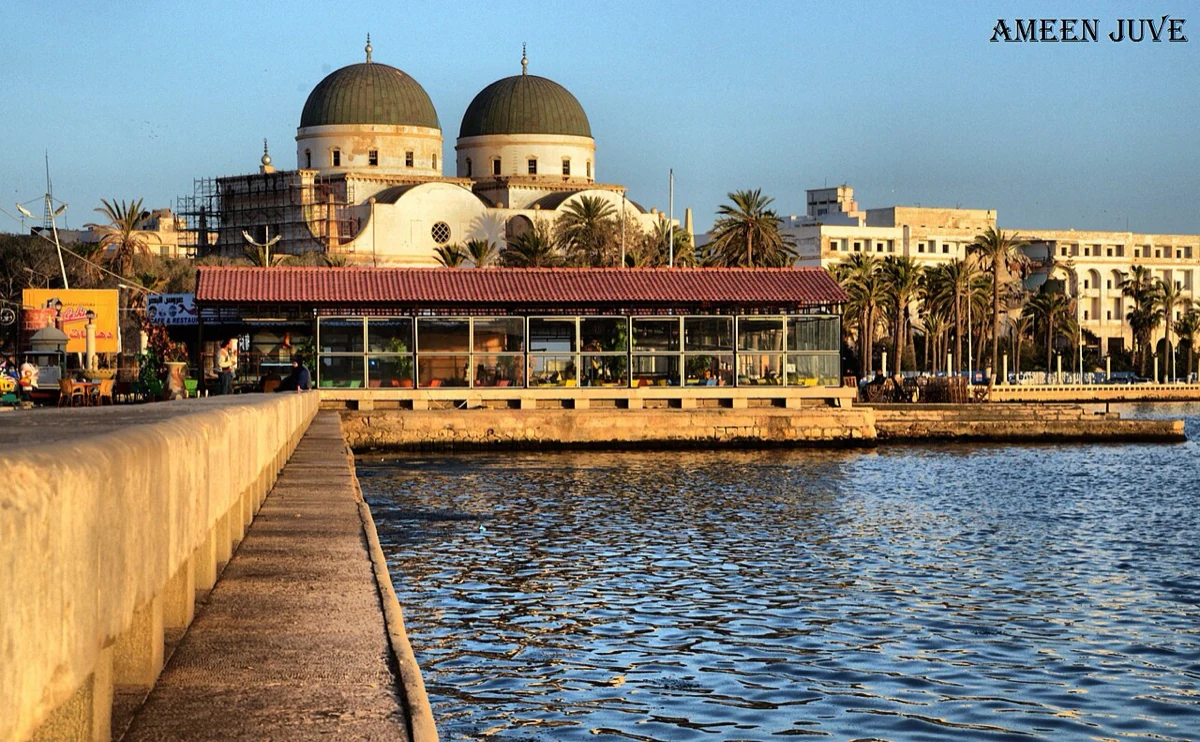
The Benghazi waterfront in eastern Libya, pictured in 2013 (file photo). Photo: Ameen.juve / Wikimedia Commons, CC BY-SA 3.0.
How a sea drone reaches Libya
A naval drone is a small uncrewed boat packed with explosives and steered remotely. It sits low in the water, which makes it hard for ship radars to detect. The AP identified the craft in SBU footage as Sea Baby drones. Their range is far short of the distance from Ukraine to Libya, so the question is how they got there.
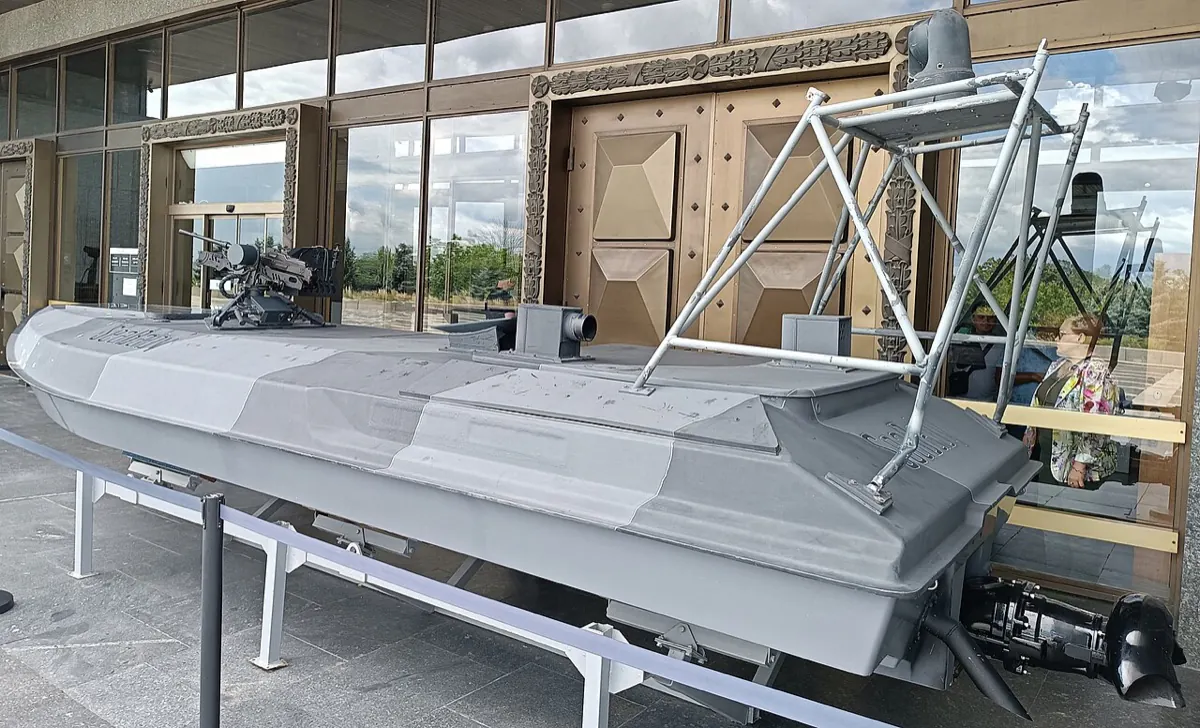
A Ukrainian Sea Baby uncrewed surface vessel, damaged in action in December 2024, on display in Kyiv in July 2026. File photo; not the craft used in Benghazi. Photo: photo User:Zenwort / Wikimedia Commons, CC BY-SA 4.0.
The SBU says the boats were carried to a designated location and launched from a "mother ship" near the target. Unnamed Libyan military officials told the AP that an initial investigation pointed instead to a facility run by Ukrainian forces in western Libya. The War Zone, a specialist defence site, could not confirm either account. Albania's government rejected reports linking it to the launch: "We categorically reject these allegations, which have been presented without verifiable evidence."
A Ukrainian presence in western Libya has been reported before. In April 2026 two unnamed Libyan officials told the AP that Ukrainian forces, mostly drone experts, worked under a covert deal with the Tripoli government, mainly at an air base in Misrata. They said the deal had Western backing. Jalel Harchaoui of the Royal United Services Institute (RUSI) told the AP it was "entirely plausible" that small groups of Ukrainian operatives were in the Tripoli area with NATO's knowledge. Neither Kyiv nor Tripoli has confirmed this.
Libya caught between two patrons
Libya has been divided since the 2011 uprising that toppled Muammar Gaddafi. A UN-recognised Government of National Unity, led by Abdulhamid Dbeibah, sits in Tripoli. A rival administration in the east is backed by the commander Khalifa Haftar and his LNA, which has close ties to Moscow. Le Monde notes that Russia moved many military assets to eastern Libya after losing its Syrian bases when Bashar al-Assad fell in December 2024.
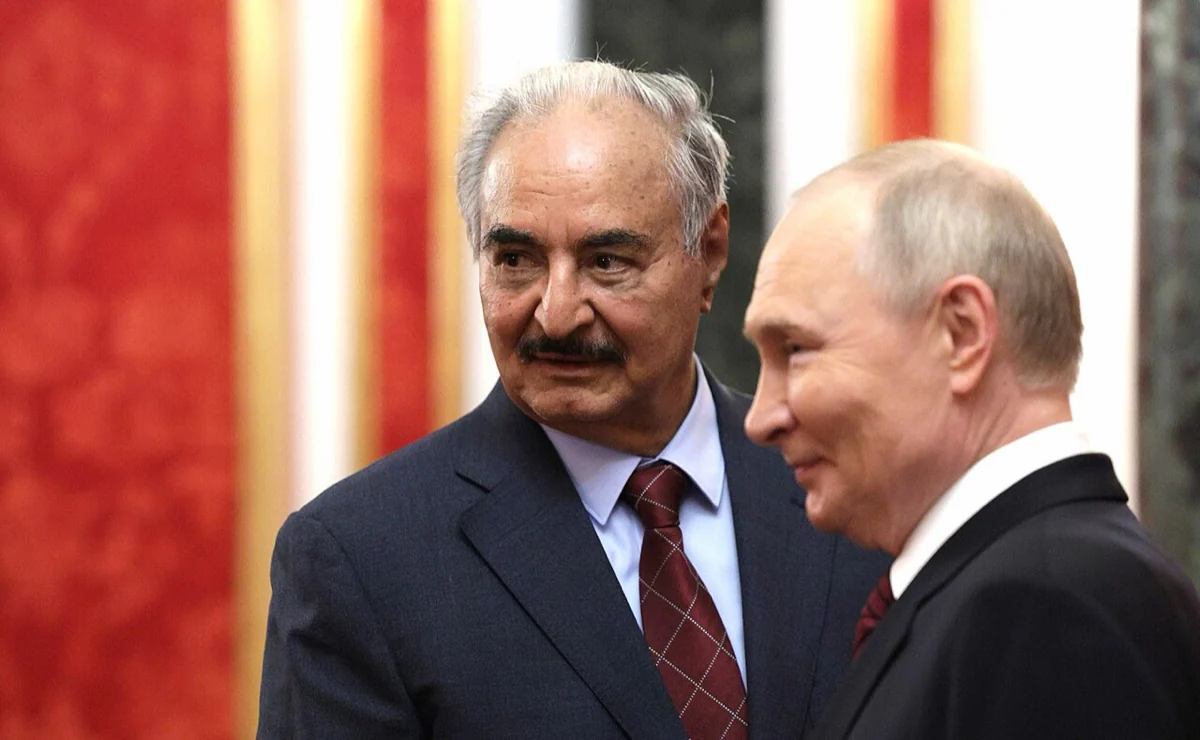
Libyan National Army commander Khalifa Haftar with Russian President Vladimir Putin at the Kremlin, May 2025. Photo: Kremlin.ru / Wikimedia Commons, CC BY 4.0.
That makes the strike awkward for both sides of Libya:
- The east called the attack "a serious assault on national sovereignty". It opened a joint investigation with Russia and asked the UN Secretary-General and Security Council to investigate whether western Libya was used to launch it.
- Tripoli's foreign ministry said it "categorically condemns the conduct of any foreign military operations within Libyan territory" and demanded official clarification from Kyiv.
- The UN mission (UNSMIL) called for an immediate, independent and transparent investigation, warning: "Libya cannot afford, and must not become a battleground for foreign conflicts."
Hamish Kinnear of the risk consultancy Verisk Maplecroft told AFP the strike was "a blow" to both Russia and Haftar. The analytical point follows from the map. If Russia's replacement for Syria can be reached by Ukrainian drones, its supply line to Africa is exposed. Zelensky made the same argument, saying that without these ships "it will be harder for Russia to fuel conflicts and instability in that region as well."
Europe's flanks and Moscow's warning
For NATO's southern members the concern is proximity. Italy's foreign minister, Antonio Tajani, said on 23 November that it was worrying for the war to reach waters a few hundred kilometres from Italy. He said escalation in the Mediterranean must be avoided and Russia's military presence there watched closely. Italy issued a warning, not a formal protest.
In the north, the cargo ship Sparta II, operated by the defence-linked firm Oboronlogistika, was hit by drones on 21 November in the Gulf of Finland. Its 16 crew were evacuated, and the burning ship drifted into Finnish waters before being towed back towards Russia. Finland's military said Ukraine was likely responsible. Kyiv has not claimed it. Finland's prime minister, Petteri Orpo, wrote: "Ukraine has the right to fight back against the aggressor." Germany was more guarded. Its government spokesman, Stefan Kornelius, said: "We have no interest in seeing an escalation in the Baltic Sea region."
Moscow's response has so far been verbal. Peskov called the Baltic strike "a very dangerous trend of expanding terrorist activity in the Baltic region". He warned of "painful consequences" and said Russia would keep striking Ukraine. Russia's ambassador to Libya, Aydar Aganin, said the attacks would not go unanswered. The Baltic matters to Moscow because its exclave of Kaliningrad depends on sea links. Russia's prime minister has announced 47 billion roubles for two rail ferries to supply it, due in 2030.
Mykola Bielieskov of Kyiv's National Institute for Strategic Studies described the strategy to Reuters as "horizontal escalation": widening the war geographically rather than at the front. "Since neither side is able to compel the other to accept terms of settlement through the battlefield only, both try to find new ways to pressure each other," he said. The strikes come as US-backed peace talks resumed this month after a nine-month pause.
What is still disputed
- How many drones hit. Ukraine says seven were deployed. LNA officials say two hit and at least four were intercepted. Libya Alhadath television reported more than 12 intercepted.
- Where they were launched. The SBU says from a mother ship. Libyan officials point to western Libya. Neither account has been verified.
- The second ship. Early reports named the Ascalon; Zelensky later named the Angara. Whether the Maltese-flagged ship reported by Libya's coast guard is the same vessel is unclear.
- Losses. Russia has published no casualty figure for the Merkury's crew.
- The Baltic. Ukraine claimed the Libya strike but not the Sparta II.
What comes next
Several decisions are pending. Russia's Defence Ministry has yet to give its account. The eastern Libyan government's request for a UN investigation now sits with the Security Council, where Russia holds a veto. Tripoli is waiting for Kyiv's explanation. Zelensky, for his part, has signalled more to come: "We continue our operations in designated waters."
The test is whether Ukraine's partners, whose backing for a Ukrainian presence in Libya has been reported but not confirmed, accept that cost. Italy and Germany have already signalled unease. Russia, meanwhile, has to decide whether to escort its Mediterranean and Baltic logistics more heavily or accept that its fleet has no safe harbour beyond the Black Sea. Hemera will follow both.
Related coverage: Drones Hit Three Commercial Ships Off Romania's Sulina Canal · Estonia to Close Russian Border After Alleged GRU Arson Plot
Featured image: Project 1164 Moskva 2009 G1 by George Chernilevsky, via Wikimedia Commons, Public domain.


