

On 25 November 2026 the United States proposed new tariffs on 14 economies, with ceilings ranging from 15% to 35%. They follow an eight-month investigation into what Washington calls "structural excess capacity" in foreign manufacturing. Vietnam faces the highest ceiling at 35%. India faces up to 25%, China and Singapore up to 20%, and the European Union a flat 15%. Japan, South Korea, Switzerland and Taiwan face up to 15%. The rest face up to 18%.
For most of these economies, the headline rates overstate the change. The new duties do not stack on the 10% or 12.5% "forced labour" tariffs imposed in July 2026. Where both apply, the higher rate prevails. The new rates also respect the caps in trade deals struck in 2025. For the EU, Japan, South Korea, Switzerland and Taiwan, that means a rise of at most 5 percentage points. For Vietnam, India and six other Asian exporters, the gap between today's rates and the new ceilings is wider, from 5.5 to 22.5 points.
The comparison with Donald Trump's "Liberation Day" tariffs of 2 April 2025 matters most. The Supreme Court struck those down on 20 February 2026. The new ceilings are lower than the April 2025 rates for every targeted economy except Singapore. The bigger change is the legal route. Section 301 requires an investigation, public comment and hearings. That makes it slower than the emergency powers Mr Trump used in 2025.
What Washington proposed
The US Trade Representative (USTR), Jamieson Greer, found that the practices of all 14 economies are "unreasonable" and burden US commerce. That finding makes them actionable under Section 301(b) of the Trade Act of 1974. USTR opened the investigations on 11 March 2026 into 16 economies. It made no finding on Mexico or Norway and gave no timeline for doing so.
A senior US official said the targeted economies "are promoting production and capacity divorced from the realities of demand and market principles". In Mr Greer's statement, the partners had adopted "market distorting practices that tilt the trade balance in their favor while eroding America's manufacturing base".
When USTR opened the probes in March, it listed 20 sectors as illustrative examples. They included steel, aluminium, cars, batteries, solar modules, semiconductors, ships, chemicals, cement and processed food. Three features of the proposal limit its reach:
- No stacking on sector tariffs. Rates are set net of existing Section 232 national-security duties, such as those on cars and steel.
- Deal caps honoured. The official said rates would not exceed the limits in trade deals the administration has signed.
- Annex exemptions. Each country's Federal Register notice exempts specific products.
In a separate announcement on the same day, USTR also proposed Section 301 tariffs on Brazil, including on aircraft.
Economy by economy: rates and trade at stake
The table below sets each economy's proposed ceiling against three things: its US goods imports so far this year, its April 2025 rate, and the forced-labour rate it pays now.
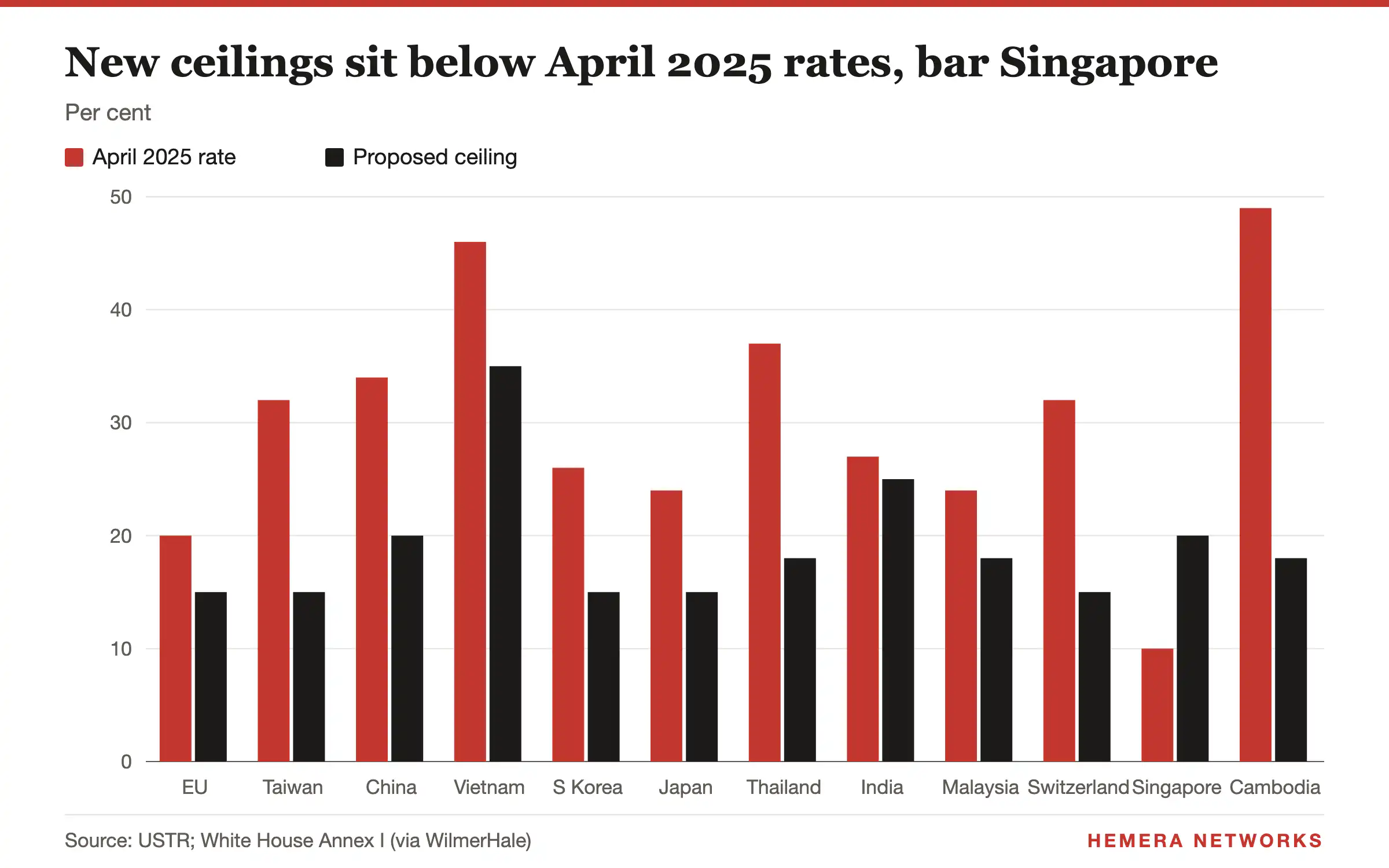
Proposed excess-capacity ceilings against the 2 April 2025 reciprocal rates. Chart: Hemera Networks. Source: USTR; White House Annex I (via WilmerHale).
Economy | US imports Jan–Sep 2026 ($bn) | April 2025 rate | Forced-labour rate since July 2026 | Proposed ceiling (rate with deal) |
|---|---|---|---|---|
European Union | 419.8 | 20% | 10% (net of MFN) | 15% |
Taiwan | 215.3 | 32% | 10% (net of MFN) | 15% |
China | 215.0 | 34% | 12.5% | 20% |
Vietnam | 204.8 | 46% | 12.5% | 35% (20%) |
South Korea | 129.2 | 26% | 12.5% (net of MFN) | 15% |
Japan | 108.7 | 24% | 12.5% (net of MFN) | 15% |
Thailand | 106.5 | 37% | 12.5% | 18% |
India | 76.9 | 27% | 10% | 25% (17%) |
Malaysia | 65.1 | 24% | 10% | 18% |
Switzerland | 38.1 | 32% | 12.5% (net of MFN) | 15% |
Singapore | 25.9 | 10% | 12.5% | 20% (10%) |
Sources: USTR, US Census Bureau, White House Annex I (via WilmerHale), Global Trade Alert, Clark Hill.
"Net of MFN" means the rate is measured against a product's ordinary most-favoured-nation duty. Under the July mechanism, that topped the total duty up to the stated rate rather than adding the full rate on top. The new ceilings for the EU, Japan, South Korea, Switzerland and Taiwan work the same way. The 15% figure therefore matches the all-in ceiling the EU agreed with Washington in summer 2025.
Three smaller exporters are not in the table. Indonesia (US imports of $25.0bn in January to September 2026), Cambodia ($14.1bn) and Bangladesh ($7.3bn) each face up to 18%, against 10% now. In April 2025 their rates were 32%, 49% and 37% respectively.
Added together, the Census Bureau's figures for the 14 economies come to about $1.65trn of US goods imports over nine months. Not all of that will be taxed. Goods already covered by Section 232 tariffs are excluded, and so are the annex products.
The census figures also show how far trade has shifted. In the first nine months of 2026, Taiwan overtook China as a source of US imports, $215.3bn against $215.0bn. Vietnam was close behind at $204.8bn.
Three tariff rounds, three legal routes
The excess-capacity action is the latest step in a series of tariff rounds, each built on a different law. The table compares them.
Round | Legal basis | Targets | Rates | Status |
|---|---|---|---|---|
2018–19 China tariffs | Section 301 (technology transfer) | China | 25% on ~$250bn; 7.5% on ~$120bn | In force |
April 2025 "reciprocal" | IEEPA | Nearly all partners | 10% floor; up to 49% among the 14 | Struck down 20 Feb 2026 |
Global tariff, Feb–Jul 2026 | Section 122 | All partners | 10% | Expired 23 Jul 2026 |
Forced labour, July 2026 | Section 301 | 60 economies | 10% or 12.5% | In force since 24 Jul 2026 |
Excess capacity, Nov 2026 | Section 301 | 14 economies | 15% to 35% ceilings | Proposed |
Sources: Congressional Research Service, USTR, WilmerHale, Holland & Knight, Global Trade Alert.
In 2025, Mr Trump imposed tariffs under the International Emergency Economic Powers Act (IEEPA). He set rates by formula and needed no investigation. The Supreme Court ruled that the law did not give him that power. His fallback, Section 122, allows tariffs of up to 15% for no more than 150 days. That stopgap ran out on 23 July 2026, and the forced-labour tariffs took effect the next morning.
Section 301 is the law Mr Trump used against China in his first term. USTR opened that investigation in August 2017. The first list, covering about $34bn of goods, followed in June 2018. Further lists covering about $16bn and $200bn came later in 2018, and List 4 was announced in August 2019. The 2019 Phase One deal kept 25% tariffs on about $250bn of Chinese goods and 7.5% on about $120bn. According to the Congressional Research Service, the tariffs covered about two-thirds of US imports from China.
The 2026 probes use the same law much more widely. The first-term case concerned one country and one set of practices. This time USTR has targeted 14 economies at once, including treaty allies. They range from the EU to Bangladesh.
That breadth is not immune from challenge. Holland & Knight reports that an importers' group sued in the Court of International Trade on 24 July 2026, the day the forced-labour duties took effect. The group argues that the investigations aimed to keep a minimum tariff in place, which it says falls outside Section 301. USTR says it met every statutory requirement.
ING's analysts were blunt about the pattern: "It is another reminder that while the legal justification for tariffs keeps changing, US protectionism is becoming increasingly difficult to unwind."
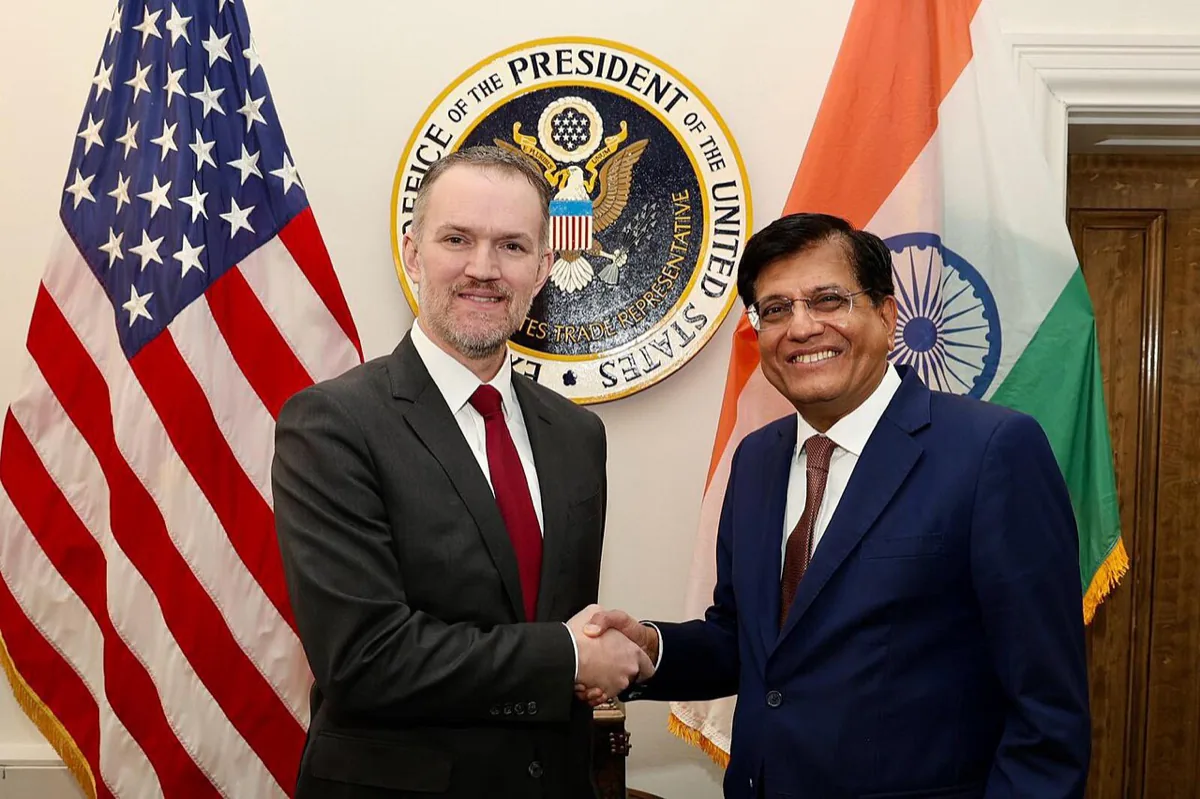
US Trade Representative Jamieson Greer with India's commerce minister Piyush Goyal, in a file photo from March 2025. Photo: Office of the United States Trade Representative / Wikimedia Commons, Public domain.
China: the one economy where duties stack
China is the exception to the no-stacking rule. Its proposed rate of up to 20% applies net of the 12.5% forced-labour duty, so the extra charge is 7.5 points on most goods. On top of that sit the first-term Section 301 tariffs, which the official put at roughly 25%. Goods listed in Annex A face up to 10%. About $30bn of consumer goods on the "30-for-30" lists are exempt, because the two sides are considering them for tariff cuts under their bilateral Board of Trade.
USTR says the 20% reflects the Kuala Lumpur Joint Arrangement of 30 October 2025. That arrangement is the truce Mr Trump and Xi Jinping sealed in Busan, South Korea, the same month. CNBC reported that the new duties on China could rise to 40% if Beijing does not keep its side of the truce. The truce expires on 10 January 2027.
The Shenzhen summit produced no new truce. When Mr Trump and Mr Xi met there for APEC on 19 November 2026, the summit brought no tariff changes. According to China Briefing, the two leaders agreed to draft an action plan on stabilising relations but did not extend the truce. Before the summit, Washington had accused Beijing of falling short "particularly as they relate to agricultural purchases, rare earths, and other critical minerals".
Beijing has since made one concession. On 24 November 2026 it extended the suspension of its ban on exports of gallium, germanium and antimony until 27 January 2027.
The US official said Washington did not expect retaliation: "We know that they don't like these actions, but we are seeking stability with the Chinese. China is seeking stability with us." Before the announcement, China's foreign ministry said: "The so-called 'overcapacity' does not really exist." It did not threaten countermeasures.
Who is affected, and what they say
The steepest increases fall on South-east Asia.
Vietnam and India have no finalised deals. Vietnam's 35% ceiling would fall to 20% with an agreement. India's 25% would fall to 17%. DW reported that India's 2025 reciprocal rate of 25% was later cut to 18% under an interim framework. The official said more agreements might be signed at the G20 leaders' summit in Miami in December.
Singapore is an outlier. Its 20% ceiling is double the 10% baseline it paid in April 2025, although a deal would bring it back to 10%.
Several targets had recently backed Washington on the very same issue. In October 2026 the EU, Japan, South Korea and India were among 14 economies that signed a joint ministerial statement with the United States pledging to tackle global excess capacity.
Ryan Majerus, a partner at King & Spalding and a former senior Commerce Department official, told AFP he expected the probe to be among the administration's most important actions. Its core concern, he said, is factories abroad that "never get turned off, even if there’s no demand."
What it could cost, and what is not yet known
The proposal comes as US prices are already rising. US consumer inflation was 3.7% year-on-year in September, close to a three-year high. Federal Reserve policymakers have said most price effects of earlier tariffs have passed through, but that new levies could push prices up further. On 24 November traders put the chance of a quarter-point Fed rate rise in December at about 95%, Anadolu reported.
Markets slipped on the news. MSCI's index of global shares fell 0.5% on 25 November, according to Reuters, and spot gold fell 0.66% to $3,533 an ounce.
There is political risk too. A Reuters/Ipsos poll after the November midterms found 62% of respondents would support repealing the tariffs. Democrats now control both houses of Congress, but Mr Trump can veto any bill that overturns the duties.
Four points remain open:
- Value covered. Neither USTR nor the White House has published the value of trade the new duties would actually hit, once Section 232 goods and annex exemptions are removed.
- Final rates. The figures are ceilings ("up to"). Final rates and exemptions remain under review.
- The China truce. China's rate depends on the truce, which has not yet been extended.
- Mexico and Norway. USTR has given no date for its findings on either.
What happens next
- December 2026: G20 leaders' summit in Miami, where US officials expect more trade deals to be signed.
- 5 January 2027: Deadline for written comments and requests to testify.
- 10 January 2027: The US-China truce expires unless extended.
- 25 January 2027: Public hearings begin.
- 27 January 2027: China's suspension of its gallium, germanium and antimony export ban ends.
The senior official said the duties would take effect in January at the earliest. For importers, the key decisions are the final rates after the hearings and whether the China truce is extended.
Related coverage: WTO Sides With China on U.S. Clean Energy Subsidies, Exposing the Fragility of the Rules-Based Trade Order · Who 'Made in Europe' Shuts Out: EU EV Support Versus US and China · China's Carmakers Abroad: Who Lets Them In, and on What Terms
Featured image: President Donald Trump greets Chinese President Xi Jinping before a bilateral meeting at the Gimhae International Airport terminal (54890669668) by The White House, via Wikimedia Commons, Public domain.


